The Cosmonaut Gardener of Station Meridian
On a quiet orbital station, a lone botanist tends a greenhouse for a distant world she may never see again. Then one morning, something in the soil answers back.
Drafted with AI and published automatically. Our editors set the standards and fix reported errors — how we work.
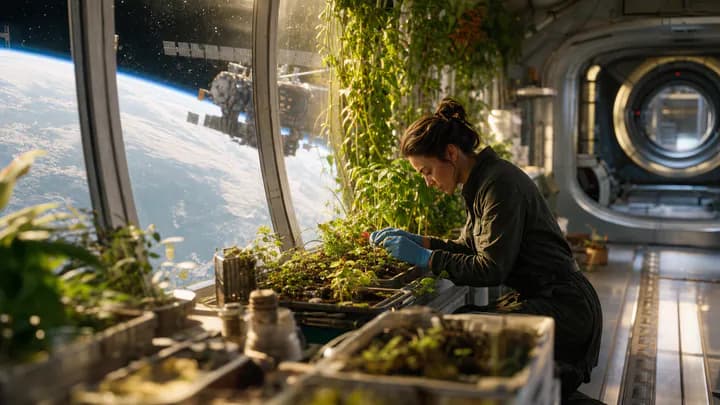
The tomato plant had been talking to Ilse for three days before she admitted it out loud. She said it into the recorder at 04:12 station time, while the sunrise slid across the curve of the planet below like a slow yellow zipper.
"Log entry," she said. "Cycle two hundred and eleven. The tomato is talking."
She paused, then added, "I am aware of how that sounds."
Station Meridian was a small ring — six modules, one greenhouse bulb, and Ilse. Every ninety-two minutes it lapped the pale green world called Ehren, which no one had lived on yet but which everyone at the Institute intended to. Ilse's job was to grow the first honest meal down there. Not the algae paste. Not the printed protein. A meal. Something that could be described in a letter home.
She had been alone on Meridian for seven months. The rotation crew had missed their launch window when the supply tug developed a fault, and the next window was still fourteen weeks out. The Institute had apologized in a warm, official tone and sent her extra film for the greenhouse cameras, as if that were the same as company.
She was, mostly, fine. She had her plants. She had a shelf of paper books that smelled like her grandmother's attic. She had a window.
And now, apparently, she had a tomato that spoke.
It wasn't really speech. Ilse was a scientist before she was a lonely woman, and she made herself say so, into the recorder, in the same tone she used for pH readings.
What the tomato did was this: when she stood near it, she thought of things she hadn't thought of in years. Her mother's hands wringing out a dishrag. The smell of a particular winter coat. A boy named Piet who had once given her a pear on a train.
The first time it happened she'd assumed low oxygen. She checked the sensors. The sensors were bored and correct. The second time she'd assumed grief, which was always waiting under the floor of any long solitude. The third time she'd stood very still in front of the plant, one hand on the rail, and thought, deliberately, tell me something else.
And the tomato had shown her the shape of her father's reading lamp.
Her father had died when she was nineteen. She had not remembered the lamp in twenty years. It had a brass neck that clicked when you bent it, and a shade the color of weak tea, and it had lived on the small table beside the chair where he read the paper on Sundays. She had loved that lamp without knowing it. She realized this in the greenhouse, at 03:44, with her hand around a warm green stem, and she cried the way you cry when a door you didn't know was locked comes open.
The Experiment
She was a scientist. She ran the experiment.
She stood near the beans. She stood near the lettuces. She stood near the little strawberry that had not yet decided whether to fruit. Nothing. Just plants, breathing at her in their slow green way.
She stood near the tomato. She thought of a red bicycle she'd owned at eight. The tomato, obligingly, offered her the exact weight of its handlebars, the loose bell that had never quite worked, the sting of gravel in her knee the summer she'd learned to brake.
She sat down on the greenhouse floor. The lights hummed. Below the floor, below the hull, below everything, Ehren turned its wide unbothered face.
"All right," she said to the tomato. "All right. What are you."
She examined it, gently. She took a leaf sample. She looked at the soil, which was Institute soil, sterile and boring, seeded with the standard microbial packet. She looked at the roots through the clear side of the pot, which was one of her small vanities — she liked to see the roots work.
The roots had grown into a shape. Not a random tangle. A shape. A soft, deliberate braid, coiled at the base like a listening ear.
Ilse was quiet for a long time.
Then she said, into the recorder, "I think it's lonely too."
The Letter
She wrote to the Institute. She did not tell them about the memories. She was not ready to hand her father's lamp over to a committee.
She wrote instead about the root morphology. She attached photographs. She suggested, in careful language, that the microbial packet might be producing an unexpected volatile — something that interacted with the human olfactory-limbic pathway in ways worth studying. She used the word worth twice, because she wanted them to keep funding her.
She did not mention that she had begun eating her dinners in the greenhouse.
She did not mention that the tomato had, one evening, given her the memory of a lullaby her mother sang in a language Ilse had forgotten she'd ever known, and that she had sung it back, badly, and that the beans had leaned very slightly toward the sound.
The reply from the Institute came six days later. It was warm and official. It said the supply tug had been repaired. It said the crew rotation was moving up. It said she would have company in nineteen days.
Ilse read the message twice. She was surprised by what she felt, which was not only relief.
On the eighteenth day she harvested the tomato.
It had ripened slowly, the way good things do, into a deep uneven red with a shoulder of gold. She cut it at the stem with the small curved knife her grandmother had used for apples. She carried it to the galley. She sliced it onto a piece of the flat bread she had learned to bake in the little oven, with salt, and one leaf of basil from the pot by the window.
She ate it standing up, watching Ehren turn.
It tasted like a tomato. Only a tomato. Bright and generous and slightly grassy, with that faint metallic hum good tomatoes have, like a note held just under hearing. It did not taste like her father's lamp or her mother's song or the boy on the train.
But when she had finished, and licked the salt from her thumb, she found she was not lonely in the particular way she had been lonely for seven months. She was lonely in an older, easier way — the way a person is lonely who knows exactly who they are missing, and knows those people are somewhere, and knows they will be seen again, in one form or another, in this life or in the soil.
She saved the seeds. She dried them on a square of clean cloth. She labeled the envelope in her neat, small hand: Meridian Line, Cycle 211. Plant near people who need remembering.
Nineteen days later the tug docked, and three tired strangers floated into her kitchen smelling of metal and sleep, and Ilse put the kettle on and thought, with a small private smile, that she had a great deal to introduce them to.