Anti-Aging Skincare Routine: The Steps That Actually Work
Most anti-aging routines fail for boring reasons: too many actives, too little sunscreen, and not enough time. Here are the five steps that carry the weight, the order to apply them in, and the decision rules that tell you what to add next.
Rewritten with AI and republished automatically. Our editors set the standards and fix reported errors — how we work.

TL;DR: An effective anti-aging routine is short. Cleanse gently, wear broad-spectrum SPF 30+ every morning, use a retinoid at night, and keep the skin barrier intact with a ceramide moisturizer. Vitamin C, peptides, and niacinamide are useful additions. Consistency over 12 weeks beats any product swap.
An anti-aging skincare routine is a daily sequence of cleansing, protection, and active treatment designed to slow visible photoaging and support the skin's own repair processes. It is not a cure for aging, and nothing sold over a counter reverses it. What a good routine reliably does is reduce the portion of aging that comes from ultraviolet exposure, barrier damage, and inflammation — which, by most dermatological accounts, is the larger portion.
People rarely fail because they picked the wrong serum. They fail because they own eleven products, use four inconsistently, and skip sunscreen on gray days. So this guide is built around the decisions that actually move the needle.
What does skin aging actually involve?
Skin aging runs on two tracks. Intrinsic aging is genetic and chronological: collagen and elastin production slows from roughly the mid-twenties onward, cell turnover lengthens, and the fat pads that give the face its structure shift and thin. You cannot stop this, and no topical product meaningfully changes it.
Extrinsic aging — photoaging — comes from ultraviolet radiation, pollution, smoking, and chronic inflammation. This is where the visible damage lives: mottled pigmentation, leathery texture, broken capillaries, and the deep etched lines on the side of the face that gets the driver's-side sun. Extrinsic aging is largely preventable, and it is the entire reason dermatologists talk about sunscreen so relentlessly.
Understanding the split changes how you shop. A cream promising to "restore youthful structure" is selling against intrinsic aging, which topicals barely touch. A sunscreen and a retinoid are working on the track you can actually influence.
What are the five steps of an anti-aging routine, in order?
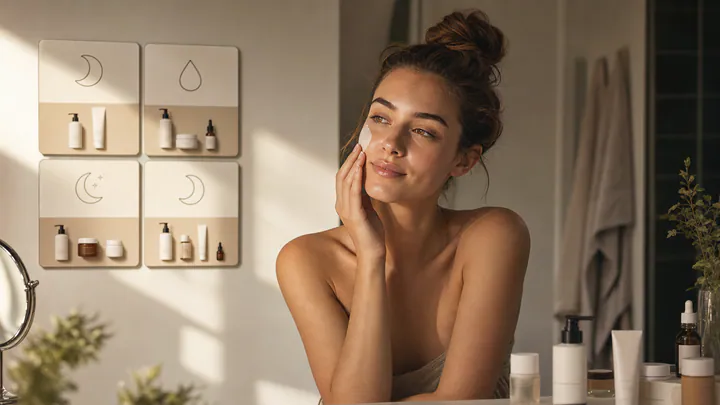
Morning: cleanse, optional antioxidant serum, moisturizer, sunscreen. Night: cleanse, treatment (retinoid), moisturizer. That's it. Layer thinnest to thickest, and give each layer thirty seconds to settle rather than rubbing the next one in immediately.
1. Gentle cleansing — twice a day, or once
Use a non-foaming or low-foaming cleanser that leaves skin comfortable rather than squeaky. That tight, stripped feeling is barrier disruption, and a compromised barrier is inflamed skin, which ages faster. If your skin is dry or you're over 50, a morning rinse with water alone is perfectly defensible — you cleansed eight hours ago and slept on a clean pillowcase.
2. Sunscreen — the single highest-return step
Broad-spectrum SPF 30 minimum, every morning, roughly a quarter teaspoon for the face and another for the neck and ears. Most people apply about a third of the tested amount, which is why real-world protection lands well below the number on the bottle. Choose a texture you genuinely like; the best sunscreen is the one you don't resent.
3. A retinoid at night
Retinoids are the most evidence-backed topical category for fine lines, texture, and pigmentation. Start at a low strength two nights a week, on completely dry skin, and build up. Prescription tretinoin is stronger and faster; over-the-counter retinol is gentler and takes longer to reach the same place.
4. Barrier-supporting moisturizer
Ceramides, glycerin, and fatty acids do the structural work; hyaluronic acid holds water but needs something on top to stop it evaporating. If retinoid irritation flares, the moisturizer is your brake pedal. Our guide to repairing a damaged skin barrier covers what to do when things go sideways.
5. Optional targeted actives
Vitamin C in the morning for antioxidant support and brightening. Niacinamide for redness and pore appearance. Peptides as a gentler supporting act. Azelaic acid if you have both pigmentation and redness. Add one at a time, four weeks apart.
Which anti-aging ingredient should I choose?
Pick based on your primary concern and your tolerance for irritation, not on which ingredient is trending. Here is how the main options compare.
| Ingredient | Best for | When to use | Time to visible change | Irritation risk |
|---|---|---|---|---|
| Tretinoin (prescription) | Fine lines, texture, sun damage | Night | 8–12 weeks; lines at ~6 months | High at first |
| Retinol (OTC) | Same concerns, gentler pace | Night | 12–24 weeks | Moderate |
| Bakuchiol | Sensitive or reactive skin, pregnancy-adjacent caution | Night or morning | 12+ weeks | Low |
| Vitamin C (L-ascorbic acid) | Dullness, uneven tone | Morning, under SPF | 4–12 weeks | Low–moderate |
| Niacinamide | Redness, barrier support, oil balance | Either | 4–8 weeks | Very low |
| Peptides | General support, layering-friendly | Either | Variable, subtle | Very low |
| AHAs (glycolic, lactic) | Rough texture, dullness | Night, 1–3× weekly | 2–6 weeks | Moderate–high if overused |
Decision rule: if you can only add one thing this year, add the retinoid. If you already use a retinoid and want a second, pick based on what bothers you most in photos — dullness points to vitamin C, redness points to niacinamide or azelaic acid, rough texture points to a low-frequency acid.
What does a realistic anti-aging routine cost?
A complete, well-formulated routine can run under $80 total and last three to four months. Prestige pricing buys elegance, not efficacy. The exception worth paying for is sunscreen texture, because cosmetic pleasantness directly drives daily compliance.
- Budget build (~$50–80): drugstore ceramide cleanser, drugstore retinol, ceramide moisturizer, drugstore mineral or chemical SPF.
- Prescription route (varies): a dermatologist visit plus generic tretinoin is often cheaper per month than mid-range retinol serums, and stronger.
- Where money is usually wasted: multi-step essence and toner systems, "collagen" creams (collagen molecules are too large to penetrate meaningfully), and eye creams that duplicate your face moisturizer at four times the price per ounce.
What mistakes stall an anti-aging routine?
Five errors account for most stalled progress: quitting too early, using too many actives, under-applying sunscreen, over-exfoliating, and treating irritation as proof something is working.
- Quitting at week five. Retinoids often trigger a purge-and-flake phase before improvement. Reduce frequency, don't stop entirely.
- Stacking actives on one face. Retinol plus acid plus vitamin C plus a scrub is a recipe for a wrecked barrier. Separate them by time of day or by night of the week — the logic behind skin cycling, which schedules actives across four nights.
- Skipping SPF when it's overcast or when you're indoors near glass. UVA, the photoaging wavelength, passes through cloud and window glass far more readily than UVB.
- Exfoliating more than two to three times a week. Stinging and shine-through redness are barrier damage, not exfoliation working.
- Changing products every three weeks. Every swap resets the clock on a 12-week ingredient.
The edge case nobody mentions: the retinoid sandwich
If a retinoid burns, apply moisturizer first, then the retinoid, then moisturizer again. This "sandwich" method buffers delivery and meaningfully reduces irritation with only a modest trade-off in potency. It is the difference between a tolerable routine and an abandoned one — and a slightly weaker retinoid used for two years beats a strong one used for two weeks.
Honest caveat: this doesn't apply if…
If you are pregnant or breastfeeding, retinoids are generally avoided — talk to your physician before continuing. If you have rosacea, eczema, or a currently compromised barrier, actives come after the barrier is calm, not before. If you have a new, changing, or asymmetric mole, skincare is beside the point; get it examined.
How should the routine change by decade?
The framework stays the same; the emphasis moves from prevention toward repair and richness.
- 20s: Sunscreen habit, gentle cleanser, moisturizer. That's genuinely enough. Prevention is the whole job.
- 30s: Introduce a low-strength retinoid. Add vitamin C if tone is uneven. Start paying attention to the neck and backs of hands, which age visibly and get ignored.
- 40s: Skin often gets drier as oil production drops. Move to richer, ceramide-heavy moisturizers; add niacinamide or peptides. Occlusive overnight layering — the slugging approach to sealing in moisture — starts earning its keep.
- 50s and beyond: Prioritize barrier repair and firmness. Bakuchiol is a reasonable swap if retinoids have become intolerable. Overnight masks two to three nights a week noticeably improve morning texture.
Season matters as much as decade. A gel moisturizer that feels right in July may leave you flaking in January. Adjust vehicle and richness; keep the actives constant.
What lifestyle factors actually affect how skin ages?
Sleep, sun behavior, smoking status, and glycemic patterns have more documented influence on skin appearance than any mid-tier serum. Research generally supports the connection between chronic sleep restriction and both barrier recovery and visible fatigue.
A few practical anchors:
- Seven to nine hours of sleep, with a consistent wake time doing more work than the total hours alone. A steady morning sunlight habit helps set that clock.
- Shade, hats, and UPF clothing during peak hours — mechanical protection is more reliable than reapplication discipline.
- Not smoking. Its effect on skin structure is one of the clearest lifestyle-to-appearance links there is.
- A varied diet with plenty of plants. No single food is protective, and "collagen drinks" remain a weak-evidence category.
None of this is medical advice. If you have a persistent skin condition, pigmentation you can't identify, or you're considering prescription treatments, consult a board-certified dermatologist rather than self-diagnosing from product labels.
How do I know if my routine is working?
Take an undated photo baseline in consistent lighting — no filter, no makeup, same window, same time of day — and repeat it at week 12 and week 24. Mirror assessment is unreliable because change is gradual and your mood is not.
Signs of genuine progress: smoother light reflection across the cheek, less visible pore shadowing, fading of flat brown spots, makeup sitting better. Signs the routine is too aggressive: tightness after cleansing, stinging from products that used to feel fine, flushing, and sudden sensitivity. If you hit those, drop everything but cleanser, moisturizer, and SPF for two weeks and rebuild slowly.
Key takeaways
- Sunscreen and a retinoid do most of the heavy lifting; everything else is refinement.
- Add one active at a time, four weeks apart, and judge at 12 weeks — not at three.
- Irritation is not evidence of progress. A calm barrier is a prerequisite for every other result.
- Cost and efficacy are weakly correlated; spend on a sunscreen you'll actually wear daily.
- Adjust richness by season and decade, but keep the core actives steady.
- See a board-certified dermatologist for prescription options, persistent redness, or any changing mole.
Frequently asked questions
What is the minimum effective anti-aging skincare routine?
Three things: a gentle cleanser, a broad-spectrum SPF 30 or higher every morning, and a retinoid at night. Everything else — vitamin C, peptides, niacinamide, exfoliating acids — is optimization on top of that base. If you only ever do two steps, make them sunscreen and a retinoid, because those two have the deepest evidence behind them for texture, tone, and fine lines.
How long does it take to see results from retinol?
Expect 8 to 12 weeks for early texture and tone changes, and closer to six months for fine lines. Cell turnover shifts within a few weeks, but collagen remodeling in the dermis is slow. The most common reason people conclude retinoids 'don't work' is that they quit at week five, often during the adjustment phase when skin looks worse before it looks better.
Should I use vitamin C and retinol together?
Use them at different times of day rather than layering them in one application — vitamin C in the morning under sunscreen, retinoid at night. They are not chemically incompatible in the way internet advice suggests, but stacking two potential irritants on the same skin at the same moment raises the odds of redness and stinging, which leads people to abandon both.
Does sunscreen really matter on cloudy days and indoors?
Yes on cloudy days; it depends indoors. A significant share of UVA passes through cloud cover and window glass, and UVA is the wavelength most associated with photoaging. If you sit near a window for hours, sunscreen is worth it. If you are in a windowless office all day, you can reasonably skip reapplication after your morning layer.
Is expensive anti-aging skincare better than drugstore?
Not reliably. Price tracks packaging, fragrance, and marketing more than formulation quality. Drugstore lines offer well-formulated retinol, niacinamide, ceramide moisturizers, and broad-spectrum sunscreen at a fraction of prestige pricing. The one place spending more sometimes buys real advantage is sunscreen texture, because a sunscreen you enjoy wearing gets applied more consistently.
At what age should I start an anti-aging routine?
Sunscreen from childhood; a retinoid usually makes sense in your late twenties or thirties. Collagen production begins its slow decline in the mid-twenties, so the twenties are about prevention — daily SPF, not smoking, sleep — rather than aggressive actives. There is no benefit to starting prescription-strength treatments on skin that has no visible concerns.
When should I see a dermatologist instead of self-treating?
See a board-certified dermatologist if you have persistent redness, a new or changing mole, melasma, cystic acne, or if six months of a consistent routine produces no change. A professional can prescribe tretinoin or azelaic acid, assess whether pigmentation is melasma or sun damage, and screen for skin cancer — none of which an over-the-counter routine can do.