How to Organize a Small Apartment Without Losing Your Mind
Organizing a small apartment is less about clever bins and more about sequence: cut the volume first, assign every zone a job, then build storage upward. Here is the system, including the renter-safe fixes and the mistakes that waste the most money.
Rewritten with AI and republished automatically. Our editors set the standards and fix reported errors — how we work.
TL;DR: Organizing a small apartment works in one order: reduce what you own, give every square foot a single job, then build storage upward instead of outward. Buy containers last. A 15-minute daily reset keeps it. Most people fail because they shop before they edit.
Small apartment organization is a design and habit system that matches the volume of your belongings to the storage your floor plan can actually support. That definition matters, because the phrase "I need more storage" is almost always the second problem. The first is volume. The fixes that last are rarely the ones that come in a box.
Where should I start when the whole apartment feels like a mess?
Start by decluttering one category, not one room, and do it before you buy anything. Pull every item of a single type — all the clothes, all the mugs, all the cables — into one pile so you see the true count. Small apartments hide duplicates across three rooms, and you cannot judge what you need until the duplicates are standing next to each other.
Work in this order, because it front-loads the biggest volume wins: clothing, kitchen equipment, paperwork, toiletries and cleaning supplies, then sentimental items. Sentimental goes last on purpose. It is the slowest category and the most likely to stall the whole project if you open it on day one.
A useful decision rule when you stall on an item: if it would take under 20 minutes and under $20 to replace, and you have not used it in a year, it goes. That rule clears the long tail of "but what if" objects faster than any inspirational quote.
Which storage upgrades return the most space per dollar?
Vertical shelving and under-bed storage return the most usable volume for the least money and the least floor area. Multi-functional furniture returns the most function but costs the most and is the easiest to get wrong. Here is how the common options compare in a real small-space budget.
| Upgrade | Typical cost | Renter-safe? | Space returned | Best for |
|---|---|---|---|---|
| Wall shelves above desk/bed/counter | Low | Needs anchors; check lease | High | Books, dry goods, daily-use items |
| Under-bed bins or a storage bed | Low to high | Yes | High | Off-season clothes, luggage, bedding |
| Lift-top coffee table | Medium | Yes | Medium | Working from the couch, remote storage |
| Over-door organizers | Very low | Yes | Medium | Shoes, cleaning supplies, pantry overflow |
| Tall ladder or freestanding shelf | Medium | Yes | High | Studios where drilling is banned |
| Sleeper sofa | High | Yes | Low (adds depth) | Only if guests stay more than a few nights a year |
Note the sleeper sofa row. It is the single most over-bought item in small apartments. A sleeper is deeper and heavier than a regular sofa, so it eats floor space 365 days a year to solve a problem that may occur twice. An inflatable mattress in a closet is the honest answer for most people.
How do I create zones in a studio without building walls?
Give each zone three signals: a floor change, its own light source, and a furniture edge. A rug defines the boundary, a table lamp or clip light tells your brain this area has a separate purpose, and a sofa back, bookcase, or tall plant stops the zones from bleeding together. That trio does more than any folding screen.
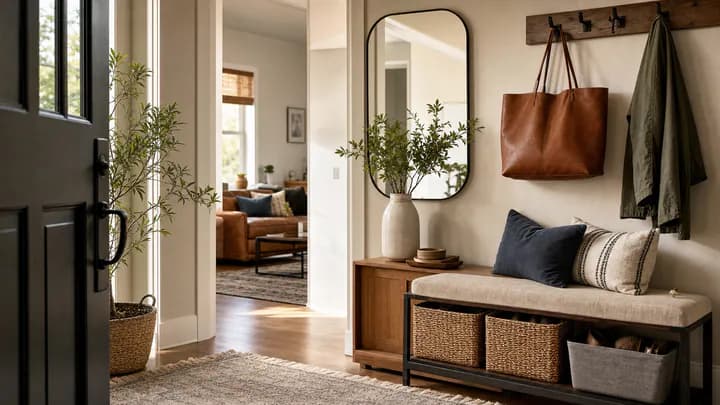
A worked example, using a hypothetical 450-square-foot layout: the dining table sits on a flat-weave rug with a pendant over it and doubles as the work zone. Three feet away, the couch faces a different rug under warm floor lamps, with a 5-foot bookcase turned perpendicular to the wall acting as the divider. The entry gets its own small runner, hooks, and a mirror. Nothing is built, nothing is drilled beyond two hooks, and the apartment reads as three rooms.
The entry is worth disproportionate attention because it is where clutter enters the apartment. Our guide to small entryways that work hard covers the drop-zone setup in detail, and making the first three feet work is the version for apartments where the "entry" is really just a patch of floor beside the door.
What can I do if my lease bans drilling into walls?
Go freestanding and go tension-based. A tall ladder shelf, a narrow bookcase, tension rods inside window frames and under sinks, and over-door hooks cover most of what wall shelves would have done. The one non-negotiable: anything over about 4 feet tall should be strapped to the wall with a removable anti-tip strap, which usually leaves a patch smaller than a dime.
Adhesive hooks are the most misunderstood tool in renter storage. They fail for three predictable reasons: the wall is textured, the paint is less than a month old, or the load exceeds the rating. Weight ratings on these hooks are per hook and lower than people assume — a few pounds each — so a coat rack made of four adhesive hooks will not survive a wet winter jacket. Use them for keys, aprons, and cables, not for anything that would hurt if it fell.
One edge case worth naming: if your building has plaster walls rather than drywall, standard drywall anchors are the wrong hardware, and pulling one out takes a chunk of wall with it. In pre-war buildings, freestanding storage is not just easier, it is cheaper than the repair bill.
How do I fix a tiny kitchen with almost no counter space?
Move everything off the counter that is not used daily, then add storage to three surfaces people forget: the fridge side, the insides of cabinet doors, and the wall between the counter and the upper cabinets. Magnetic spice tins on the fridge flank, adhesive or screw-in racks inside cabinet doors for pot lids and measuring spoons, and a wall rail with S-hooks for utensils and mugs will typically clear an entire counter run.
Two more rules that hold up in cramped kitchens. First, decant dry goods into square stackable containers — round jars and bagged goods waste roughly a third of a shelf's depth. Second, keep only one of any single-use tool. Small kitchens die from duplicate spatulas and three half-empty bottles of the same oil.
If the reason your kitchen is chaotic is that you cook complicated meals in a space that cannot support them, changing the cooking style is a legitimate fix.
How many clothes should a small closet actually hold?
A single standard closet rod comfortably holds roughly 40 to 50 hanging items on slimline velvet hangers, and about half that on bulky plastic ones. If you are stacking, wedging, or fighting the rod, the answer is not better hangers — it is fewer garments.
This is where a capsule approach pays off in square footage rather than style points. Choosing a limited set of neutral bottoms and outerwear that combine with a rotating group of tops cuts the hanging count dramatically without cutting the number of outfits. We walk through the exact build in the 30-piece capsule wardrobe guide.
Two practical adds: store off-season clothing in flat under-bed bins so the closet only ever holds the current season, and hang a second rod below the first for shirts and folded pants if your closet has more than 40 inches of dead vertical space under the hanging line.
What is the most expensive mistake people make?
Buying organizers before decluttering. Containers preserve volume rather than reduce it, and mismatched bins waste shelf depth, so the money buys a tidier version of the same problem. Measure your shelves, drawers, and closet depth after the edit, then buy one size of bin that fits those dimensions exactly.
The second expensive mistake is furniture bought for a floor plan you have not measured. Before any purchase over a few hundred dollars, tape the footprint on the floor with painter's tape and live with it for two days. A sofa that is 6 inches too deep turns a walkway into a shuffle, and returning upholstered furniture is often the most painful return in retail.
If furniture upgrades keep landing on a credit card, the fix is budgeting rather than willpower. Setting aside a small monthly amount for planned home purchases is how most people stop buying the cheap version twice. This is general organizing and budgeting guidance, not financial advice.
How do I keep it organized past week two?
Run a 15-minute reset at the same time every day and enforce a one-in, one-out rule at the door. The reset is not cleaning — it is returning objects to their assigned zone. Small apartments degrade fast precisely because there is no spare room to absorb the drift, which is also why they recover fast.
Three habits that do the heavy lifting:
- Empty the entry drop zone nightly. Mail, bags, and shoes are the source of most visible clutter.
- Keep one empty shelf and one clear counter run. Blank space is the buffer that absorbs a busy week without the whole apartment collapsing.
- Do a 10-minute donation sweep monthly. One bag, no deliberation, out the door before you rethink it.
Sleep quality and morning routines are quietly tied to this. A bedroom that is also a storage unit is harder to wind down in, which is why we treat the bedroom as its own project in calm, cozy bedroom upgrades.
When does this advice not apply?
It does not fully apply if you share the apartment with someone who has not agreed to the system, if you have young children, or if your work or hobby genuinely requires bulk storage — instruments, sports gear, art supplies, professional tools.
In shared spaces, the fix is allocation rather than reduction: each person owns specific shelves and a specific closet section, and shared surfaces stay clear by agreement. With kids, plan for rotation instead of minimalism — half the toys live in a bin out of sight and swap every few weeks. With bulk hobby gear, accept that one zone will be dense and protect the rest of the apartment by containing it to a single wall or closet rather than letting it migrate.
And if the apartment still feels impossible after a full declutter and a proper zone plan, the problem may be the floor plan, not you. Some layouts — a long hallway apartment with no wall runs, a studio with four doors — genuinely cannot hold a normal amount of stuff. Knowing that is not failure; it is information for the next lease.
Key takeaways
- Sequence beats products: declutter by category, assign zones, then buy containers sized to measured shelves.
- Vertical shelving and under-bed storage return the most space per dollar; sleeper sofas usually return the least.
- Define zones with a rug, a separate light source, and a furniture edge — no walls required.
- Renters should favor freestanding and tension-based storage, and treat adhesive hook weight ratings as hard limits.
- A 15-minute daily reset plus one-in, one-out is what makes an organized small apartment stay organized.
- Leave one empty shelf and one clear counter as breathing room; the buffer is what absorbs a bad week.
Frequently asked questions
Where should I start organizing a small apartment?
Start with decluttering one category — not one room — before you buy a single container. Clothes are usually the highest-volume category, so most people free up the most space fastest by editing the closet first, then moving to kitchen gear, paperwork, and sentimental storage.
How much storage furniture do I actually need for a studio?
Most studios under 500 square feet need three anchors: one piece with hidden storage (bed or ottoman), one vertical unit (shelving that reaches at least 6 feet), and one entry drop zone. Beyond that, added furniture usually costs more floor space than it returns.
Do adhesive hooks and renter-safe shelves really hold?
Yes, within their rated limits, which are lower than most people assume. Adhesive hooks typically handle a few pounds each and fail on textured or freshly painted walls; tension rods and freestanding ladder shelves are safer for anything heavy, and a bookcase anchored with a removable strap is the best bet for real load.
How do I make a studio feel like separate rooms without walls?
Use a rug, a lighting change, and a piece of furniture with a back or a tall plant to mark each zone. The eye reads a break in floor covering and a separate light source as a separate room, and the furniture edge stops the zones from bleeding into each other.
What is the most common small-apartment organizing mistake?
Buying bins, baskets, and organizers before decluttering. Containers preserve the volume you already own instead of reducing it, and mismatched sizes waste shelf depth, so most people end up storing their clutter more attractively rather than owning less of it.
How long does it take to organize a small apartment properly?
Plan on two to four weekends for the initial work and about 15 minutes a day to maintain it. Decluttering by category takes the bulk of the time; installing storage and assigning zones is usually a single afternoon once you know what actually needs a home.
Does a capsule wardrobe work if I need office clothes and casual clothes?
Yes, but you build two overlapping cores rather than one. Keep neutral bottoms and outerwear shared between both contexts and let tops carry the difference, which is what keeps the total piece count low without leaving you short for work.