The Clean Girl Aesthetic in 2026: How to Actually Nail It
The clean girl aesthetic looks expensive but runs on about six products and twelve minutes. Here is the realistic version: what to buy, what to skip, how to slick hair back without wrecking your hairline, and when the trend simply isn't worth chasing.
Rewritten with AI and republished automatically. Our editors set the standards and fix reported errors — how we work.

TL;DR: The clean girl aesthetic is grooming, not glamour. It runs on roughly six products and twelve minutes: hydrated skin, sheer coverage, cream blush, brushed brows, glossy lips, smoothed hair, neutral clothes, small gold jewelry. The look fails when people add more instead of less, or pull the bun tight enough to damage a hairline.
What exactly is the clean girl aesthetic?
The clean girl aesthetic is a minimalist beauty and style look built on dewy skin, sheer makeup in neutral and rosy tones, smoothed-back hair, neutral clothing in simple silhouettes, and small gold jewelry. It signals care and polish rather than transformation. The finished face should look like skin that has been looked after, not skin that has been covered.
It grew out of short-form video in the early 2020s and borrowed heavily from older references: 1990s minimalism, Scandinavian dressing, and the long tradition of glazed, luminous skin in Korean and Japanese beauty routines. Adjacent trends you will see named alongside it include glazed donut skin, latte makeup, quiet luxury, and the old-money look. They share a finish; they differ in how much shine and how much structure.
The key thing to understand before you spend anything: this is a low-product aesthetic that is often sold as a high-product one. The visual is achieved through restraint, not through a twelve-step routine.
What does a clean girl skincare routine actually look like?
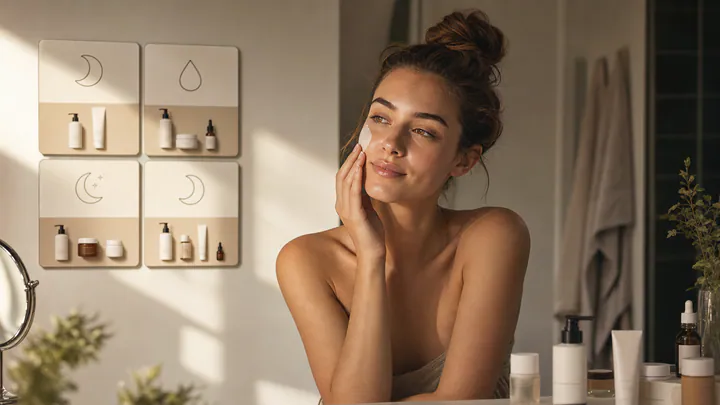
Three steps in the morning and three at night, done consistently, will get you most of the way there: cleanse, moisturize, apply sunscreen in the morning; cleanse, treat, moisturize at night. Consistency beats complexity here, and the glow everyone is chasing is mostly hydration plus an intact skin barrier reflecting light evenly.
That last point matters more than any single serum. Skin that is stripped, over-exfoliated or irritated looks flat and patchy no matter what you put on top, because a damaged barrier scatters light instead of reflecting it. If your skin currently stings when you apply moisturizer or looks tight after cleansing, start with our skin barrier repair guide before you add actives.
Two routines pair naturally with this look. Skin cycling gives you a structured way to use retinoids and exfoliating acids without overdoing either, and overnight slugging is a cheap way to wake up with the plumped, glassy surface that makes sheer makeup sit well. Neither is essential. Both are more useful than a fourth serum.
One honest caveat: if you are managing active acne, rosacea, eczema or persistent pigmentation, a trend routine is not the right tool. Consult a qualified dermatologist and build the aesthetic around the treatment plan, not instead of it.
Which products do you actually need, and what can you skip?
Six products cover it: gentle cleanser, moisturizer, SPF, skin tint, cream blush, lip gloss or balm. Brow gel and a small tube of concealer are the only sensible additions. Everything else in the viral shopping hauls is optional, and several items actively work against the finish.
| Conventional step | Lighter swap | Why it works | Skip the swap if |
|---|---|---|---|
| Full-coverage foundation | Skin tint or tinted moisturizer | Evens tone while letting real skin texture show through | You need even coverage for melasma or vitiligo and prefer it — that is a valid choice |
| Setting powder all over | Powder at the T-zone only, or blotting paper | Preserves shine on the cheekbones where it reads as health | You work in heat or humidity and need the face to hold |
| Powder bronzer and contour | Cream bronzer on the high points | Melts into skin rather than sitting on top of it | Cream formulas slide off your oily skin within an hour |
| Powder blush | Cream or liquid blush on cheeks and nose bridge | Creates the flushed, from-within color the look depends on | You are very oily — gel-cream or a soft powder holds better |
| Matte liquid lipstick | Tinted gloss or lip oil | Adds light to the lower face and reads as effortless | You hate stickiness — a satin balm does the same job |
| Hard-hold styling gel | Smoothing serum plus a soft-hold gel | Keeps hair sleek without the crunchy cast that ruins the finish | Nothing else holds your hair type — then use less product, not a weaker one |
Sheer formulas are one of the few beauty categories where price genuinely matters least. A drugstore skin tint and a drugstore cream blush are hard to distinguish from luxury versions once they are blended, because there is very little pigment doing the work.
How do you do the whole face in under 12 minutes?
Here is the worked version, timed. Minute 0 to 3: cleanse, moisturizer, SPF, and let it settle while you brush your teeth. Minute 3 to 5: skin tint pressed on with fingers or a damp sponge, concealer only on individual spots and the inner corners. Minute 5 to 7: cream blush on the apples, up toward the temples, and a whisper across the nose bridge.
Minute 7 to 9: brow gel brushed up, one coat of mascara or a lash curler if you prefer bare lashes, a touch of cream highlighter on the tops of the cheekbones and the inner eye. Minute 9 to 10: lip gloss. Minute 10 to 12: hair.
Use that timing as a diagnostic. If your version takes half an hour, you are doing full glam in neutral colors, which is a perfectly good look but a different one with a different time budget. The clean girl aesthetic is supposed to buy you time back.
How do you slick hair back without damaging your hairline?
Keep it loose enough to raise your eyebrows without resistance, vary the part and bun position between wears, and give your scalp gel-free days. Repeated tension at the hairline is a recognized cause of traction alopecia, and daily tight buns are one of the most common triggers. This is the single most costly mistake associated with the trend, because the hair loss it causes can become permanent.
The technique itself is simple. Work a smoothing serum through damp or dry hair, brush from the crown down with a boar bristle brush, apply a soft-hold gel only along the surface where flyaways live, secure with a snag-free elastic, and smooth the edges with the tail of a comb. Tie a silk scarf over it for five minutes while you finish your face and the set is done.
Because gel and daily tension both stress the scalp, this look benefits from real scalp care between styles — clarifying properly to remove product buildup, and letting the hair sit loose on rest days.
If you have curly, coily or fine hair
Forcing textured hair flat with gel and tension is where this trend does the most damage, and it is not the only route to the look. A smoothed puff, a low twisted bun, sleek braids, or a defined wash-and-go with tidy edges all read as polished and intentional. Fine hair, meanwhile, often looks thinner when slicked back; a soft low bun with face-framing pieces left out gives the same clean line without the scalp on display.
What belongs in a neutral capsule wardrobe?
Start with eight pieces: a white tank or fitted tee, a crisp button-down, a relaxed blazer, straight-leg trousers, well-fitting jeans, a slip skirt or dress, a knit in oatmeal or gray, and one pair of clean leather shoes. Add a structured tote and you can dress for most situations for a week without repeating an outfit.
The palette does the coordinating: white, cream, beige, taupe, gray, navy, black, with one soft accent if you want it. The discipline is in silhouette and fabric, not color. This is also where the aesthetic gets genuinely expensive, because neutral basics have nowhere to hide — a thin, badly cut white tee looks cheap in a way a patterned one does not.
Our decision rule: buy neutral basics slowly and individually, and touch the fabric before you commit. Skip anything semi-sheer unless you plan to layer it, and prioritize fit over brand. One well-cut blazer outperforms three mediocre ones.
What accessories finish the look?
Small gold hoops or huggies, one fine chain, a slim watch or a plain bangle, a claw clip, and a bag with no visible logo. That is the whole vocabulary. The rule is that accessories should be noticed second, after the person wearing them.
An edge case worth naming: silver and gold are both fine, despite the trend's gold bias. Go with whatever flatters your skin and what you already own, and keep the metals consistent within one outfit rather than mixing three.
What are the most common clean girl mistakes?
Three come up repeatedly, and all three are avoidable.
- Over-exfoliating to chase glass skin. Acids and scrubs used daily strip the barrier, and stripped skin looks dull and blotchy — the exact opposite of the goal. Two exfoliation days a week is plenty for most people.
- Buying the whole viral shelf. A cabinet of fourteen products encourages layering, and layering is what turns a sheer look heavy. Finish what you have before you add.
- Treating it as a personality standard. The trend has been fairly criticized for presenting an expensive, narrow, largely Eurocentric version of "effortless." Effortless is a look, not a moral category, and there is nothing wrong with liking bold color, big hair or heavy eyeliner.
A fourth, quieter one: skipping sunscreen. Uneven tone is the thing sheer coverage cannot hide, and daily SPF is the most reliable preventative step available to you.
Does the wellness part actually matter?
Partly, and less mystically than the trend suggests. Hydration, regular movement and adequate sleep visibly affect skin, undereye shadows and energy — that much is well established. What no lifestyle habit does is replace skincare, and framing wellness as a substitute for treatment is where the trend goes wrong.
Two habits with the best return for the effort: fixing sleep and getting ten minutes of morning sunlight, which helps anchor your body clock. Both are free. Neither is a beauty product.
Key takeaways
- The clean girl aesthetic is built on six products and about twelve minutes — if yours takes longer, you have drifted into a different look.
- The glow comes from a healthy skin barrier and hydration, not from stacking serums or exfoliating daily.
- Never wear the slick bun tight; repeated tension at the hairline can cause lasting hair loss, and textured hair has better options than forced flatness.
- Sheer makeup is the category where budget formulas compete best; spend your money on wardrobe fabric and fit instead.
- Adapt the finish to your skin type — satin instead of dewy, gel-cream instead of cream blush — rather than copying a tutorial exactly.
- If you are treating an active skin condition, work with a qualified dermatologist and build the look around that plan.
Frequently asked questions
What is the clean girl aesthetic?
The clean girl aesthetic is a minimalist beauty and style look built on dewy, lightly covered skin, sheer makeup in neutral and rosy tones, slicked-back or smoothed hair, neutral clothing in simple silhouettes, and small gold jewelry. It emphasizes polish and grooming over coverage and color.
How many products do you need for the clean girl look?
Six is usually enough: a gentle cleanser, a moisturizer, a daily SPF, a skin tint or tinted balm, a cream blush, and a lip gloss or balm. A brow gel and a light concealer are the only common additions. Buying more than that tends to make the look heavier, not better.
Does the clean girl aesthetic work on textured, curly or coily hair?
Yes, but not in the sleek-bun form. Forcing curls and coils flat with gel and tension is a fast route to breakage and traction alopecia. A smoothed puff, a low twisted bun, a defined wash-and-go with clean edges, or sleek braids read just as polished and are far kinder to the hair.
Is the slicked-back bun bad for your hair?
It can be if it is tight, worn daily, and secured with a hard-hold gel that dries stiff. Repeated tension on the hairline is a known cause of traction alopecia. Keep the bun loose enough to move your eyebrows, vary the position and part, and give your scalp gel-free days.
How do you get glowing skin for the clean girl look if you have oily skin?
Keep the hydration but move the shine where you want it. Use a lightweight gel moisturizer, a satin rather than dewy skin tint, a powder or gel-cream blush instead of a cream one, and apply highlighter only on the top of the cheekbones. Blot rather than powder the whole face.
How much does it cost to put the look together?
The makeup and skincare side can be assembled for a modest sum from drugstore brands, since sheer formulas are one of the categories where price differences matter least. The wardrobe is the expensive part, because neutral basics only look good when the fabric and fit are good. Build it slowly rather than all at once.
How long should the routine take?
About twelve minutes for face and hair on a normal morning. If your version takes thirty, you have drifted into a full glam routine wearing neutral colors, which is a different look and a different time commitment.
Can you do the clean girl aesthetic with acne, texture or rosacea?
Yes, with adjustments. Sheer coverage plus targeted concealer on individual spots usually looks more natural than full foundation, and a satin finish avoids drawing light onto raised texture. If you're managing an active skin condition, work with a qualified dermatologist rather than layering trend products.