Inkjet or Laser Printer? Working Out the Real Cost per Page
The printer is the cheap part. Learn to turn cartridge price and rated yield into cost per page, see three-year totals at 20, 100 and 400 pages a month, and pick inkjet, ink tank or mono laser.
Drafted with AI. This version has not been reviewed by an editor, so it carries no ads — how we work.
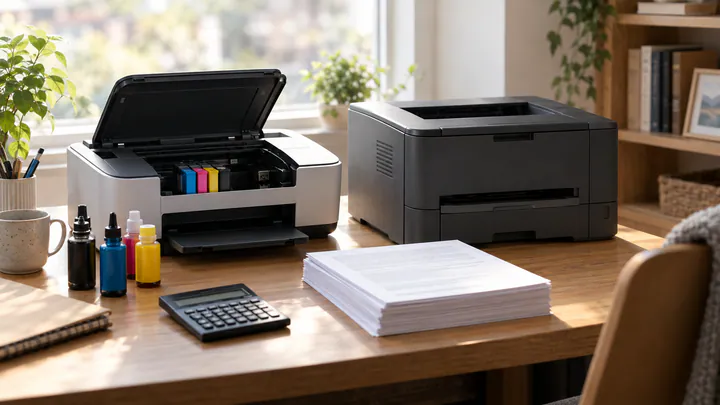
Over three years, the ink or toner a home printer uses usually costs more than the printer itself, so the cheapest machine on the shelf is often the most expensive one to own. This guide is for a household or freelancer replacing a printer, printing anywhere from a handful of pages a month to a few hundred, who wants the lowest total over three years. You will learn to work out cost per page from two numbers on any cartridge listing, see how your monthly volume changes which printer wins, and end with a plain rule for choosing a cartridge inkjet, an ink tank or a mono laser. If you print gallery-quality photos or run a busy shared office, your priorities (color accuracy, duty cycle, network management) are different and this math will only take you part of the way.
The formula: cartridge price divided by rated yield
Cost per page is the price of a cartridge divided by the number of pages it is rated to print. Manufacturers publish that rated yield on the cartridge's product page or box, usually labeled as an ISO yield or "approximate page yield."
Worked example: two cartridges
- Inkjet black cartridge: $30 rated for 300 pages. $30 ÷ 300 = $0.10, or 10 cents a page.
- Laser toner cartridge: $80 rated for 3,000 pages. $80 ÷ 3,000 = $0.0267, or about 2.7 cents a page.
The toner costs more than twice as much at the register and still works out cheaper per page, because its yield is ten times higher. That gap is the whole story of printer economics in miniature.
For color, run the same calculation for each cartridge or bottle. A tri-color inkjet cartridge at $35 rated for 200 pages is $35 ÷ 200 = 17.5 cents per color page. Tri-color cartridges have a catch: when one color runs dry, the whole cartridge is finished, even if the other two are half full. Printers with separate cartridges for each color avoid that waste but have more cartridges to buy.
Use the high-yield version when there is one
Many printers accept a standard and a high-yield (often labeled XL) cartridge. Calculate both. The high-yield version usually costs more up front and less per page, but it only pays off if you finish it before it dries out, which matters for slow printers (more on that below).
What a rated page yield actually measures
Yield figures come from standardized test methods published by ISO and IEC, so you can compare one brand's number with another's. Inkjet yields are measured under ISO/IEC 24711, using a set of test pages defined in ISO/IEC 24712. Monochrome toner uses ISO/IEC 19752, and color toner uses ISO/IEC 19798. The test pages are a mix of text and simple graphics that leave most of the sheet white; for monochrome toner the test page works out to roughly 5% coverage, and the inkjet test suite is similarly light.
That has a direct consequence: if your pages are heavier than the test pages, your real cost per page is higher than the calculated one. Coverage scales roughly in proportion, so a page with four times the ink or toner gets about a quarter of the yield.
Worked example: a heavy page
Take the $80 toner rated for 3,000 pages at about 5% coverage. If you print slides or forms with dark headers that average 20% coverage, the cartridge lasts about 3,000 × (5 ÷ 20) = 750 pages. Cost per page becomes $80 ÷ 750 = 10.7 cents instead of 2.7 cents. Dense spreadsheets, shaded tables, full-page images and photos all push you in this direction; plain letters and invoices sit close to the rated figure.
The test also runs in controlled conditions. It does not count ink spent on cleaning cycles or the ink that dries in a cartridge left for months, which is why the rated yield is a best case for inkjets that sit idle.
Illustrative per-page numbers for the three printer types
The prices below are hypothetical but typical of entry-level home models in the US. Swap in the real figures for any printer you are considering; the arithmetic is the same.
| Printer type | Printer price | Supplies (price ÷ rated yield) | Black page | Color page |
|---|---|---|---|---|
| Cartridge inkjet | $80 | Black $30 ÷ 300; tri-color $35 ÷ 200 | 10 cents | 17.5 cents |
| Ink tank | $250 | Black bottle $20 ÷ 7,500; three color bottles $42 ÷ 6,000 | 0.27 cents | 0.7 cents |
| Mono laser | $150 | Toner $80 ÷ 3,000 | 2.7 cents | Not possible |
An ink tank printer is an inkjet that you fill from bottles instead of swapping sealed cartridges. You pay more for the machine and far less for ink. A mono laser fuses black toner powder onto the page with heat; it prints sharp, smudge-resistant text quickly but cannot print color at all.
Three-year totals at 20, 100 and 400 pages a month
Three-year cost is the printer price plus pages printed times cost per page. At 20 pages a month you print 720 pages in 36 months; at 100, 3,600 pages; at 400, 14,400 pages. The table assumes black text pages at rated coverage.
| Pages per month | Pages over 3 years | Cartridge inkjet | Ink tank | Mono laser |
|---|---|---|---|---|
| 20 | 720 | $152.00 ($80 + $72.00) | $251.92 ($250 + $1.92) | $169.20 ($150 + $19.20) |
| 100 | 3,600 | $440.00 ($80 + $360.00) | $259.60 ($250 + $9.60) | $246.00 ($150 + $96.00) |
| 400 | 14,400 | $1,520.00 ($80 + $1,440.00) | $288.40 ($250 + $38.40) | $534.00 ($150 + $384.00) |
Read across each row and the purchase price stops mattering quickly. At 20 pages a month, the inkjet is $17.20 cheaper than the laser on paper. At 100 pages, the laser edges the ink tank by $13.60. At 400 pages, the cartridge inkjet costs $1,520.00 against $288.40 for the ink tank, and the laser sits in between at $534.00.
Three caveats keep this honest. First, you buy supplies in whole cartridges, not fractions, and most printers ship with ink or toner in the box, so at 20 pages a month an ink tank or laser may never need a refill in three years. Check whether the included supplies are full size or a lower-yield "starter" set. Second, some lasers use a separate drum unit that wears out after a set number of pages, and ink tanks have a maintenance box that collects waste ink; both are extra purchases at high volume, so look up their price and rated life for the model you are considering. Third, the low-volume row ignores wasted ink, which is the next section.
Adding color pages
Suppose you also print 20 color pages a month: school projects, flyers, the odd map. Over three years that is 720 color pages. On the cartridge inkjet, 720 × $0.175 = $126.00. On the ink tank, 720 × $0.007 = $5.04. A mono laser cannot do it; at a hypothetical 50 cents a page at a copy shop, those pages would cost 720 × $0.50 = $360.00. Regular color is where the ink tank's high purchase price pays for itself.
The idle-printer problem: clogged nozzles and cleaning cycles
Inkjets that sit unused waste ink, and toner does not. An inkjet printhead fires ink through nozzles finer than a hair, and when the printer is idle, ink at the nozzle openings can dry and block them. To prevent and clear this, inkjets run automatic cleaning cycles, typically when they power up after a gap or on a schedule, pushing ink through the nozzles into an internal waste pad or maintenance box. If prints come out streaky, a manual cleaning cycle uses more ink again. None of that ink appears on paper, so it is invisible in the rated yield.
For a low-volume household this can flip the result. As an illustration, if drying and cleaning cost you the equivalent of one extra $30 black cartridge a year, the three-year inkjet total at 20 pages a month rises from $152.00 to $242.00 ($152 + 3 × $30), now $72.80 more than the mono laser's $169.20.
Where the printhead sits matters too. On many cartridge inkjets the printhead is built into the cartridge, so a badly clogged one is fixed by buying a new cartridge. On ink tanks and other fixed-head printers, the head is part of the machine; a stubborn clog is a printer problem, not a supplies problem. Ink tanks waste little money per cleaning because bottled ink is cheap, but they still need regular use.
Toner is a dry powder, so there is nothing to evaporate. A laser can sit for months and print a clean page the first time, which is why it suits people who print in bursts with long gaps. Store spare toner sealed, away from heat and humidity, and it keeps well.
If you do choose an inkjet and print rarely, two habits help: turn it off with its own power button rather than at the wall, so the head parks and caps properly, and print a page or two every week or so to keep ink moving.
Subscriptions, third-party cartridges and firmware lockouts
The prices in the tables assume original cartridges bought outright. Two common alternatives can lower the per-page cost, and both come with conditions you should read before committing.
Before signing up for an ink subscription
Ink subscription plans usually charge a monthly fee for an allowance of pages, then ship cartridges as the printer reports it is running low. Because they charge per page rather than per drop of ink, a full-color photo counts the same as a one-line note, which makes them cheaper for color-heavy users and poor value for light text printing. Check:
- Your real monthly count. Most printers keep a total page counter you can see on a configuration or status page. Divide the change over a few months by the number of months.
- Rollover and overage terms. How many unused pages carry over, the cap on rollover, and the price of extra pages if you go over.
- What happens when you cancel. On some plans, cartridges supplied under the subscription stop working once the plan ends, so you would need to buy new cartridges immediately.
- Connection requirements. These plans typically need the printer online to track usage; a printer that drops off your network may pause printing.
Before buying third-party cartridges
Compatible cartridges (newly made by another company) and remanufactured cartridges (refilled originals) can cost a fraction of the brand price. Run the same price-÷-yield calculation on them, because some carry lower yields that eat into the savings. Then check:
- The seller's return policy, in case the printer rejects the cartridge or prints poorly.
- Recent compatibility reports for your exact model, since chips on third-party cartridges sometimes stop being recognized.
- Your printer's warranty terms on damage caused by non-original supplies.
- Firmware updates. Some manufacturers have released updates that made printers refuse cartridges they previously accepted. Turning off automatic updates can avoid this, but it also delays security fixes for a device on your home network, so weigh that trade-off before switching them off.
If a brand is known for blocking third-party supplies, price your three-year total using original cartridges only. Treat any savings from alternatives as a bonus, not the basis of the decision.
Which printer to buy: a rule you can apply
Start by counting your pages, using your current printer's counter or by multiplying the cartridges you bought last year by their rated yield. Then:
- Mostly text, printing infrequently (a few pages a week or less, with gaps of weeks): buy a mono laser. It costs slightly more than a cheap inkjet up front, nothing dries out, and it is ready whenever you need it. Send the rare color page to a copy shop.
- Regular color printing, at any volume: buy an ink tank. Its color cost per page is a small fraction of a cartridge inkjet's, and the higher purchase price is recovered quickly. Print something every week to keep the head clear.
- High-volume text (a few hundred pages a month): both work. In the example, the ink tank's running cost wins; a laser is faster, produces smudge-proof pages and tolerates holidays without maintenance. Compare the real supply, drum and maintenance-box prices for the two models you are weighing.
- A cartridge inkjet makes sense only when you need occasional color, print steadily enough that cartridges do not dry out, and have a tight upfront budget. At anything above light use, its per-page cost dominates the total.
Whatever you choose, do the division before you buy: the cartridge or bottle price, the rated yield and your monthly page count tell you more about the next three years than the price tag on the box.