The Puppeteer's Apology to the Rain
When a traveling puppeteer arrives in a drought-parched town, the children ask for a show that might do more than entertain. What follows is a bargain older than the strings in his case.
Drafted with AI and published automatically. Our editors set the standards and fix reported errors — how we work.
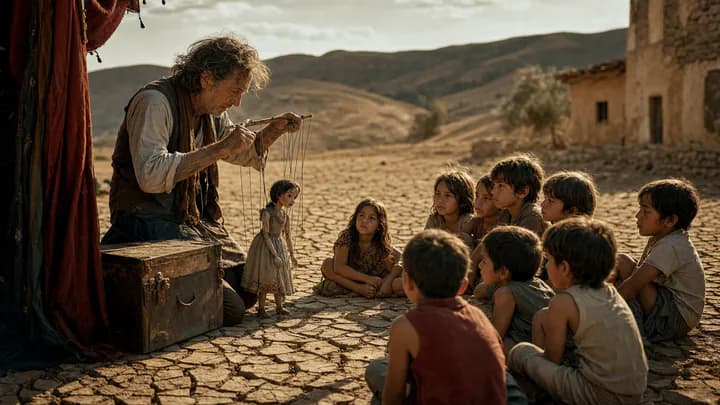
The puppeteer arrived in Alcoba on the seventh Tuesday of the drought, pulling a cart that squeaked like an animal too proud to complain. Dust rose around his boots in small, apologetic clouds, as if even the ground had learned to say sorry for itself.
He set up in the square without asking permission. There was no one left to ask. The mayor had gone to the capital to argue with men in air-conditioned rooms, and the priest had taken to sleeping through the afternoons because his sermons on patience had begun to embarrass him. Only the children came out, drawn by the sound of the cart and the promise of anything that was not another hot afternoon.
"What's your name?" a girl asked. She was perhaps nine, with two long braids and a scab on her knee shaped like the country of Portugal.
"Tobias," said the puppeteer. "And I owe the rain an apology."
The children considered this. In Alcoba, where the reservoir had shrunk to a silver coin at the bottom of a stone bowl, this was not the strangest thing anyone had said that week. A boy named Elio had claimed to have seen a fish walk out of the dry riverbed and shake its head at him, and no one had disagreed.
"Are you going to do a show?" the girl with the braids asked.
"I am going to try," Tobias said.
The Stage
He unfolded the cart the way a card player reveals a good hand: slowly, with respect for the moment. Panels swung out into a small proscenium painted the color of old wine. A curtain the color of a sunset that had gone slightly wrong. From a case lined with faded velvet he took his puppets one by one and laid them on a bench so the children could see.
There was a farmer with a straw hat and eyes stitched from black beads. A woman in a blue dress with a real pocket sewn into her apron. A dog with too many legs, which Tobias explained had been an accident but a fortunate one, because the dog could now run in any direction at once. A cloud with a face — not smiling, not frowning, just watching. And, at the bottom of the case, wrapped in a scrap of linen, a small puppet of a boy no taller than a hand, with painted freckles and a shirt sewn from what looked like a piece of somebody's Sunday best.
"Who's that?" asked Elio, who was seven and considered himself an authority on strange things.
Tobias did not answer at once. He set the boy puppet down beside the cloud, and the way he did it made the girl with the braids sit down cross-legged without being asked. The other children followed, sitting in a semicircle in the dust. Somewhere a shutter banged in a wind that had forgotten how to bring anything with it.
"That," said Tobias, "is who I was when I made a promise I couldn't keep."
The Show
He began without music. He had no music. His hands moved into the puppets the way a hand moves into a familiar coat, and the farmer came alive first, tipping his straw hat to the audience.
The story he told was this. Long ago, in a village like Alcoba but not Alcoba, a boy loved the rain more than anything. He would run outside when it came and stand with his arms out and his mouth open, and the rain, in the way of children's stories, learned his name and would visit him particularly. The other villagers, being farmers, were glad, because when the boy was happy the rain came generously and when he was elsewhere it went elsewhere too.
One summer the boy grew tired of being loved by weather. He wanted to be loved by people, which is a more difficult and less reliable thing. He told the rain to go away and not come back until he called for it. The rain, who understood loneliness better than most, obeyed.
The boy went out into the world. He learned to make puppets. He learned that people applaud briefly and then go home. He learned that the sound of a small crowd walking away is one of the loneliest sounds there is. By the time he thought to call the rain back, he had forgotten the word.
"What was the word?" asked the girl with the braids.
Tobias's hands paused inside the puppets. The farmer and the woman in the blue dress hung there, waiting.
"I have spent forty years," he said, "trying to remember."
The children were very quiet. Above them the sky was the flat white of a plate left out in the sun. The cloud puppet, resting on the bench, seemed to lean forward slightly, though no one had touched it.
Elio stood up. He was not a shy boy, and he had the kind of certainty that seven-year-olds sometimes have and adults sometimes envy.
"Maybe it isn't a word," he said. "Maybe it's a sorry."
Tobias looked at him for a long time. Then he set down the farmer and the woman and picked up the small boy puppet with the painted freckles. He held it in both hands, gently, the way you hold something that is either very fragile or very old, or, in this case, both.
"I'm sorry," he said. He said it to the puppet, but he said it loudly enough for the sky to hear if the sky was listening. "I'm sorry I sent you away because I was ashamed of being loved by you. I'm sorry I forgot. I'm sorry I made a whole life out of forgetting."
Nothing happened. This is important to say. The sky did not open. The clouds did not gather in a dramatic rush. A woman at the edge of the square, who had come to the window because of the children's stillness, did not gasp.
What happened was smaller. A single drop of water landed on the painted forehead of the boy puppet. Then another on the back of Tobias's hand. Then one on the scab shaped like Portugal.
The girl with the braids looked up. "It's raining," she said, in the flat tone of someone reporting a fact rather than a miracle, which is how the best miracles are always received.
After
It rained for two hours, softly, the way rain falls on something it has missed. The children stayed in the square with their mouths open. The priest woke up and stood in his doorway holding a cup that filled while he watched. Tobias packed his puppets away, because puppets do not like to get wet, and sat on the edge of his cart and let the rain fall on him instead.
Before he left the next morning, he gave the small boy puppet to the girl with the braids. "He should stay somewhere," he said. "He's been traveling a long time."
She held the puppet carefully, the way Tobias had. "What if it stops raining again?"
"Then say sorry to him," Tobias said. "He knows the word."
He pulled his cart out of the square and down the road that led out of Alcoba, and the wheels no longer squeaked, because the wood had drunk. The girl stood in the wet dust and watched him go, and for the rest of her life, whenever the sky forgot itself, she would take the little puppet down from the shelf and remember how easy it had been, in the end, and how hard.