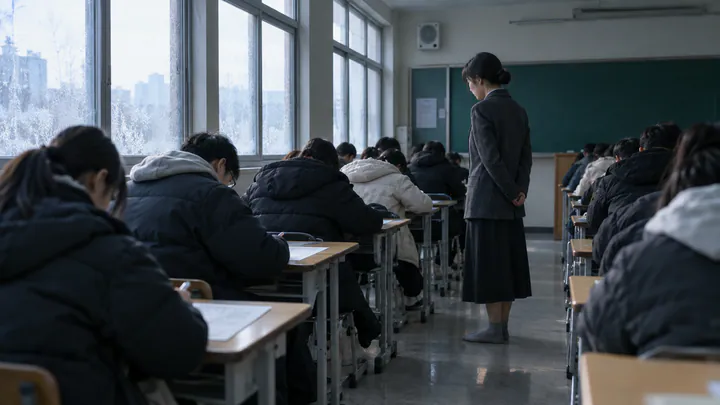
Last Hour on the Overnight Billing Floor
A short story about a Manila call-centre supervisor who, in the last hour of a typhoon-warning night shift, must decide what to do about her best agent's secret fee waivers.
Drafted with AI and published automatically. Our editors set the standards and fix reported errors — how we work.

Story Time is original short fiction. The characters, places and events in this story are invented.
At 5:02 the QA flag landed in Analyn's inbox with a red exclamation mark, which Kristel only used when she wanted something to become someone else's problem before day shift. The subject line read: TEAM 7 — UNAUTHORISED ADJ — PLS SUBMIT DISPOSITION B4 HANDOVER.
Analyn opened the spreadsheet with her headset still looped around her neck. Forty-three rows. The same agent ID in every one: BDIMAC.
Benjie Dimaculangan. Top of the leaderboard eleven weeks running, lowest handle time on the billing floor, satisfaction scores so high that Sir Dennis had once printed them and taped them to the pillar outside the pantry, where they still hung, curling at the corners.
Code WV-07, late payment fee waived, twenty-five dollars. Code WV-12, reconnection fee waived, eighty-five dollars. Four months of them, scattered across his shifts like he'd been careful not to cluster them. Total: two thousand three hundred and ten dollars.
Behind her the windows of the fourteenth floor ticked and shuddered. Signal Number 2 had gone up over Metro Manila at four, and the building admin had sent a text blast asking anyone who could leave at handover to leave at handover. Down on Ortigas Avenue the buses were still moving, their lights smeared long across the wet glass. On the floor, half the stations were dark. The ones still lit belonged to the Ohio account, where it was five in the afternoon and people were coming home from work to find their houses silent and their refrigerators warm.
Analyn pulled up the first recording.
A woman's voice, flat with exhaustion. Zanesville. Two months behind, disconnected that morning. Benjie, polite, the script exactly right: identity verification, balance, payment arrangement offer. Then a pause the script did not contain.
“Ma'am, is anyone in the home using medical equipment that needs power?”
A silence. Then: “My husband does dialysis at night. At home. There's a machine.”
The correct path was the Medical Certification Program. A physician's form, faxed or uploaded, ten business days to process. Analyn had trained new hires on it herself, with slides.
“I'm going to apply a one-time courtesy adjustment to your account, ma'am,” Benjie said on the recording, “and put in a same-day reconnect. I'll also send you the medical form, okay? Please fill it out this week. It protects you next time.”
She listened to three more. A man in Chillicothe whose daughter used a nebuliser. A grandmother with an oxygen concentrator who kept apologising. A woman who said nothing about equipment at all, only that she had a baby and the formula needed boiled water, and Benjie had waived the late fee and nothing else.
At 5:19 she typed into the team chat: Pantry. Aux yourself. 2 mins.
The pantry smelled of someone's reheated adobo and the burnt-sugar edge of three-in-one coffee. Benjie came in already pulling his headset off, a lanyard of ID cards swinging against his chest. He was twenty-six and still stood like a nursing student on ward rounds, feet together, hands where you could see them.
“Kristel flagged you,” Analyn said.
He nodded slowly. “How many?”
“You don't know?”
“I thought forty-one.” He rubbed the back of his neck. “Maybe I lost count.”
“Forty-three.”
The window rattled. Somewhere down the corridor a printer woke up, ran, went quiet.
“Why didn't you escalate them to me?” she asked.
“Because you'd have to say no, Ma'am Ana.” He said it gently, like it was a kindness. “That's your job. I didn't want to make you do your job.”
“That's not how it works.”
“I know how it works.” He looked at the curling printout on the pillar. “Ten business days. You know what ten business days is when the machine is at home? In third year we had a patient from Tanauan, his family couldn't pay the generator diesel during a brownout. I was the one who had to call it.” He stopped. “Anyway. It's twenty-five dollars. They pay it back. Most of them pay the next bill early, you check.”
She had not checked. She would.
“You know what happens if I file this straight,” she said.
“Termination for integrity breach.” He said it like reading a code off a screen. “File it, Ma'am. Your interview is next week. Everybody knows.”
“Everybody knows,” she repeated.
“Ma'am Carmela's team has a clean quarter. You need a clean quarter.” He hesitated. “Joanna starts college in June. Paolo and Rina are still in high school. I'll find another account. There are always accounts.”
He said it the way people in this building said it, as if it were weather. Then he put his headset back on and went back to his queue, because there were still callers waiting in Ohio and the board on the wall showed four in line.
At 5:34 she sat down in front of the disposition form.
Agent ID. Finding. Root cause, a dropdown: Agent non-compliance. Process gap. Supervisor-directed. Corrective action. Submitted by.
Her phone buzzed against the desk. Her mother: Walang pasok si Migs, Signal 2. Tulog pa. Ingat pauwi.
No school today. She would not have made it to the gate anyway. She never made it to the gate. Migs was seven and had started telling her about his week on Sundays, in a rush, as if catching her up on a show she'd missed. Operations managers worked eight to five, Manila time, in an office with a door. She had already pictured the route: drop-off on Shaw, the MRT, coffee she bought instead of drank from a packet.
She selected Agent non-compliance. The corrective action field opened beneath it, white and patient.
She sat with her hands off the keyboard for almost a minute.
Then she opened the customer histories, all forty-three, and started building columns. Medical flag mentioned on call: thirty-one. Infant in the home: six. Next bill paid on or before due date: thirty-eight. Accounts closed or churned since: zero. Against that she pulled the average cost the account published for a disconnection-reconnection cycle, truck rolls and all, and multiplied it out. The number at the bottom was larger than two thousand three hundred and ten dollars. Not by much. Enough.
At 5:47 she changed the dropdown to Supervisor-directed.
In the finding field she wrote: Waivers were applied under a goodwill retention trial for medically vulnerable and infant households, approved verbally by Team Supervisor A. Reyes. The trial was not routed to Operations for sign-off as required. This is a supervisor process violation. Agent followed TL direction. Retention data attached.
In corrective action she wrote: Trial suspended pending Ops review. TL to accept findings. Recommend formal evaluation of a fast-track medical waiver.
She logged out of Kristel's shared view and logged back in under her own credentials so the timestamp and the name would sit together where nobody could separate them.
Kristel messaged within a minute of the draft saving. Ana sure ka? Pangalan mo na to. Interview mo.
Sure, Analyn typed. She clicked submit at 5:52.
At 5:57 her desk phone lit with Sir Dennis's extension. He was calling from home; she could hear a television and a kettle.
“Ana. I'm looking at this.”
“Yes, Sir.”
“You understand what this does to next week.”
“I understand.”
A long breath down the line. “The retention numbers are real?”
“Pulled them myself, Sir.”
“Written warning. It'll sit on your file twelve months.” Another pause, and the kettle clicking off. “Send me the numbers separately. Don't put them in a reply-all.”
“Yes, Sir.”
He hung up without saying the other thing, and she did not need him to.
Joyce from day shift came in at 5:59 with her umbrella dripping and her trousers soaked to the knee, saying the jeeps on Meralco Avenue were already thinning out. Analyn walked her through the queue, the open escalations, the two agents who had called in because of flooding in Marikina. She did not mention the audit. It would be in Joyce's inbox by eight.
Benjie was logging off when she passed his station. He had seen it; the disposition went to the agent too. He stood up, the headset still in his hand, and opened his mouth.
“Medical flag in the case notes,” she said, before he could speak. “Every time. Equipment, prescription, whatever they tell you. And you route it to me first, even if I have to say no.”
“Ma'am Ana—”
“Go home before the jeeps stop.”
At her desk she took the rubber slippers out of the bottom drawer, put her work shoes into a plastic bag, and knotted it twice. In the elevator she typed to her mother: Pauwi na. Pag nagising si Migs, sabihin mo hintayin ako bago mag-almusal.
Then she put the phone in her pocket, held the bag of shoes against her chest, and stepped out into the lobby, where the guard was already taping the glass doors.