Twelve Cakes, and Only Ever Twelve
Maud gets paid eleven pounds an hour to stand in other people's queues. Then a stranger's standing order at a tiny bakery turns twenty-six Fridays into the only appointment that matters.

For eleven pounds an hour, I will stand anywhere you like.
I have held places in queues for passport offices, for concert tickets, for the public gallery of a courtroom, and once, memorably, for a man who wanted to be the first person in Broughmill to buy a particular mattress. He arrived at opening time in a very good coat, looked at me the way you'd look at a wet umbrella, and said, "You can go now." I went. He'd paid for four hours and I'd stood five, because that's the job.
The app is called Placeholder. My rating is 4.9. The missing 0.1 belongs to a woman who felt I hadn't held her spot with sufficient enthusiasm, and honestly, she may have had a point.
People ask if it's boring. It isn't. A queue is the last honest institution we've got. Nobody in a queue can buy their way forward, or charm their way forward, or explain that they're actually quite important. You arrive when you arrive and that's your place. I've stood in enough of them now to think that if the whole country ran on the rules of a bakery line, we'd all be considerably better off.
The Rules of the Line
Nadia Ferro's bakery is on Cawley Street, between a locksmith and a shop that has been "opening soon" since before my husband died. She opens at seven. She bakes twelve cardamom-and-honey cakes a day and no more, because the recipe was her grandmother's, the oven is small, and Nadia is the most magnificently stubborn woman I have ever met. People have offered her money to bake thirteen. She looks at them with genuine pity.
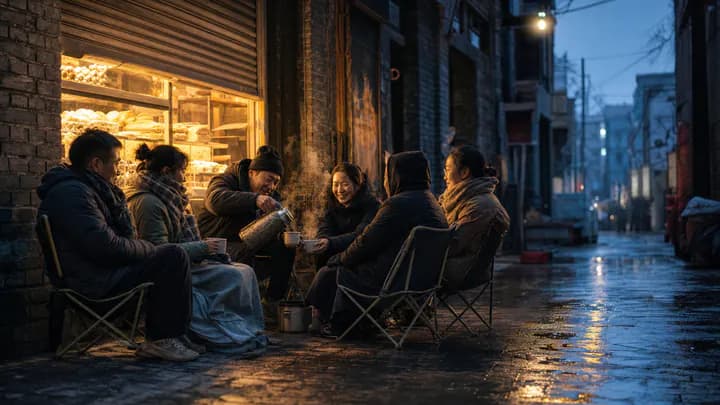
The line starts around half five. By six there are chairs.
We have rules, and nobody wrote them down. You may hold one extra place if the person is parking. Two extra places require biscuits. If someone in front of you falls asleep — and Bartek, who comes straight off nights at the hospital, always falls asleep — you wake them at ten to seven and you do not take their number. The numbers live on a ripped-off piece of cardboard that Hettie brings, and Hettie has been number one so many times that we'd riot on her behalf if anyone challenged it.
That's the society I joined, professionally, on a Friday in October. The order came through the app from a client called D. Marsh. One cardamom-honey cake, weekly, Fridays. Deliver to 14 Pell Road. Ring twice. Leave on the chair beside the door. Do not wait.
Standard enough. What wasn't standard was that it repeated. Week after week after week.
"Maybe he's allergic to mornings," said Bartek, around week nine, chin on his chest, eyes shut. "Maybe he is very rich and very lazy."
"Rich and lazy doesn't last twenty-six weeks," I said. "Rich and lazy tries it twice and then discovers a bakery that delivers."
Hettie leaned back from number one. "It's a woman," she said, with the certainty of a person who has decided something. "There's always a woman."
I want to be clear that I did not snoop. I am not paid to be curious. But you cannot carry a warm box through the same six streets twenty-six times without building a picture, and my picture of 14 Pell Road was this: net curtains, a ramp over the front step, a plastic chair by the door with a folded tea towel on the seat so the box wouldn't sit on the wet.
Somebody had thought about that tea towel. Somebody had gone out in the dark and folded it.
Fourteen Pell Road
The twenty-seventh Friday it rained the way it only rains in February, sideways and personal. The tea towel was soaked through. I stood there with a warm box under my coat, breaking the only instruction I'd been given, and rang twice, and then rang again.
The woman who opened the door had a lanyard and a kind, exhausted face. "Oh," she said. "You're the cake."
"I'm the cake."
Behind her, in a front room the colour of weak tea, an old woman sat in a high-backed chair with a blanket over her knees, watching the window rather than the television. Her hair had been brushed with great care by somebody who loved her.
The carer took the box, and as she turned, the lid lifted a fraction, and the smell got out — honey and cardamom and hot butter, that particular sweetness that gets into the back of your throat.
The old woman's head came round.
"Mama's making cake," she said.
It was perfectly clear. It was the voice of a woman standing in a kitchen sixty years ago with flour on her sleeves. The carer put her hand flat on the doorframe, and I saw her eyes go bright, and she said, "There you are, Rosalind. There you are, love."
I walked home the long way and didn't notice the rain.
My Colin has been gone three years. I stopped baking the week of the funeral, not as a decision, just as a thing that quietly didn't happen again. I hadn't thought about why until I stood on Pell Road and understood that a smell can go where words can't, straight past everything broken and into the room where the person still is.
Twenty-six Fridays. Somebody had worked that out, and then paid a stranger eleven pounds an hour to keep doing it.
The orders stopped in March.
Two Fridays came and went with nothing in the app. On the third, I got up at half five anyway, stood in the cold behind Bartek, bought a cake with my own money, and carried it to Pell Road.
The man who opened the door was maybe fifty, in a jumper with a hole in the elbow, and he had Rosalind's exact eyebrows. He looked at the box for a long moment.
"Tuesday," he said. "Eleven days ago. In her sleep."
"I'm so sorry."
"You're the one who brought them." It wasn't a question. "I never met you. I didn't want to be here when it arrived, isn't that stupid. I couldn't watch her not know me and know the cake." He rubbed his face. "She was sure about three things by the end. Her mother's kitchen. The smell. And Friday. You were the only part of the week she was certain of."
I said the only true thing I had. "It was the best job I've ever had."
He took the box. He said thank you about four times too many, the way people do, and I left him to it.
A month later a new order arrived. Client: D. Marsh.
One cardamom-honey cake. No delivery address. Eat it yourself.
And underneath, in the notes field where clients usually type things like do not lose my place:
I'll be in the line.
He was, too. Twenty to six on a Friday morning, Cawley Street blue-black and shining, and Devlin Marsh standing outside the locksmith's with two camp chairs under his arm because he'd read somewhere that you need one and hadn't been sure I'd have my own.
Hettie gave us nine and ten on the cardboard. Bartek came off his shift and fell asleep on my shoulder within four minutes, which the rules permit. Somebody's thermos went round, and somebody's dog got fussed over by everyone, and Devlin told me about a kitchen in a flat above a chemist's where his grandmother used to grind cardamom by hand, and I told him about Colin, who could not bake but could eat, which is its own vocation.
At seven the bolt went back. The whole street went warm and sweet at once, and there were twelve cakes, and only ever twelve, and not one of us was in any hurry to go in.
Frequently asked questions
Why does Maud insist that a queue is "the last honest institution"?
For her, a line is the one place where arriving first still means something and no amount of money or charm can move you forward. It's a small, portable fairness she can believe in after a life that hasn't always been fair to her.
What does the weekly cake actually accomplish for Rosalind?
It doesn't restore her memory; it restores a moment. The story suggests that smell reaches places speech can't, and that a single sentence spoken on a Friday can be worth twenty-six weeks of somebody's stubbornness.
Is Devlin's final order an act of gratitude or an invitation?
Both, and deliberately unclear even to him. He has spent half a year buying a place in his mother's day; when that ends, the only ritual he has left is the line itself, and he'd rather not stand in it alone.
Why does the story end before anyone eats the cake?
Because the eating was never the point. The story is about the waiting — the chairs, the thermos, the shared cold — and it ends at the exact moment when waiting stops being work and becomes company.