Olive, Canola, Avocado or Butter: Which Fat for Which Job
Most kitchens need only two or three cooking fats. Compare olive, canola, avocado oil, butter and ghee on heat, flavor and cost per tablespoon, then match each to searing, roasting, baking and dressing.
Drafted with AI. This version has not been reviewed by an editor, so it carries no ads — how we work.
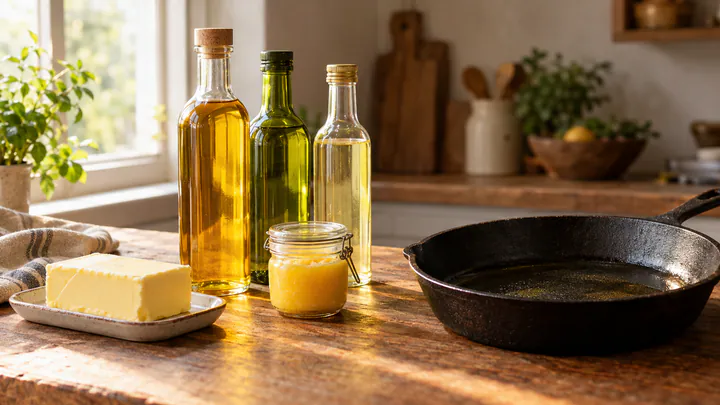
A home kitchen can run on two or three fats: an extra virgin olive oil for everyday sautéing, roasting and dressings, a cheap neutral oil such as canola for very high heat and frying, and butter (or ghee) for flavor and baking. Everything else on a crowded oil shelf is usually a duplicate. This guide compares the common fats on heat tolerance, flavor and cost per tablespoon, assigns each one a job, and shows which bottles you can stop buying. It is about cooking performance, not the health debate over dietary fats; that is a question for your doctor or a registered dietitian.
What smoke point means at the stove
Smoke point is the temperature at which a fat starts to give off a steady stream of visible smoke. Past it, the fat breaks down, tastes acrid and bitter, and fills the kitchen with fumes. It is a useful guide, not a precise line: published figures vary from source to source, and the same oil can differ by brand, batch, how refined it is and how old the bottle is.
Two things matter more than the exact number. First, refining raises smoke point: refined oils have had most of the particles and flavor compounds removed that burn first, which is why light olive oil and refined avocado oil handle more heat than their unrefined cousins. Second, the oil is rarely as hot as the dial suggests. In a 400°F (200°C) oven, oil coating vegetables stays well below the air temperature while the vegetables are still releasing moisture. In a skillet, though, a thin film of oil on an empty pan heats fast, which is where smoke points really bite.
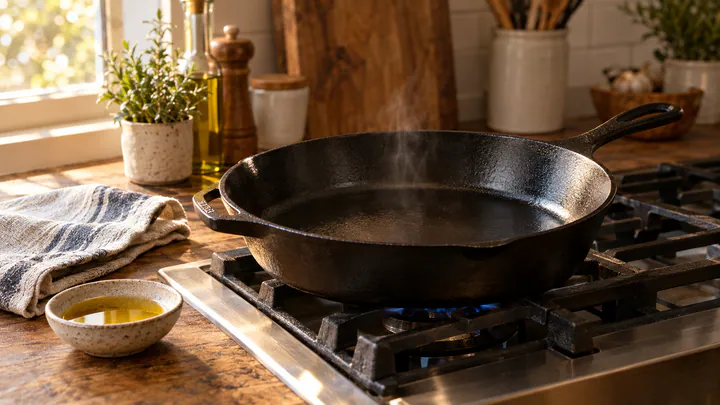
A practical rule: when oil shimmers and flows like water, it is ready for most cooking. When it gives off wisps of smoke, it is ready for a hard sear. When it smokes heavily, it is too hot, so pull the pan off the burner. If oil ever catches fire, turn off the heat and cover the pan with a lid or baking sheet; never pour water on it.
The fats side by side
| Fat | Approx. smoke point | Flavor | Best jobs | Avoid for |
|---|---|---|---|---|
| Butter | About 300°F (150°C) | Rich, sweet, browns to nutty | Baking, finishing, basting, low-heat eggs | Searing on its own |
| Extra virgin olive oil | About 375–410°F (190–210°C) | Fruity, grassy, sometimes peppery | Sautéing, roasting, dressings, drizzling | Deep frying (cost), delicate baking |
| Light (refined) olive oil | Roughly 430–465°F (220–240°C) | Mild, faintly olive | Higher-heat cooking if you avoid seed oils | Dressings (little flavor) |
| Canola, sunflower, vegetable | About 390–445°F (200–230°C) | Neutral | Searing, stir-frying, deep frying, oil-based cakes | Dishes where the fat should taste of something |
| Refined avocado oil | About 480°F (250°C) | Neutral to faintly buttery | Very hot searing, high-heat roasting | Deep frying (cost) |
| Ghee / clarified butter | About 480°F (250°C) | Buttery; ghee is nuttier | Searing, pan-frying, curries, roasting potatoes | Recipes that rely on butter's water and milk solids |
Extra virgin versus light olive oil
Extra virgin olive oil is the most versatile bottle you can own, and it handles more heat than its reputation suggests. With a smoke point around 375–410°F (190–210°C), it is perfectly suited to everyday sautéing over medium to medium-high heat and to roasting vegetables, potatoes and chicken at 400°F (200°C). The flavor softens with heat, so you lose some of the grassy, peppery notes, but nothing goes wrong.
Can you sear with olive oil? For a quick sear on fish, chicken thighs or pork chops, yes, if you heat the pan first, add the oil, and get the food in as soon as the oil shimmers. Where it struggles is a ripping-hot sear on a thick steak or a long stir-fry in a carbon-steel wok, where the pan runs hotter for longer. That is a job for a neutral oil, refined avocado oil or ghee.
"Light" olive oil refers to color and flavor, not calories: it is refined olive oil, often blended, with a milder taste and a higher smoke point. It is worth buying only if you specifically want an olive-based oil for high heat. If you already keep canola or sunflower oil, light olive oil does the same job at a higher price, so it is the first bottle we would drop.
One extra virgin oil is enough for most cooks. If you love finishing dishes with a fragrant, expensive bottle, keep a small one for drizzling and use a mid-priced extra virgin for cooking, but two cooking-grade extra virgin oils on one shelf is clutter.
Neutral oils: canola, sunflower, vegetable
Canola, refined sunflower and the oil sold as "vegetable oil" (in the US usually soybean, sometimes a blend) are interchangeable for most cooking. All are neutral in flavor, inexpensive and comfortable at high heat, with smoke points around 390–445°F (200–230°C) for typical refined versions. Pick whichever is cheapest where you shop and keep only one.
A neutral oil earns its place for four jobs: hard searing, stir-frying, shallow and deep frying (where you need a quart or more, so price matters), and oil-based cakes and muffins where olive oil's flavor would intrude. Deep frying usually runs at 350–375°F, comfortably below these oils' smoke points. Thin coats of neutral oil are also what build the seasoning on cast iron, so the same bottle covers pan care.
The limit: neutral oil adds nothing to a salad, a bowl of beans or a slice of bread. If you only cook at medium heat and never fry, you may not need one at all.
Avocado oil: when the price is worth it
Refined avocado oil, the pale yellow kind, has one of the highest smoke points in the grocery aisle, around 480°F (250°C), and a clean, mild taste. It is the easiest oil to sear with: a steak in a smoking-hot cast iron pan, scallops, or vegetables charred under the broiler.
Whether it is worth paying for depends on how you cook. If you sear hard several times a week and prefer not to use seed oils, refined avocado oil can replace both a neutral oil and light olive oil, so you still own only two bottles. If you sear occasionally, a neutral oil does the job for much less per tablespoon (see the worked example below). It is rarely worth using for deep frying, where you would pour a whole bottle into the pot.
Check the label. Unrefined or cold-pressed avocado oil is green, tastes more like avocado and has a noticeably lower smoke point, closer to extra virgin olive oil. It is good in dressings but does not deliver the high-heat advantage you are paying for.
Butter, ghee and clarified butter
Butter is mostly fat, with the rest largely water and milk solids. Those milk solids are what brown into nutty flavor, and what burn at around 300°F (150°C). That makes butter excellent for baking, scrambled eggs, pan sauces, basting and finishing, and poor for searing on its own.
For high-heat searing with butter flavor, you have two options:
- Cut butter with oil, or add it late. A mix of neutral oil and butter dilutes the milk solids, so they take longer to scorch, but they still burn eventually. The more reliable method is to sear in oil, then add a tablespoon or two of butter in the last minute or two, tilt the pan and spoon it over the food.
- Use ghee or clarified butter. Both have the water and milk solids removed, leaving almost pure butterfat with a smoke point around 480°F (250°C). Clarified butter is gently melted and strained; ghee is cooked longer so the solids brown before straining, giving a nuttier flavor. Either works for searing, pan-frying potatoes and blooming spices.
You can make clarified butter at home: melt a pound of unsalted butter over low heat, skim the foam, and pour the clear golden fat off the milky layer at the bottom. You will end up with noticeably less than you started with, because the water and milk solids are discarded. Don't swap ghee for butter in baking that depends on creaming or steam from butter's water content, such as cookies, pie crust and laminated pastry; the texture changes.
What each fat costs per tablespoon
Shelf prices mislead because bottles come in such different sizes. Convert everything to cost per tablespoon: divide the price by the number of tablespoons in the container. There are 2 tablespoons in a fluid ounce, and about 14.8 milliliters in a US tablespoon, so a 500 ml bottle holds about 33.8 tablespoons (500 ÷ 14.8). A pound of butter is 4 sticks of 8 tablespoons, or 32 tablespoons. Ghee is usually sold by weight; count roughly 2 tablespoons per ounce.
| Fat | Hypothetical price and size | Tablespoons | Cost per tablespoon |
|---|---|---|---|
| Canola oil | $5 for 48 fl oz | 96 (48 × 2) | About $0.05 ($5 ÷ 96) |
| Butter | $5 for 1 lb | 32 (4 × 8) | About $0.16 ($5 ÷ 32) |
| Refined avocado oil | $10 for 500 ml | 33.8 (500 ÷ 14.8) | About $0.30 ($10 ÷ 33.8) |
| Extra virgin olive oil | $12 for 500 ml | 33.8 | About $0.36 ($12 ÷ 33.8) |
| Ghee | $12 for 13 oz | About 26 (13 × 2) | About $0.46 ($12 ÷ 26) |
Run your own numbers with the prices at your store. In this example, a tablespoon of canola costs about $0.05 against about $0.36 for extra virgin olive oil. That gap barely matters when you sauté with one tablespoon, but it adds up quickly when you shallow-fry with half a cup (8 tablespoons): about $0.40 for canola (8 × $0.05) against about $2.88 for olive oil (8 × $0.36).
Keeping oil fresh so you use it up
Light, heat and air make oil go rancid, and a stale bottle ruins the flavor of everything it touches. Store oils in a dark, cool cupboard, not next to the stove or on a sunny windowsill, and keep the cap closed. Buy sizes you will finish within a few months of opening; a giant tin of olive oil is only a bargain if you use it before it fades.
To check a bottle, pour a little into a spoon and smell it. Fresh oil smells clean, fruity or of very little. Rancid oil smells like crayons, putty, old nuts or stale paint, and tastes flat or bitter. There is no rescuing it, so throw it out. Butter keeps best wrapped in the fridge or freezer, and ghee keeps well in a sealed jar in a cool cupboard as long as you use a clean, dry spoon.
A two- or three-bottle starter set by cooking style
Match the set to how you actually cook, and count butter as a fridge staple rather than a bottle.
| Cooking style | Keep | Stop buying |
|---|---|---|
| Weeknight sautéing, roasting, salads | Extra virgin olive oil, butter | Light olive oil, a second cooking-grade extra virgin |
| Frequent searing and stir-frying | Extra virgin olive oil, one neutral oil (or refined avocado oil), butter | Duplicate neutral oils (canola and vegetable and sunflower) |
| Regular frying | Extra virgin olive oil, a large bottle of neutral oil, butter | Avocado oil for frying |
| Keen baker | Butter, neutral oil, extra virgin olive oil for savory cooking | Ghee unless you also sear often |
| Steak and curry cook | Extra virgin olive oil, ghee, butter | A separate high-heat oil if ghee covers it |
If you are clearing a cluttered shelf, start by smelling every open bottle and discarding anything rancid. Then keep one extra virgin olive oil, one high-heat fat, and butter, and let the specialty oils run out without replacing them. Flavor oils such as toasted sesame are an exception worth keeping in small bottles, because they are seasonings, not cooking fats; you use a teaspoon at the end, never a tablespoon in a hot pan.