Whole Chicken or Chicken Parts: Which Costs Less per Meal
A whole chicken has the lowest sticker price per pound, but bones, back and trim change the math. Here is how to work out cost per usable portion, including stock value and your time.
Drafted with AI and published automatically. Our editors set the standards and fix reported errors — how we work.
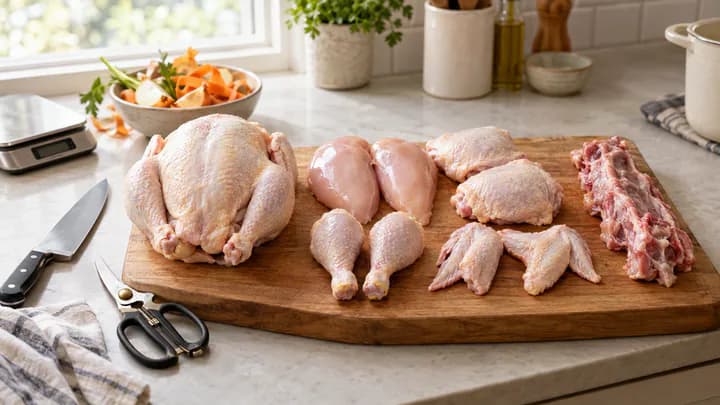
A whole chicken almost always has the lowest price per pound in the meat case, but that price covers the back, neck, bones and fat you will never serve as a main course. The fair comparison is cost per usable portion: what you pay for the pieces you actually cook and eat. Run that math and a whole bird usually still wins for a household that uses the legs, wings and carcass, though by less than the sticker suggests, and a good sale on thighs or a family pack of breasts can beat it outright.
This breakdown is for cooks who buy chicken every week and want to know whether learning to joint a bird is worth the effort. If your household eats only boneless breast and the legs, wings and carcass would end up in the trash, buy the breasts: the savings from a whole bird depend on using every part.
Price per pound versus price per usable portion
Price per pound tells you what the store charges for weight, not what reaches the plate. A whole bird carries weight that is not a serving piece: the backbone, the neck, the wing tips, a lump of fat near the cavity and sometimes a bag of giblets. Bone-in packs carry bone too, but none of the back or neck. Boneless packs are almost all usable, apart from a little trimming.
There are two useful ways to measure, depending on what you are comparing against:
- Cost per pound of usable parts. Divide the bird's price by the combined weight of the breasts, thighs, drumsticks and wings after you cut it up. Use this when you would otherwise buy bone-in packs.
- Cost per pound of edible meat. Divide by the weight of meat once it is off the bone. Use this when you would otherwise buy boneless packs, which are sold as pure meat.
A basic kitchen scale settles both. Weigh the parts from one bird, and the meat from one cooked bird, and you have yield figures for your usual store and bird size that you can reuse every week.
What a typical whole bird yields
A whole chicken breaks down into eight serving pieces: two breasts, two thighs, two drumsticks and two wings. Left over are the back, neck, wing tips and the breast bones if you debone, plus the giblets when the bird includes them. The breasts are the heaviest pieces, the legs come next and the wings are the smallest. You can cut each breast in half crosswise to make ten pieces for a larger table, or take the breast meat off the bone entirely.
A sizable share of any bird's weight is bone, cartilage, skin and fat, and the exact proportion shifts with the size of the bird and how cleanly you cut. Bone-in thighs and drumsticks have the same issue on a smaller scale, so the per-pound price on a bone-in pack overstates what you pay for meat. With boneless packs, the sticker price is close to the true meat price. That is why a boneless pack at a higher price per pound can still be the better deal, and why your own edible-yield figure matters more than any rule of thumb.
Worked example: one bird against equivalent packs
Every price below is hypothetical. Swap in the figures from your own store's shelf tags or weekly flyer; the arithmetic works the same way.
| Part | Hypothetical weight | Hypothetical pack price per pound | Cost if bought as packs |
|---|---|---|---|
| Two bone-in breasts | 1.6 lb | $2.80 | $4.48 |
| Two thighs | 0.9 lb | $2.20 | $1.98 |
| Two drumsticks | 0.65 lb | $1.90 | $1.24 |
| Two wings | 0.45 lb | $3.50 | $1.58 |
| Back, neck, wing tips, trim | 0.9 lb | not sold | none |
| Serving pieces total | 3.6 lb | $9.28 |
The whole bird costs $8.10 (4.5 lb × $1.80). Buying the same serving pieces as packs costs $9.28, so cutting it up yourself saves $1.18 ($9.28 − $8.10).
Now look at cost per pound of usable parts. The bird's $1.80 sticker looks far below every pack, but once the 0.9 pound of back and trim comes out, you are paying $2.25 a pound for serving pieces ($8.10 ÷ 3.6). The packs work out to about $2.58 a pound ($9.28 ÷ 3.6). The gap is real but much narrower than the shelf tags suggest.
Per meal, say those eight pieces feed a family of four across two dinners, or eight servings. The bird comes to about $1.01 a serving ($8.10 ÷ 8) against $1.16 for packs ($9.28 ÷ 8).
If you would otherwise buy boneless breasts
Many households compare against boneless, skinless breasts, not bone-in. Suppose you take the breast meat off the bone and get a hypothetical 1.2 pounds of boneless meat. At a hypothetical $4.50 a pound for boneless breasts, that much would cost $5.40 (1.2 × $4.50). The pack total becomes $10.20 ($5.40 + $1.98 + $1.24 + $1.58), and the bird now saves you $2.10 ($10.20 − $8.10). You also keep the breast bones for the stock pot.
What the carcass is worth as stock
The back, neck, wing tips and breast bones are the raw material for stock, and this is where a whole bird can pull well ahead. Put the bones in a large pot with vegetable scraps you would otherwise throw out: onion ends and skins, carrot peels, celery leaves, a few peppercorns and a bay leaf. Cover with about 3 to 4 quarts of cold water, bring it up slowly and keep it at a bare simmer for 3 to 4 hours, or use a pressure cooker for roughly an hour to an hour and a half. Strain it, and you will typically have 2 to 3 quarts of stock.
Boxed stock usually runs roughly $3 to $5 for a 32-ounce carton, which is one quart. Using a hypothetical $3.50 a carton, two quarts of homemade stock replaces $7.00 of boxed stock (2 × $3.50). Added to the $1.18 cutting savings in the example, that is $8.18 of value from an $8.10 bird.
Two caveats keep this honest. The stock is only worth $7.00 if you would have bought boxed stock anyway; if you rarely make soup, risotto or pan sauces, count it as zero. And simmering for hours uses gas or electricity, a small cost that eats a little into the savings. Homemade stock is unsalted, so season the dish you use it in, not the stock itself.
Cool stock quickly rather than leaving the pot on the stove: divide it into shallow containers so it chills fast, refrigerate it promptly and freeze what you will not use soon. Quart containers suit soups, and ice cube trays give you small portions for sauces. If one carcass feels like too little to bother with, keep a bag in the freezer and add bones from each bird until you have two or three for a bigger batch.
The time cost of breaking down a chicken
Once practiced, jointing a whole bird into eight pieces takes about 10 minutes. Your first few attempts will take longer, perhaps 20 to 30 minutes, and the pieces may look ragged. They cook and taste the same.
You need a sharp chef's knife or boning knife, a pair of poultry shears for the backbone and a cutting board you can wash in hot, soapy water afterward. The basic sequence:
- Remove the legs. Cut through the skin between the leg and body, bend the leg back until the thigh joint pops, then cut through the joint.
- Separate thigh and drumstick. Find the joint by flexing the leg; a thin line of fat on the skin side usually marks it. Cut straight through.
- Take off the wings. Cut through the shoulder joint where the wing meets the breast. Snip off the tips for stock if you like.
- Remove the back. Use the shears to cut along both sides of the backbone and lift it out.
- Split the breast. Cut along the breastbone to make two bone-in breasts, or slide the knife along the bone to lift off boneless meat.
The knife should go through joints and cartilage, not bone. If you hit hard resistance, wiggle the piece to find the joint and cut there.
What your 10 minutes earn
In the bone-in example, $1.18 saved for 10 minutes of work equals $7.08 an hour ($1.18 × 6). Against boneless breasts, $2.10 saved equals $12.60 an hour ($2.10 × 6). At a beginner's 30 minutes, the bone-in savings drop to $2.36 an hour ($1.18 × 2), so treat the first few weeks as practice that pays off later. Stock adds value on top, and most of its time is unattended simmering.
If cutting does not appeal, roasting the bird whole gets you the lower price and the carcass with no knife work beyond carving. What you give up is the flexibility to cook thighs one night and breasts another.
Handling raw chicken safely
Keep raw chicken and its juices away from produce and cooked food, and wash your hands, knife, shears and board with hot, soapy water as soon as you finish. Skip rinsing the bird, which only splashes juices around the sink. However you cut it, cook it to the 165°F that FoodSafety.gov's safe minimum internal temperature chart lists for all poultry, including whole birds and parts. Check the thickest part of each piece with an instant-read thermometer, since small wings finish well before large breasts.
When buying parts wins
A whole bird is a good default, not an automatic winner. Packs of parts come out ahead in several common situations.
A deep sale on thighs
Suppose bone-in thighs go on sale at a hypothetical $0.99 a pound. Against the bird's $2.25 a pound for usable parts, thighs win easily. The edible-meat view tells the same story: if a hypothetical 70% of thigh weight is meat, you pay about $1.41 per pound of meat ($0.99 ÷ 0.7), while a bird with a hypothetical 60% edible yield costs $3.00 per pound of meat ($1.80 ÷ 0.6). Thighs on sale also keep their bones for stock.
Bulk boneless breast packs
A family pack of boneless breasts at a hypothetical $1.99 a pound beats the $3.00 per pound of meat from the bird in the same example, because you pay nothing for bone. You lose the stock bones, so this deal is strongest for households that rarely make stock.
Parts you will not use
If nobody eats wings or dark meat, the bird's lower price disappears once those pieces go uneaten. Count only the pieces you will actually serve when you redo the arithmetic.
No freezer space or no time
A whole bird delivers eight pieces at once. A single cook without room to freeze portions may not finish them before they spoil, and a small pack of exactly what you need is cheaper than food you throw away. The same goes for weeks when even 10 minutes of cutting will not happen.
A quick test for any week's prices
For bone-in packs, compare the pack's price per pound with the bird's price divided by your usable-parts share (3.6 ÷ 4.5, or 80%, in the example: $1.80 ÷ 0.8 = $2.25). For boneless packs, compare the pack price with the bird's price divided by your edible-meat share. Whichever number is lower is the better buy that week, before you count any stock. When whole birds are the winner and your freezer has room, buying two and jointing both in one session spreads the setup and cleanup across twice the meat.