Stargazing From a Bright City Without a Telescope
Streetlights hide the Milky Way, but not the Moon, the bright planets, the Pleiades or the Orion Nebula. Here is what a city sky still shows your eyes and binoculars, and how to plan the nights that show it best.
Drafted with AI. This version has not been reviewed by an editor, so it carries no ads — how we work.
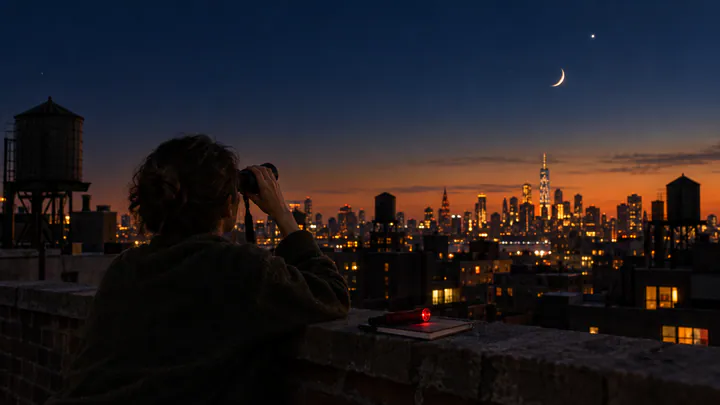
A bright city sky hides the Milky Way and most faint galaxies, but it leaves the Moon, the bright planets, a handful of star clusters, one nebula and the International Space Station in plain view. If you live in a city or suburb, have no telescope and can't easily drive to a dark-sky site, you can still spend a rewarding evening outdoors with your eyes, a pair of ordinary binoculars and a little planning around the Moon and the weather. This guide covers what to look for, where to stand and when to go out.
What city light hides and what it leaves
Light pollution doesn't block starlight; it drowns it. Streetlights, signs and windows scatter light off dust and moisture in the air, turning the sky into a gray or orange glow. Anything fainter than that glow disappears, and anything brighter stays visible.
That sorting works in your favor once you know it. Diffuse, faint objects suffer most: the Milky Way, the Andromeda Galaxy, dim nebulae and most meteors. Compact, bright objects barely notice: the Moon, the planets, the brightest stars and tight star clusters. A city observer simply works from the bright end of the list, and that list is longer than most people expect.
Judging your sky with the Bortle scale
The Bortle scale rates sky darkness from 1 to 9, where 1 is a pristine, remote sky and 9 is an inner-city sky. It was devised by amateur astronomer John Bortle as a practical way to describe what you can actually see from a given spot.
- Classes 8–9 (city centers): the sky glows gray or orange, only the brightest stars and the main shapes of a few constellations show, and you may count no more than a few dozen stars.
- Classes 6–7 (bright suburbs and the edges of cities): the main constellations are complete, the brighter clusters are visible to the eye, and binoculars start to pay off.
- Class 5 (outer suburbs): hints of the Milky Way may appear overhead on the best nights, well away from the horizon glow.
You can estimate your class with a quick test: look at a familiar constellation, such as Orion in winter or the Big Dipper in spring, and see how many of its fainter stars you can pick out after your eyes have adjusted. Online light pollution maps, built from satellite measurements, also show the approximate brightness of the sky over your neighborhood.
Finding the darkest spot near you
The darkest spot within walking distance usually beats the perfect spot an hour away, because you'll actually go. What matters most is not distant city glow but direct light hitting your eyes.
- Get out of direct glare. Stand in the shadow of a building, wall or tree so no streetlight shines straight at you. A backyard corner shaded from a porch light can be better than an open field next to a floodlit parking lot.
- Look up, and away from downtown. The sky directly overhead is usually darkest, because you are looking through the least air. The horizon toward the city center is the worst.
- Try height. A rooftop, a high balcony or a hilltop park gets you above nearby lights and gives a wider view of the horizon.
- Check large parks and waterfronts. Lakes, rivers and big parks create pockets with fewer lights and open sky.
Think about comfort and safety too. Go with a friend if the spot is isolated, tell someone where you'll be, and check whether parks close at dusk. A folding chair or a reclining lawn chair makes looking overhead far easier on your neck.
Giving your eyes time to adapt
Your eyes need roughly 20 to 30 minutes in darkness to adapt fully. The pupils widen within seconds, but most of the gain comes more slowly as the light-sensitive cells in the retina rebuild their sensitivity. Stars you can't see when you first step outside often appear after a quarter of an hour.
One glance at a white phone screen or flashlight resets much of that progress. Use a red light instead: a red-filtered headlamp, a flashlight covered with red cellophane or a phone set to its red night-mode filter with the brightness at its lowest. Red light disturbs night vision far less.
Two more tricks help with faint targets. Averted vision means looking slightly to one side of an object rather than straight at it, which uses the more light-sensitive edge of your retina; a dim cluster can seem to brighten when you do this. And patience: stare at the same patch of sky for a full minute, and more detail tends to appear.
Targets you can see from a bright city
Start with these. All of them show from a bright suburb, and most from a city center.
The Moon
The Moon is the best city target there is, because light pollution does nothing to it. Even with your eyes alone you can trace the dark plains, called maria, and the bright highlands. Binoculars reveal dozens of craters, especially along the terminator, the line between the lit and dark halves. A thin crescent often shows earthshine, a faint glow on the dark part caused by sunlight bouncing off Earth.
Venus, Jupiter, Saturn and Mars
The bright planets look like steady, unusually bright stars, and they tend to twinkle less than true stars do. Which ones are up changes month to month, so check a free planetarium app or an astronomy almanac for your date.
- Venus is the brightest point of light in the sky after the Moon. It never strays far from the Sun, so you'll find it low in the west after sunset or low in the east before sunrise.
- Jupiter is bright and creamy white. Held steady, binoculars show up to four of its largest moons as tiny pinpoints in a line beside it, and their positions change from night to night.
- Saturn is fainter and yellowish. Its rings need a telescope to show clearly; in binoculars the planet may look slightly oval at most.
- Mars has a distinctly orange-red color. Its brightness varies a great deal, and it is at its best for a few months roughly every two years, when Earth passes it.
The Pleiades
The Pleiades, or Seven Sisters, is a compact star cluster in the constellation Taurus, best seen on evenings from late fall through winter in the Northern Hemisphere. To the eye it looks like a tiny, misty dipper shape; from a city you might pick out only a handful of stars. Binoculars turn it into a sparkling group of dozens of blue-white stars, one of the most satisfying sights available from anywhere.
The Orion Nebula
Below the three stars of Orion's belt hangs a short line of fainter stars known as the sword. The middle "star" of the sword is actually the Orion Nebula, a cloud of gas where new stars are forming. From a bright suburb it can look like a slightly fuzzy star to the eye, and binoculars show a small, soft glow around it. Look for it on winter evenings.
Mizar and Alcor
In the bend of the Big Dipper's handle sits Mizar, a bright star with a fainter companion, Alcor, very close beside it. Splitting the pair with your eyes alone is a classic eyesight test, and from a city it can be a challenge. In binoculars the two separate easily. The Big Dipper rides highest on spring evenings, and from much of the United States it stays above the horizon all night.
Adding binoculars you may already own
Binoculars are the best first instrument for a city observer: they show more than your eyes, they are easy to aim, and you may already have a pair in a closet. If you bought a pair for birds, they will work; the features that make a good pair for birdwatching from a local patch, such as sharp optics and comfortable eyecups, matter at night too.
The two numbers on binoculars tell you the magnification and the width of each front lens in millimeters. A 7x50 pair magnifies seven times through 50 mm lenses; a 10x50 pair magnifies ten times. The large 50 mm lenses gather plenty of light, which is why these two sizes are the traditional choice for the night sky.
| Size | Strengths | Drawbacks |
|---|---|---|
| 7x50 | Wide view, easy to find objects, steadier in the hand | Less detail on the Moon and planets |
| 10x50 | More detail; Jupiter's moons and craters easier to see | Shake is more visible; narrower view |
| 8x42 or 10x42 | Lighter, often already owned for birding or travel | Gather somewhat less light than 50 mm lenses |
If you're buying, a decent new 7x50 or 10x50 pair generally costs roughly $50 to $150. Pairs much stronger than 10x are hard to hold steady without a tripod, so skip them for now.
Shake is the main enemy. Every tremor of your hands is magnified along with the sky, so brace the binoculars whenever you can:
- Rest your elbows or the binoculars themselves on a wall, fence rail, balcony railing or car roof.
- Lean your back against a tree or post and tuck your elbows into your chest.
- Lie back in a reclining chair and rest your elbows on the armrests for objects high overhead.
- For longer sessions, a camera tripod with an inexpensive binocular adapter holds them perfectly still.
Planning around the Moon, weather and seasons
The Moon decides what kind of night you'll have. It goes through a full cycle of phases in about 29.5 days, and its light brightens the whole sky, which is a real cost in a city that is already bright.
- Around new moon, when the Moon is absent from the night sky, is the time for faint targets like the Pleiades in binoculars, the Orion Nebula and Mizar and Alcor.
- Around first quarter, about a week after new moon, is the best time to look at the Moon itself. It is half lit and high in the evening sky, and the low angle of sunlight along the terminator throws crater walls and mountains into sharp shadow.
- Around full moon, the Moon looks flat and glaring because sunlight hits it head-on, and it washes out faint objects. Use these nights for the planets and bright stars, which cope well with moonlight.
Weather matters as much as the Moon. A clear sky isn't always a good one: humid, hazy air scatters city light even more, while the crisp, dry air that often follows a passing cold front can make the sky noticeably darker and sharper. Check a cloud-cover forecast before heading out, and favor nights with low humidity.
Seasons change both the targets and the logistics. Winter brings long nights that start early, plus Orion, the Pleiades and many bright stars, but you'll need warm layers, a hat and something to stand on besides cold ground. Summer nights are short, and the sky may not get fully dark until well after 9 p.m. in much of the United States, though the warm evenings are more comfortable for lingering.
Catching the International Space Station
The International Space Station is one of the easiest and most surprising things to see from a city. It looks like a bright, steady point of light gliding across the sky without blinking, often outshining every star, and a good pass lasts a few minutes from one horizon to the other.
You can only see it when the station is lit by the Sun but your location is dark, so passes cluster in the hour or two after sunset and before sunrise. Free pass-prediction services, including NASA's Spot the Station and several satellite-tracking apps, list upcoming passes for your location. Each prediction gives the start time, the direction where the station appears, its highest point above the horizon and where it disappears.
Choose passes that climb high, ideally well over halfway up the sky, since low ones get lost in haze and buildings. Be outside a few minutes early, face the direction listed for the start, and don't be surprised if the station fades out partway across: that is the moment it slips into Earth's shadow.
Starting a simple observing log
A short written record turns scattered evenings into a hobby you can see progress in. It also teaches you how your own sky behaves: which nights are worth going out, which spot works best and which targets you have yet to find. A pocket notebook is enough; a notes app in red-light mode works too.
Record the same five things each time: the date, the time, your location, the sky conditions and what you saw. Under sky conditions, include cloud, haze, the Moon's phase and your own rough Bortle estimate.
Illustrative log entry
- Date: January 14
- Time: 8:40–9:30 p.m.
- Location: Back porch, west corner shaded from the alley light
- Sky conditions: Clear and dry after a front, no Moon, slight orange glow to the east; Orion's belt and sword stars visible, so roughly class 7
- What I saw: Jupiter with three moons in 10x50 binoculars braced on the porch rail, two on one side and one on the other. Pleiades: 5 stars by eye, dozens in binoculars. Orion Nebula a faint smudge with averted vision. Next time: try Mizar and Alcor once the Big Dipper is higher.
Over a few months, entries like this show patterns no app will tell you, such as how much better the sky is after a cold front, or that your rooftop beats the park. Revisiting the same targets is part of the appeal: Jupiter's moons will have moved, the Moon will show different craters along its terminator, and each season brings new constellations around to your patch of city sky.