The Stone Ballast of the Floating Islands
A short story about a grandmother on a Lake Titicaca reed island who tells her restless grandson the fable of Apolinar, the builder who argued with the lake over a boat too light to sink.
Drafted with AI. This version has not been reviewed by an editor, so it carries no ads — how we work.
Story Time is original short fiction. The characters, places and events in this story are invented.
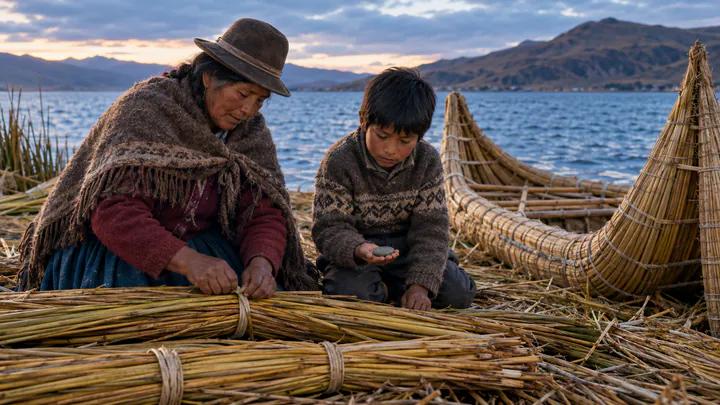
Wilber cut the binding cord too short again, and the bundle of totora sprang open across my knees like a broom dropped off a roof. I made him start over. He is eleven and believes that anything done twice is an insult to his intelligence.
“The motorboats don’t need any of this,” he said, dragging a new length of cord off the coil. “They just go.”
“They go on petrol from Puno,” I said, “which costs money, which comes from the tourists, who come on the motorboats. Hold the end. Tighter. Kneel on it.”
The sun had dropped behind the hills on the Bolivian side, and the cold came up off the water the way it does at this height, all at once and straight into your sleeves. Our island had been sinking at the north corner for a month, the old reeds rotting from underneath faster than we could lay fresh ones on top, so every evening we cut and dried and bundled. Down the walkway my nephew was driving a eucalyptus stake into the root block to keep us from drifting toward the channel. Wilber’s first boat lay on its side by the cooking hut, two fat bundles with nothing yet to join them, and he had not touched it in three days.
He kept one hand on the pocket of his jacket while he worked, the way he had since September. In that pocket was a pebble from the bus terminal in Juliaca, which he picked up the morning his father got on the bus to the mines, and which he thinks nobody saw him take.
“You know why every boat carries a stone,” I said.
“Because Grandpa was superstitious.”
“Because of Apolinar.”
He groaned, but he knelt on the cord.
In the season when the lake rose, I told him, there was a builder named Apolinar, and his boats were the lightest on the water. He cut his totora only at the full moon, when the stalks are hollowest. He dried them a week longer than anyone else, until they rattled like gourds. He bound them with cord he twisted himself, thin as hair and stubborn as a donkey. When his boats went by, the fishermen said it was like watching a heron that had decided flying was beneath it.
“Was he handsome?” Wilber said.
“He thought so.”
That season the lake climbed over the shore fields. The potatoes drowned in the ground, and the oca, and the beans. The islands rose with the water, of course, which is the good thing about living on reeds, but there was no one left on the near shore to trade fish with. Across the lake the fields sat high and dry, and the people there had seed and chuño. Someone had to cross, and it was a long crossing, longer than anyone went in those days, out past where you can see the bottom.
“Apolinar,” everyone said, “your boats are the fastest.”
And Apolinar said, “I will build one so light the lake won’t even feel it on its back. It can’t take what it can’t feel.”
“That’s actually smart,” Wilber said.
“Hush. Your cord is slipping.”
He built it in three days, light enough to carry under one arm. He pushed off in the morning with the water flat as a plate, and he was far out, past the last fishing nets, when the lake lifted one shoulder, like this, and tipped him in.
“The lake doesn’t have shoulders.”
“In this story it does. It is very large and very old and in no hurry about anything. Do you want to hear it or not?”
He wanted to hear it. He would never say so.
Apolinar swam back pushing his boat, because in those days everyone could swim, not like now. He built another, lighter. The lake tipped it. He built a third, so light that when he set it on the island a dog sniffed it and it rolled into the water by itself. Out on the lake, the shoulder came up again, slow and patient, and over he went.
The fourth time, hanging in the water with his teeth knocking, he shouted, “What do you want from me? I’m carrying nothing! I’m taking nothing from you!”
And the lake answered, slowly, because a lake says everything slowly: “That is why. A boat that carries nothing belongs to the wind, and the wind and I have been playing this game since before your grandfather’s grandfather. You are not in your boat, Apolinar. You are only sitting on top of it.”
“That makes no sense,” Wilber said.
“Apolinar said the same. They argued all afternoon. He offered to carry fish, and the lake said the fish were its own already. He offered his good cord, and the lake said it weighed less than a complaint. Then the lake said, ‘There is a river that comes down from the mountains into me. You know the one.’”
Wilber stopped twisting. “Why would he know it?”
I took the bundle from him and pulled the knot over myself, so my hands had something to do.
When Apolinar was a boy, I said, he and his brother Fausto walked to that river to trade dried fish for maize. It was the time of the melt and the ford was loud. Apolinar went across first, quick, jumping stone to stone with nothing in his hands, and when he reached the far bank he turned around laughing and called his brother an old llama for being so slow. Fausto was carrying the sack. He was halfway over when the river took him, sack and all, and Apolinar stood on the bank with nothing in his hands at all.
After that he never went back to the river. He took the long way around it for twenty years. And everything he made, he made light.
Wilber said nothing. His hand had gone to his pocket again.
“So he had to go there,” he said finally.
“Two days walking. He stood at the ford a whole morning. Then he bent down and picked up a stone, grey, about the size of two fists, with a white line through the middle. It was no bigger than a loaf of bread, and it was the heaviest thing he had ever lifted.”
“A stone is a stone. It can’t be heavier than it is.”
“You would know,” I said, and he looked at me sharply, and I looked at the reeds.
Apolinar carried the stone home and wedged it into the bottom of his boat, between the bundles, where the reeds meet. The boat sat low. It was slow. That morning the young men set out too, in copies of his old light boats, and they passed him easily, calling across the water that Apolinar had turned into an old woman, that he would reach the far shore in time for next year’s harvest.
Halfway across, the wind came down off the mountains. The lake lifted its shoulder. The light boats went over one after another, like reeds flicked off a table. Apolinar’s boat rocked once, hard, and then settled, because there was something in it that belonged to him and would not let go.
“Did he leave them?”
“What do you think?”
Wilber thought about it longer than I expected. “He picked them up.”
“Two of them. Wet as fish and twice as heavy. Now the boat was so slow a duck could have overtaken it. He reached the far shore after dark, with two shivering young men and a stone from the river that drowned his brother. The people there gave him seed. On the way back, with the boat full of seed and the stone still in the bottom, the lake did not even bother to look at him.”
“And then everyone carried a stone.”
“Everyone. But not from his river.”
“From where, then?”
I handed him the bundle, properly bound now, and did not answer. My knees had gone stiff from the cold, and my nephew was calling that the stake was in and was there any soup.
Wilber set the finished bundle on the pile. Then, without looking at me, he went over to his boat by the cooking hut and turned it upright. He knelt between the two fat bundles, took the pebble out of his jacket pocket, and held it a moment in his palm. It was small and pale and ordinary, the kind of stone a bus drives over a thousand times a day. He pushed it deep into the reeds, down where the bundles meet, and began to wrap the cord around it.
I went in to heat the soup. Behind me I heard him pull the cord tight, and then, because it had slipped, pull it tight again.