The Cartoonist Who Drew the Wind
When a small-town newspaper cartoonist begins sketching wind in the margins of his strips, the breeze starts answering back. A gentle tale about listening to what no one else can see.
Drafted with AI and published automatically. Our editors set the standards and fix reported errors — how we work.
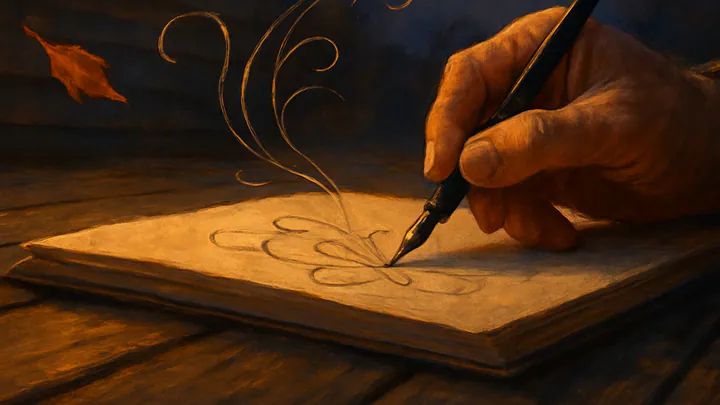
Marcus had been drawing the same duck for twenty-six years, and on a Tuesday in late October, the duck started complaining about the wind.
Not out loud, of course. Marcus wasn't that kind of cartoonist, and the Riverbend Gazette wasn't that kind of paper. But there, in panel three of Wednesday's strip, beneath the duck's webbed feet, Marcus had drawn three little curved lines he hadn't planned. They looked like a breeze lifting the duck's tail feathers, and when he lifted his pen, the lines kept moving on the page.
He blinked. He set down his coffee. He looked again.
The lines were still. Of course they were still. He was sixty-one years old, he hadn't slept properly since his wife Helen had passed in the spring, and ink did not move on Bristol board. He inked the panel, scanned it, emailed it to the paper, and went out to rake the leaves he had been avoiding for three weeks.
The wind met him at the porch.
It wasn't a strong wind. It was the kind of wind that pretends to be nothing — a hand on the back of the neck, a turned page in a book left open on a bench. But Marcus had spent his whole life watching small things, and he noticed that this wind was waiting for him.
"All right," he said, because he had begun talking to small things since Helen had gone. "What."
The wind lifted one yellow leaf off the pile and set it down precisely on the toe of his left boot.
The Margins
By Friday he was drawing wind in every panel.
He didn't mean to. He would start a strip — Mallard the duck arguing with the heron about lake-weed, the usual — and his pen would drift to the edges and put down a curl of air, a gust through the cattails, a little spiral above the water. His editor, Pratim, called on Friday afternoon.
"Marcus. The strip."
"Too much wind?"
"No," Pratim said slowly. "More wind. People are writing in. Mrs. Halloran says she could feel her kitchen window rattling when she read Wednesday's."
"Mrs. Halloran's window always rattles."
"She says it rattled in time."
Marcus looked at the strip on his drafting table. The wind he'd drawn in panel two was moving. Not much. Just a flutter, the way a curtain breathes when the house is asleep. He put his hand flat over the paper. The paper was cool. The ink was dry. The wind kept moving anyway.
"Pratim," he said. "Can I ask you something strange."
"You're a cartoonist. You're allowed one strange thing a year."
"When you look at panel two, what do you see?"
There was a long pause. Then Pratim said, very quietly, "I see my mother's laundry line. From when I was small. I don't know why."
Marcus said thank you and hung up and sat at his drafting table for a long time.
That night he went out into the yard with a sketchbook and a folding stool. The October sky was scraped clean of clouds and the stars were doing what stars do, which is pretend to be still. The wind came around the corner of the house and settled near his shoulder like a cat that had decided to allow him.
"I don't know what you want," Marcus said.
The wind moved his pencil half an inch to the left on the open page.
"Okay," he said. "Okay."
He let his hand go loose. He let the pencil drift. What it drew was not a duck, not a heron, not a cattail. It drew a long sweeping line, then another, then a shape like a coat thrown over the back of a chair. It drew the suggestion of a sleeve. It drew, with great care, the curve of a wrist.
Marcus stopped breathing.
The wind kept going. It drew a collar he knew. It drew the particular slope of a shoulder. It drew, at the place where a face should have been, only more wind — soft spirals, the kind he'd been putting in the margins all week, the kind that meant here, here, I am here, I have been here.
"Helen," he said.
The wind did not say yes. The wind was not a person and had never been a person. But it leaned against him, and it was the precise temperature of the kitchen in February when the radiator clanged and she would come up behind him with her cold hands and put them on the back of his neck and laugh.
He sat in the yard until the pencil rolled out of his hand.
Sunday's Strip
He didn't draw her. That wasn't what she — what it — what the wind was asking for. He understood that now. The wind had been trying for months to be noticed, and he had been the only person in Riverbend stubborn enough to keep watching small things even after the big thing had been taken from him.
Sunday's strip ran in color.
Mallard the duck stood on the edge of the lake. The heron stood beside him. Neither of them said anything. The whole strip, all six panels, was wind: through the reeds, across the water, under the wings of a bird too far away to identify, around the duck's silly orange feet. In the last panel, the wind lifted one small yellow leaf and set it down, very precisely, on the duck's webbed toe.
The Gazette got forty-three letters that week. A man named Don wrote that he had cried at his breakfast table and could not say why. A teacher wrote that her class had spent twenty minutes in silence looking at the funny pages. A boy named Eli, age nine, wrote in pencil: Dear Mr. Marcus. I think the wind is somebody. Thank you for drawing them.
Marcus pinned Eli's letter above the drafting table.
He kept drawing the duck. He kept drawing the heron. He kept drawing, in every strip, somewhere — in the margin, behind a cattail, lifting a single feather — the wind. Some weeks it was strong. Some weeks it was barely there. Some weeks, when he sat at the table and picked up his pen and felt nothing at all in the room, he drew it anyway, because he had learned that what you notice keeps coming back, and what you don't notice goes looking for somebody else.
On the porch in the evenings he sat with his coffee getting cold, and the wind would come around the corner of the house, and he would say, out loud, into the perfectly ordinary October air, "I see you. I see you. I see you."
And the leaves would lift, and settle, and lift again.