The Bus Driver Who Kept the Last Stop
On the night route through the valley, Ines drives a bus that always has one more passenger than her manifest. Tonight, she finds out who has been waiting.

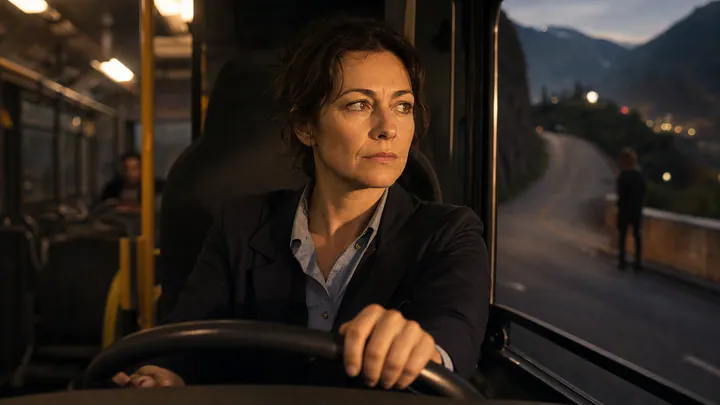
The 11:40 valley bus always left with seventeen passengers and arrived with eighteen. Ines had been driving Route 9 for six years, and she had stopped trying to explain the arithmetic to anyone who wasn't willing to ride it.
She checked her mirrors before easing out of the depot. Rain speckled the windshield in that undecided way it had in early autumn — not committing to a storm, not letting the road dry. The bus smelled of diesel and the peppermints she kept in the coin tray for children who cried at tunnels.
"Evening, Ines." Marta, the dispatcher, leaned in through the folding door with a clipboard. "Full manifest tonight. Sixteen booked. One walk-up at the trailhead, maybe."
"Seventeen, then," Ines said.
"Seventeen," Marta agreed, and tapped the door twice for luck.
Ines pulled onto the road that snaked up the ridge like a shoelace someone had dropped. The first stop was the hospital, where a young nurse boarded still smelling of hand soap and exhaustion. Then the paper mill, where two men in reflective vests sat across the aisle and immediately fell asleep on each other's shoulders like brothers, though Ines knew they weren't. Then the university, where a girl with a cello case took up two seats and apologized to everyone who passed her.
By the switchback at Copper Bend, Ines had sixteen passengers. She counted them in the long mirror above the windshield, the one angled so she could see every row.
Sixteen.
She pulled into the trailhead lot, where a hiker with a headlamp still glowing on his forehead climbed aboard, apologetic about the mud on his boots. Seventeen.
Ines closed the door and glanced up at the mirror.
Eighteen.
The Passenger in Row Nine
He was always in row nine, on the aisle. Tonight he wore a gray coat with the collar turned up and a hat that might have been fashionable forty years ago. His hands rested on his knees. He did not read. He did not sleep. He looked, politely, out the window at the dark he could not possibly be seeing anything through.
The first time Ines had noticed him, three years ago, she had panicked and pulled over at a service stop. She'd walked the aisle counting heads, and when she reached row nine, the seat was empty. But in the mirror, from the driver's seat, he was there. He had nodded at her once, kindly, as if to say please, don't make a fuss.
She hadn't made a fuss since.
She had, however, made him tea. Not literally — she couldn't leave the wheel, and she suspected he wouldn't drink it anyway — but she had begun to think of him as a passenger she was responsible for. She kept the heat a little higher in the cold months. She took the switchbacks gently. She played the soft channel on the radio, the one with old ballads and long instrumental stretches, because he seemed like a man who would have preferred that to talk shows.
Tonight, something was different.
Tonight, he was looking at her.
Ines caught his eye in the mirror and nearly missed the turn onto the ridge road. He didn't stare. His look was gentle, almost apologetic. But it was direct. And when she glanced up again ten minutes later, he was still watching her, patient as a lamppost.
She cleared her throat. "Everyone comfortable back there?" she asked, which was not something she usually said. A few passengers murmured yes. The cellist girl said "mm-hm" without looking up from her phone.
In the mirror, the man in the gray coat inclined his head. Thank you for asking.
The Stop That Isn't on the Map
Route 9 has fourteen stops. Ines could recite them backwards while brushing her teeth. But between stop eleven (the old dairy) and stop twelve (the crossroads chapel), there is a stretch of road where, if you are paying attention, you will see a bench.
It sits under a linden tree. There is no shelter, no schedule posted, no lamp. Ines had asked, once, about the bench, and the depot manager had said, "Oh, that. Someone put it there decades ago. We were going to take it out, but no one ever got around to it."
She had never stopped at the bench. It was not a stop. But tonight, as she came around the last curve before the dairy, she found her foot lifting from the accelerator.
The man in the gray coat was standing.
He had never stood before. In three years, he had never so much as shifted in his seat.
He walked down the aisle toward the front of the bus, and no one turned to look at him, because no one could see him. He stopped just behind the yellow line and waited, hands folded, the way a courteous passenger waits to disembark.
Ines slowed. She slowed until the bus was crawling, until the two men from the paper mill stirred and one of them mumbled "we there?" and the cellist looked up in mild alarm.
"Sorry," Ines said, her voice thicker than she expected. "Deer."
She pulled over at the bench.
She opened the door.
The man in the gray coat looked at her in the mirror one last time, and this time he smiled. It was the smile of a person who has been waiting a very long time for a small kindness, and has received it, and is not going to make a speech about it.
He stepped off the bus.
Ines watched him in the side mirror as he walked, unhurried, to the bench under the linden tree. A woman was already sitting there. She wore a coat the color of river stones, and when she saw him, she stood, and she put her hand to her mouth, and then she put her hand on his cheek.
They sat down together. They did not speak, or if they did, it was not the kind of speech Ines could hear.
She closed the door and pulled back onto the road.
In the mirror, the seat in row nine was empty. She counted heads. Seventeen.
At the depot, Marta was waiting with her clipboard and her thermos.
"How was the run?"
"Uneventful," Ines said. She stepped down from the bus and stood for a moment in the rain, which had finally committed. "Marta. That bench, out past the dairy. Do you know who put it there?"
Marta squinted. "An old driver, I think. Before my time. His wife used to ride his route on Fridays to keep him company on the last run. She passed, and he kept driving, and one day he stopped the bus at that spot and put a bench there. Said she liked lindens." Marta shrugged. "Then he retired. Then he died, I guess. It was a long time ago."
"A long time ago," Ines repeated.
She thought about the man in row nine, and the woman in the river-stone coat, and how some appointments take decades to keep, and how a bus is only a bus until it isn't.
"Same time tomorrow?" Marta asked.
Ines nodded. "Same time tomorrow."
She walked to her car through the soft, committed rain, and for the first time in three years, she did not count to eighteen.
Frequently asked questions
Why do you think Ines never told anyone about the eighteenth passenger?
Some knowledge feels like a trust rather than a discovery. Ines seems to understand that naming the passenger publicly would break whatever quiet arrangement allowed him to keep riding, and she chooses stewardship over explanation.
What role does routine play in the story?
Route 9 is a scaffolding of small, repeated acts — mirrors, headcounts, peppermints, soft radio. The story suggests that ordinary routines are what make room for extraordinary tenderness; grace tends to arrive on schedule when someone is paying attention.
The bench appears well before Ines stops there. How does the story use setting as foreshadowing?
The linden bench sits in the narrative the way it sits on the road — noticed, unexplained, waiting. Its early mention teaches the reader to trust that landscape can hold meaning without insisting on it, which mirrors how the passenger himself is present without demanding attention.
What is the emotional weight of the final line, and why not end on the reunion?
Ending on Ines walking to her car returns the story to the living. The reunion belongs to the passengers; the final line belongs to the driver who released the count. It honors both the mystery and the small human cost of carrying it.