The Diver Who Counted the Harbor's Coins
For thirty years, Iona dove for the wishes people threw into Port Aran's harbor. Then one autumn morning, a coin came up warm.

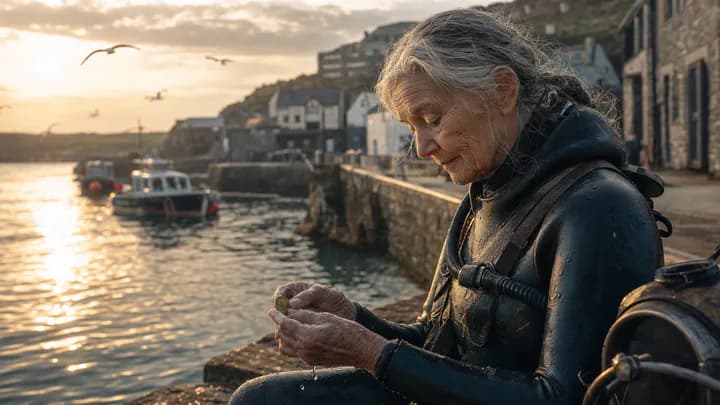
Iona had been diving for coins in Port Aran's harbor for thirty years, and she could tell, by weight alone, the difference between a wish for love and a wish for money. Love coins were lighter — people threw them from the wrist, not the shoulder — and they landed closer to the ferry pilings, as if drawn to the warmth of engines.
She kept a ledger. Not the city's ledger, which recorded her salvage weights and the modest stipend the harbormaster paid her, but her own: a waterlogged notebook wrapped in oilcloth, its pages ruled in her tidy blue script. April 3rd. Seventeen coins. Two foreign. One with a hole drilled through, threaded with a red string. Wish uncertain.
She was sixty-one that autumn, and the mornings had begun to feel colder than the water. She dove in a black neoprene suit patched at both elbows, and the harbor knew her the way a house knows its longtime tenant. The mussels made room. The gulls called down her name in their crooked, gull-shaped way.
The morning the warm coin came up, there had been fog on the water — the kind that made the ferry blow its horn every ninety seconds, mournful as a cow separated from its calf. Iona surfaced near the north buoy and emptied her mesh bag onto the dock. Thirty-two coins clattered out. She sorted them by touch: cold, cold, cold, cold — warm.
She stopped.
The coin was the size of a thumbnail, copper-colored, and unmistakably warm, as though it had just left a palm. She turned it over. No date. No country. Only a small stamped shape she couldn't identify — perhaps a bird, perhaps a hand.
She pressed it against her cheek. Warm. Not sun-warm. Not engine-warm. Warm like a person had wished on it a moment ago and dropped it directly into her waiting bag.
The Ledger
That evening, in the room above the tackle shop where she had lived alone since her husband died, Iona opened the oilcloth notebook. She wrote:
October 14th. Thirty-two coins. One warm. Origin unknown. Wish — indeterminate.
She held the coin under her reading lamp. Still warm. She set it on the windowsill and made tea. When she returned, it was still warm. She put it in a jar of harbor water. Warm. She wrapped it in a linen cloth and put it in the freezer between a bag of peas and a fillet of mackerel she had been meaning to eat.
In the morning, the coin was warm.
She took it to Mr. Devlin at the numismatist's shop on Quay Street, a man so old he seemed to have been carved from the same driftwood as his counter. He examined the coin through a jeweler's loupe, then through a magnifying glass, then through his bare eyes, which were the pale blue of a shallow bay.
"Where did you find this?" he asked.
"North buoy. Six meters down."
"It isn't a coin," he said.
"It looks like a coin."
"It looks like a coin," Mr. Devlin agreed. "But coins have countries. This has no country. Coins have dates. This has no date." He set it down between them. "This is a token. A person made this. One person, for one purpose."
"What purpose?"
He tapped the small stamped shape. "A hand, I think. Or a wing. Whoever made it," he said, "made it warm on purpose."
The Bench at the End of the Pier
Iona thought about the token for a week. She did not dive. She sat at her window and watched the ferry come and go, and she read back through her ledger, thirty years of small blue entries. Coins clustered near ferry. Coins clustered near lighthouse steps. Coins clustered near the bench at the end of the pier.
The bench at the end of the pier. She had noted it many times. Coins there were often bright, often recent, often thrown with force — the way a person throws something they want gone. She had assumed, over the years, that people sat on that bench to make hard wishes: to forget, to release, to let go.
She went to the bench on a clear afternoon. The fog had lifted. A woman was sitting there — perhaps forty, wearing a coat too thin for October, her hair pulled back with a rubber band. She was turning something between her fingers.
Iona sat at the far end of the bench and did not speak. The gulls did their gull-shaped calling. The ferry blew a courtesy note as it slid past.
After a while, the woman said, without looking up: "My mother used to bring me here. She said the harbor took wishes and remembered them."
"It does," Iona said. "A diver keeps a ledger."
The woman looked at her then. "You're joking."
"I'm the diver."
The woman opened her hand. In her palm was a copper token, the size of a thumbnail, warm even in the cool air, stamped with the small shape of a hand — or a wing.
"My mother made these," the woman said. "She was a metalworker. She made them warm somehow — she wouldn't tell me how. She said a cold wish sinks and stays sunk. A warm wish" — she smiled faintly — "a warm wish gets found."
Iona took her own token from her pocket and set it on the bench between them.
The woman didn't seem surprised. She only nodded, the way people nod when a long arithmetic finishes correctly.
"She died in the spring," the woman said. "I've been throwing them in one by one. I didn't know if anyone was on the other end."
"I am," Iona said. "I have been for thirty years."
They sat together while the ferry made its slow turn in the outer harbor. Iona thought of her ledger — its thousands of entries, its careful accounting of what the sea had returned. She had thought, all these years, that she was cataloguing what people had let go of. She saw now that she had been cataloguing what people had trusted her to find.
"How many do you have left?" she asked.
The woman opened her coat pocket. Six tokens, warm as small hearts.
"Would you like to throw them?" Iona said. "I'll be under the water tomorrow. North buoy. Six meters."
The woman laughed once, softly, and it was not a sad laugh.
"Yes," she said. "I think I would."
They walked to the end of the pier together, and one by one the woman dropped the tokens into the harbor, and one by one the harbor took them, and the water closed over each small warmth the way a hand closes over something it means to keep safe until morning.
Frequently asked questions
Why does the story emphasize the difference between warm and cold coins?
The warmth becomes a metaphor for intention. Cold coins are wishes thrown away; warm ones are wishes entrusted. The distinction reframes Iona's work from salvage to stewardship.
What role does Iona's ledger play in the narrative?
The ledger represents a life of quiet, patient witnessing. It suggests that even unnoticed labor accumulates meaning, and that record-keeping can be its own form of care.
How does the encounter on the bench change Iona's understanding of her thirty years?
She realizes she has not been a passive collector but the intended recipient of countless private hopes. The story reframes solitude as connection she simply hadn't recognized.
What does the mother's craft — making warm tokens — suggest about grief and inheritance?
It suggests grief can be engineered into an object that continues to seek out the living. The daughter completes her mother's design by trusting a stranger to find what her mother sent.