The Bee Inspector of Petal Row
When a district inspector arrives to condemn an old orchard's hives, she finds one colony behaving in a way no textbook can explain. What she does next surprises even her.
Drafted with AI and published automatically. Our editors set the standards and fix reported errors — how we work.
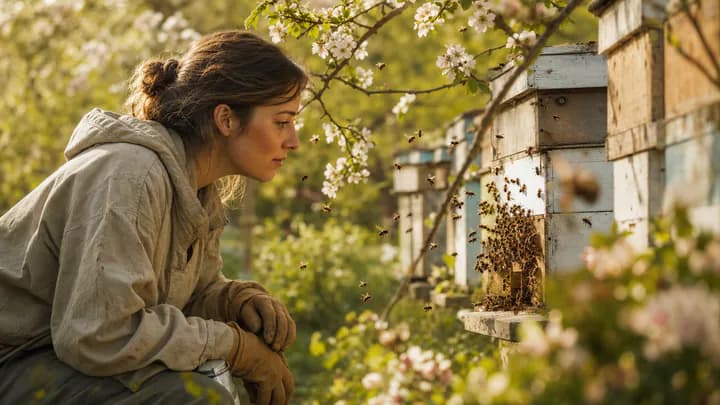
The last hive at Petal Row was humming a note June had never heard before. It was low, almost tuneful, the kind of sound a person feels in the sternum before the ear catches up.
June Alder set her clipboard on the grass. She had been a district apiary inspector for eleven years, long enough to know the difference between a queenless roar, a swarm's rising fever, and the calm domestic drone of a colony packing away goldenrod. This was none of those. This was closer to the sound her grandmother used to make, standing at the sink, humming without knowing she was humming.
“They’ve been doing that since Tuesday,” said the man behind her. His name was Wendell Cope, and he owned the orchard, which was less an orchard now than a memory of one. Petal Row had thirty acres of apple trees when June was a girl. It had eight now, and half of those were leaning.
“Since Tuesday,” June repeated.
“Since my wife.”
She turned. Wendell was a tall, folded-looking man in a shirt that had once been blue. He did not elaborate, and she did not ask him to. She had come to condemn his hives. Three of the four boxes showed clear signs of a mite collapse she had been tracking through the county all summer — sunken brood, the sweet-rotten smell, bees crawling in the grass with translucent wings. The paperwork was already half filled out in the truck.
The fourth hive, though. The fourth hive was singing.
I.
“Mr. Cope,” June said carefully, “when did you last open this one?”
“I haven’t. Not this year. Ellen kept this one. She said it was hers.” He looked away, at the tree line. “I keep meaning to.”
June knelt. The hive was old cedar, silvered by weather, the lid held down by a smooth river stone. Someone — Ellen, presumably — had painted a small pale moon on the side, so faded now it looked like a watermark. Bees moved in and out of the entrance in an orderly stream, their legs heavy with pollen the color of butter.
She lit her smoker out of habit, then thought better of it and set it aside. She lifted the stone. She lifted the lid.
The humming didn’t change. That was the first strange thing. Colonies always adjusted their pitch when opened — a rise of alarm, a shifting of the collective throat. This one kept its note.
The second strange thing was the comb. It was drawn perfectly, wall to wall, capped in a pale gold wax so clean it looked poured. In eleven years June had never seen a hive this healthy in a yard this sick. Not once. Mites should have found it. The collapse should have crossed the six feet of grass between boxes and settled here like weather.
She pulled a frame. The bees walked over her gloved hands without concern, as if she were a branch that had always been there. In the center of the frame, worked into the wax in a pattern too regular to be accident, was a spiral. Not a flaw. Not a sag. A spiral, drawn in cells, tightening toward a center that held a single capped queen cell.
“Huh,” June said, which was the strongest word she permitted herself on the job.
“Is it bad?” Wendell asked.
“No,” she said. “No, it’s — it’s the opposite of bad.”
She stood there a long time with the frame in her hands. The bees kept humming their low sternum-note. A few landed on the paper edge of the queen cell and stroked it with their forelegs the way a person might smooth a bedspread over a sleeping child.
II.
June had a rule about her job, and the rule was this: bees do what bees do, and beekeepers are the ones who invent meanings. She had watched people read messages in swarm shapes, hear names in the drone of a summer yard, decide a hive that survived a winter had chosen them. She had learned, gently, to say nothing. Grief made cathedrals out of insects. It was not her business to remodel them.
But she had also learned, over eleven years, that healthy colonies do not appear inside sick yards without a reason. Something had kept this hive whole. Some quality of the wood, some tilt of the ground, some accident of genetics in Ellen’s original queen. The spiral in the comb was a coincidence — bees drew what the frame allowed. The queen cell was seasonal — a colony this strong would supersede, would replace its aging mother without drama.
These were the true things. June believed them.
She also believed, standing in the long grass of Petal Row with a frame of humming gold in her hands, that a woman named Ellen had loved this box and this box had noticed.
“Mr. Cope,” she said. “I’m going to condemn the other three. I have to. But I’d like your permission to split this one.”
“Split it?”
“Take half the frames, half the bees, put them in a new box. You’d have two hives from this one by fall. It’s a strong colony. It wants to become more than itself.”
Wendell looked at her for a while. He had the face of a man who had recently discovered that his own house was larger than he could cross.
“She’d have liked that,” he said. “She was always saying the orchard needed more. More trees, more bees, more — ” He stopped. “More.”
“Then let’s give it more.”
They worked into the afternoon. June brought a spare nucleus box from the truck — she carried one for emergencies, though she had never used one this way, not on a job that was supposed to be an ending. She showed Wendell how to lift a frame without crushing the bees at the edges. She showed him how to find the queen — a longer, calmer body among the shorter ones — and how to leave her where she was, and how to be sure the new box had eggs young enough to raise a new queen from.
His hands shook at first. Then they didn’t.
When they were finished, the two hives sat side by side in the grass, one old cedar with its faded moon, one clean pine that smelled like a lumberyard. The humming had not stopped. If anything, it had spread — a second sternum-note starting up in the new box, tentative, finding its pitch.
June closed her clipboard without filling out the rest of the form.
“I’ll be back in three weeks,” she said. “To check the new queen.”
“And the others?” He nodded at the three condemned boxes.
“Burn them. I’m sorry. It’s the only way to keep the mites from your new ones.”
“All right.”
She walked back to her truck through the sagging orchard. The apples that remained on the trees were small and freckled and honest. At the gate she turned around, because something made her turn around, and she saw Wendell Cope standing between his two hives with his hand resting on the old cedar one, not opening it, not disturbing it, just resting his hand there the way a person rests a hand on a shoulder.
June got into her truck. She sat for a moment with the keys in her lap. Then she wrote, in the margin of the form where no one would ever read it: One colony singing. Split successful. Recommend follow-up indefinitely.
She started the engine, and drove home through a countryside that, for the length of the drive at least, seemed to be humming too.