The Glassblower Who Worked Past Midnight
When a grieving glassblower receives a commission she cannot refuse, she discovers that some shapes refuse to cool the way she intends.
Drafted with AI and published automatically. Our editors set the standards and fix reported errors — how we work.
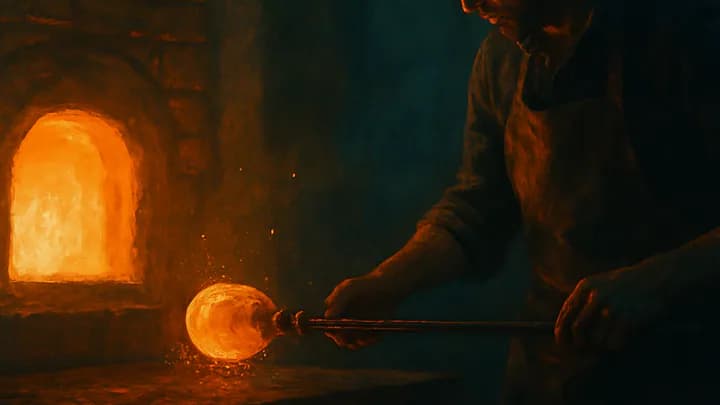
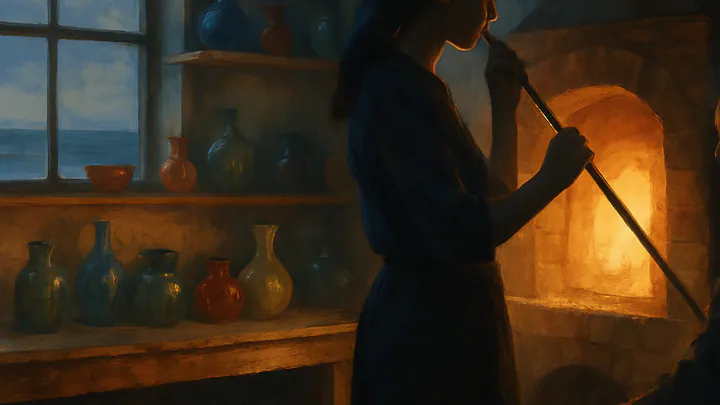
The bell over Marin's studio door had not rung in eleven days, which was why she almost didn't answer it on the twelfth. She was hunched over the bench at half past eleven at night, shaping a vase she didn't have a buyer for, when the small brass tongue jangled and a draft of cold autumn pushed into the heat.
"We're closed," she said, without looking up.
"I know," said a voice. "I waited until you were."
Marin set down the jacks. The man in her doorway was about sixty, wearing a coat that had been good once and was now only careful. He held his hat in both hands like he was afraid of dropping it. Behind him, the street was empty in that complete way streets get after the last bus.
"I'd like to commission something," he said.
"Come back Tuesday."
"It has to be tonight."
She almost laughed. Tonight she had been planning to ruin three more pieces and go upstairs and not sleep. Tonight she had been planning, in a quiet unspecific way, to decide whether to keep the studio open at all. Her brother Theo had been the one who loved the late shifts, the orange light, the dangerous beautiful patience of the work. He had been gone since spring.
"What is it you want made," she said.
The man stepped inside. He smelled faintly of rain and pipe tobacco. From his coat pocket he produced a small cloth bundle and laid it on her bench with the tenderness of someone returning a borrowed child. He unfolded the cloth. Inside were shards of pale blue glass — six, seven pieces, the largest no bigger than a thumbnail.
"It was a bird," he said. "My wife made it. She wasn't a glassblower, she just took a class once, on our anniversary. It sat on our windowsill for thirty-one years." He cleared his throat. "I broke it last Tuesday. Reaching for the curtain."
Marin touched one of the shards with the pad of her finger. The blue was the blue of a sky you only see in October, thin and high.
"I can't put this back together," she said gently. "Glass doesn't —"
"I don't want it put back. I want you to make a new one. From these."
"Sir, there isn't enough here for —"
"Please." He didn't raise his voice. He didn't have to. "She passed in August. The bird was the last thing of hers I hadn't broken yet, and now I've broken that too. I read about you. I read that your brother could make anything."
The name struck her like a hand on a hot pipe. She kept her face still. "My brother isn't here."
"I know," the man said. "I'm sorry. I'm asking you."
She told him to come back at seven in the morning. She told him she wasn't promising anything. She told him the price, which he paid in cash without flinching, and then he left, and the bell rang again on his way out, and Marin stood alone with seven shards of someone else's marriage on her bench.
She didn't know why she said yes. Maybe because Theo would have said yes. Maybe because the man had said please in the voice of a person who had been practicing saying it all the way over.
She fed the furnace. She mixed cullet from her own scrap bin, the clear stuff, and weighed out a small charge of cobalt to chase the blue. She crushed two of the smaller shards with the back of a spoon, because they were too thin to do anything else with, and stirred the dust into the melt. The rest she set aside.
By one in the morning the gather on her pipe glowed the color of a low sun. She rolled it on the marver. She blew, and the bubble swelled, and she pinched a neck, drew a tail, shaped a small high breast with the wooden block. A bird. A simple bird, the kind a beginner might make on an anniversary, holding her husband's hand on the bench behind her for balance.
She worked without thinking, which was the only honest way to work. And as the bird took shape, Marin noticed something she could not at first explain.
The glass was warmer than it should have been.
Not the furnace heat — she knew that heat the way a swimmer knows water. This was something underneath the heat. A second temperature. As if the gather were remembering being held.
She nearly dropped the pipe.
"Theo," she said aloud, to no one, "if you're doing this, stop."
Nothing answered. The bird kept its shape. She finished the tail, knocked it off into the annealer, and sat down on the concrete floor and cried for the first time since the funeral, properly, the way you cry when there is no one to perform it for.
In the morning the bird was cool and blue and small enough to fit in a coat pocket. The man came at seven exactly. He had shaved. He picked up the bird with both hands and held it up to the window light, and his face did something Marin had to look away from.
"It's not hers," she said, because she had to say it. "I want you to know that. It's a new bird. It only has a little of her in it."
"I know," he said. He was smiling, which surprised her. "That's all right. A little is the right amount. Too much and I'd never put it down."
He paid her the rest. He thanked her in a voice that did not shake. At the door he turned.
"Does it happen often?" he asked. "The warmth?"
She stared at him.
"My wife felt it," he said, "the night she made hers. She told me the glass felt like it already knew what it wanted to be. I wondered if it was just her. I'm glad it wasn't."
He tipped his hat and stepped out into a morning that was beginning to smell like wet leaves and bread from the bakery two doors down. The bell rang behind him.
Marin stood in the doorway a long time. Then she went back inside, fed the furnace, and opened the appointment book to a fresh page. She wrote, in Theo's old habit of underlining the date twice: Open again. Late hours by request.
Upstairs, the kettle was where she had left it. The studio behind her ticked and breathed and held its heat the way it had always held it, patient as anything that has learned to wait for the next pair of hands.