The Tamada Has Lost His Voice
A short story about a famous Georgian toastmaster who loses his voice on the day of his niece's wedding feast and must run eighty guests, two feuding uncles and a nine-year-old interpreter with a chalkboard.
Drafted with AI and published automatically. Our editors set the standards and fix reported errors — how we work.
Story Time is original short fiction. The characters, places and events in this story are invented.
The first toast was supposed to be to peace, and Zurab had been rehearsing it since June, so when he rose with the horn in his hand and eighty faces turned toward him and what came out of his throat was the sound of a tram door with a bad hinge, he sat down again faster than a man of sixty-one ought to.
"He's sick," said someone at the bride's end.
"He's drunk already," said someone at the groom's end, which was unfair. He had drunk nothing since noon except honey water and a raw egg that Manana had cracked into a glass on the advice of her sister.
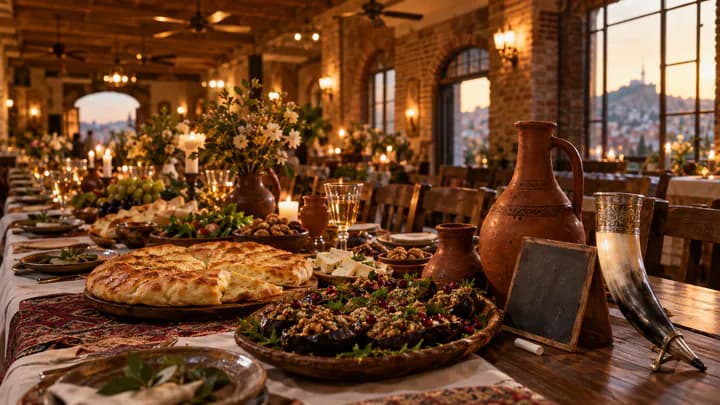
He tried once more. Mshvidobas came out as steam from a kettle. Beside him Manana closed her eyes, which was what she did instead of saying I told you not to shout at the football. The ceiling fans turned. Through the floorboards came the smell of the bakery below, the long boat-shaped shoti loaves going into the clay oven for the evening trade, and the hall above, which Gogi the baker rented out for weddings and christenings, was already as hot as the oven itself.
For thirty-four years Zurab had dispatched trams from the depot on Vazha-Pshavela, and he knew what happened to a line with nobody at the switch. Cars bunched. Drivers improvised. Someone ended up in Didube who had wanted Vake.
He mimed writing in the air. Manana understood immediately and sent cousin Paata, the merikipe, who was supposed to be pouring wine, downstairs. Paata came back with Gogi's chalkboard, the one from the bakery window. It still said SHOTI 80 TETRI, MADAURI 1 LARI. Zurab rubbed it clean with a napkin and wrote, in the square capitals of a man who had filled in departure logs for three decades: PEACE.
He held it up. Eighty people squinted. The board was the size of a tray.
"I can read it," said a voice at his elbow.
It was Dato, his niece's nephew, which made him some sort of grand-nephew, nine years old, in a waistcoat his mother had bought two sizes large so it would last until his own wedding. His mother Ketevan waved from the third table, a gesture that meant take him, he's yours, I have wine to drink.
"I'm the best reader in my class," Dato said. "Except for Salome, but she cheats."
Zurab handed him the board. The boy climbed on a chair, and the hall went quiet in the way a hall goes quiet for a child, indulgently, waiting for something to go wrong.
"Peace!" Dato announced. Then, because eighty people were still looking at him: "Uncle Zurab says peace, and also the khachapuri is getting cold, so drink fast."
The hall laughed and drank. Zurab had not said that. But the khachapuri was getting cold, so he let it pass.
They got through the toast to the occasion and the toast to the young couple in reasonable order. Zurab wrote; Dato read; Dato added things. For the couple, Zurab wrote LOVE, LONG LIFE, CHILDREN, and Dato read it out and added, "But not too many, because Nino says Levan already snores like three people." Nino put her face in her veil. Levan raised his glass and said, "Two people," and the groom's side cheered him as though he had scored.
It was during the toast to the parents that Zurab saw Gela.
Gela sat at the far end of the groom's table, broad as a wardrobe, with his jacket off and his sleeves rolled to show he meant business. At the opposite end of the same table, as far away as the seating plan allowed, sat his brother Tengiz, narrower, with a moustache he had grown in 1987 and defended ever since. They were the groom's uncles on his mother's side, and they had not exchanged a word in eleven years, not since their father died and left them a single metal garage in a courtyard in Saburtalo. Tengiz kept tomato crates in it. Gela wanted to keep a car in it, although he did not own one. Each had put his own padlock on the door, so that neither could open it without the other, and so neither did.
Gela caught Zurab's eye and tapped his own chest twice. Then he pointed at the chalkboard and raised one finger, then made a small circle in the air with it, like stirring tea. The meaning was plain to any Georgian: the ancestors' toast, when you pass it on, comes to me.
Zurab looked the other way. Tengiz was already looking at him. Tengiz tapped his own chest twice.
The ancestors' toast was the eighth. It was the one where the hall stood, where nobody clinked, where the tamada spoke of the dead and then passed the alaverdi to the eldest man of the family to continue. Gela was the elder by eight minutes. Tengiz had been registered first, in a village where the clerk was a cousin and the paperwork had a sense of humour, and he had never once let it go.
Without a voice, Zurab could not do what he would normally do, which was to talk for so long and so beautifully about grandfathers and vineyards that by the end nobody remembered who was supposed to speak next. He had seen this coming since the spring and had planned a speech of nine minutes. Now he had a chalkboard and a child.
He wrote, smaller: TOAST 8. GELA, THEN TENGIZ. ALAVERDI. He showed it only to Dato.
Dato read it, lips moving. "What's alaverdi?"
Zurab put his face in his hands.
By the seventh toast, to friends, the hall had noticed. Gela had moved two chairs closer to the head table. Tengiz had moved three. Paata hovered with the jug of amber wine, the family's own, deep orange from six months on the skins in a qvevri buried in his father-in-law's yard, and looked from one brother to the other like a man holding a lit match near a curtain. Somebody's aunt said, not quietly, "Here we go."
Zurab stood. The hall stood with him; they knew what came eighth. He wiped the board and wrote: TO THOSE WHO ARE NOT WITH US.
Dato read it in a small, careful voice, and for a moment the hall was only the fans and the oven door banging downstairs.
Then Gela pushed back his chair. Then Tengiz pushed back his. They began to walk toward the head of the table from opposite ends, at exactly the same pace, as if neither wanted to be seen to hurry.
Zurab did the only thing he could. He pointed at Gela and held up one finger. He pointed at Tengiz and held up two. He raised the horn, the single silver-rimmed horn, and lifted it once, twice: first, then second.
Dato frowned at him. Then he turned to the hall.
"Uncle Zurab says Uncle Gela, one. Uncle Tengiz, two. And one horn." He considered this. "So you both hold it."
Zurab shook his head violently and waved both hands.
"He says yes, very much," said Dato.
The brothers stopped, a metre apart. Zurab, desperate now, mimed a key turning in a lock, then made a pushing-away gesture, meaning this is not about the garage, forget the garage, tonight is not about the garage.
Dato watched carefully. "And he says the garage," he told the hall.
Eighty people stopped breathing through their mouths. Zurab reached for the chalk.
"He says," Dato went on, warming up, because he had been at many supras and knew a toast should go somewhere, "that Grandpa Shalva is in the garage right now. With all the other dead people. Because that's where they wait. And he can't come out because there are two locks, and Uncle Gela has one key, and Uncle Tengiz has the other key, and it's August." He wiped his forehead, as if to demonstrate. "It's very hot in a garage in August. And there are tomatoes in there, so it smells."
Somebody at table four made a noise like a sneeze that was not a sneeze. Manana had both hands over her mouth.
"So if you drink from one horn," Dato finished, "he can come out and have khachapuri. But you have to be quick, because it's still getting cold."
Zurab had the chalk lifted. He had the word NO half-formed in his fingers. He looked at Gela, whose wide face was doing something complicated around the mouth, and at Tengiz, whose moustache was trembling. He looked at the boy on the chair, waiting to be told whether he had got it right.
He put the chalk down and nodded.
Paata, who had the sense of a good merikipe, filled the horn to the brim. Gela took it. Tengiz did not reach for it, so Gela held it out, and for a long moment it hung between them, dripping. Then Tengiz put his hand on it too, below his brother's, and they raised it together, which is not how a horn is meant to be raised, and the hall rose with them.
Gela drank first. He drank for a long time.
"Half," said Tengiz. It was the first word in eleven years. "Half, you camel."
Gela handed it over. Tengiz drained the rest, and amber wine ran down his chin into his collar, and he came up gasping, and said, "You drank two-thirds."
"I'm older."
"By registry—"
But the hall was laughing too hard to hear the registry argument again, and Gela put his arm around his brother's wet shoulders and said, loud enough for the front tables, "The tomatoes can go on the left side." Tengiz said nothing to that, which from Tengiz was a treaty.
After that the line ran itself. Toast to the children, toast to the women, toast to Georgia, sung rather than spoken, the men at the groom's table finding the low notes Zurab could not. Gela and Tengiz sat down at the middle of the table, which nobody had planned, and argued about the tomatoes the entire time. Dato read every board and improved every one. For the women he added his mother by name. For Georgia he added Salome, who cheats.
At a quarter to midnight Zurab wrote the last toast: TO THE ROAD. SAFE HOME. Dato read it, and added, "And Uncle Zurab says thank you to Gogi for the board, and he will give it back tomorrow, and he says sorry about the prices."
They drank. The chairs scraped. Downstairs the oven door banged once more.
Dato climbed off his chair and stood in front of Zurab, waistcoat sliding off one shoulder. "Did I say it right?"
Zurab took the chalk, thought about it, and wrote: NO.
The boy's face fell. Zurab rubbed the side of his hand through the corner of the board, cleared a space beneath, and wrote, very slowly, so the best reader in the class would have time: BETTER.