Adventure Travel Activities: A Practical Guide for Thrill-Seekers
Adrenaline is easy to find; a well-planned adventure trip is not. Here are ten activities worth the flight, with honest cost ranges, skill requirements, seasons, and the insurance and altitude details most listicles skip.
Rewritten with AI and republished automatically. Our editors set the standards and fix reported errors — how we work.
TL;DR: The best adventure travel activities balance thrill against preparation. Skydiving and paragliding need nerve but no skill; scuba and high-altitude trekking need certification, acclimatization and specialist insurance. Pick by skill level and season first, destination second — and check your policy's hazardous-activity exclusions before you pay a deposit.
What exactly counts as an adventure travel activity?
An adventure travel activity is a trip experience that combines physical exertion, an element of managed risk, and an unfamiliar natural environment. The defining trait is participation: the outcome depends partly on your own preparation, not just on a booking confirmation.
That distinction matters because it changes how you plan. Sightseeing tolerates improvisation. Adventure travel does not — weather windows, certifications, permits, acclimatization schedules and insurance riders all have lead times. The adjacent decisions (fitness, gear, guide selection, medical clearance) are where a trip is actually won or lost.
Which adventure activity should I choose for my first trip?
Choose by the constraint that is hardest to change. If you have limited vacation days, pick something you can do in an afternoon. If you have limited fitness, pick a tandem experience. If you have limited budget, pick an activity where the flight is the main cost, not the activity.
Our simple decision rule: if an activity requires a certification, a permit, or more than three days of acclimatization, treat it as the trip itself — not an add-on. Trying to squeeze Everest Base Camp or a dive course into a broader itinerary is how people end up exhausted, sick, or rushed into bad conditions.
| Activity & place | Skill needed | Best season | Typical cost range | Time commitment |
|---|---|---|---|---|
| Tandem skydiving, Interlaken, Switzerland | None (tandem) | May–Oct | $300–$500 | Half day |
| Scuba diving, Great Barrier Reef, Australia | Open Water certification (or intro dive) | Jun–Oct | $450–$750 for a course | 3–4 days |
| Whitewater rafting, Colorado River, USA | Fitness, no experience | May–Sep | $100 day trip to $2,000+ multi-day | 1–14 days |
| Snowboarding, Niseko, Japan | Intermediate+ for the good terrain | Dec–Feb | $60–$100/day lift pass plus rental | 4–7 days |
| Sport climbing, Kalymnos, Greece | Basic belay skills or a guide | Apr–Jun, Sep–Nov | Guide $120–$200/day | 3–10 days |
| Sandboarding, Huacachina, Peru | None | Year-round | $15–$35 with dune buggy | 2–3 hours |
| Mountain biking, Moab, Utah | Intermediate for Slickrock | Mar–May, Sep–Oct | $70–$130/day rental | 2–5 days |
| Volcano boarding, Cerro Negro, Nicaragua | None, plus a hiking hour | Nov–Apr (dry) | $30–$60 | Half day |
| Tandem paragliding, Ölüdeniz, Turkey | None (tandem) | Apr–Oct | $100–$180 | 2 hours |
| Everest Base Camp trek, Nepal | Strong hiking fitness | Mar–May, Oct–Nov | $1,400–$3,500 guided, excl. flights | 12–16 days |
Prices move with exchange rates, fuel surcharges and season; treat the ranges as planning anchors, not quotes.
Which destinations deliver the biggest thrill for each activity?
Skydiving over Interlaken, Switzerland
Interlaken is the classic first jump because the scenery does half the work — you exit over the Jungfrau massif with two lakes below. Tandem is the only sensible option for beginners. Note the weight limits most drop zones enforce (commonly around 95–100 kg / 210–220 lb) and the fact that jumps are weather-dependent, so give yourself a spare day.
Scuba diving the Great Barrier Reef, Australia
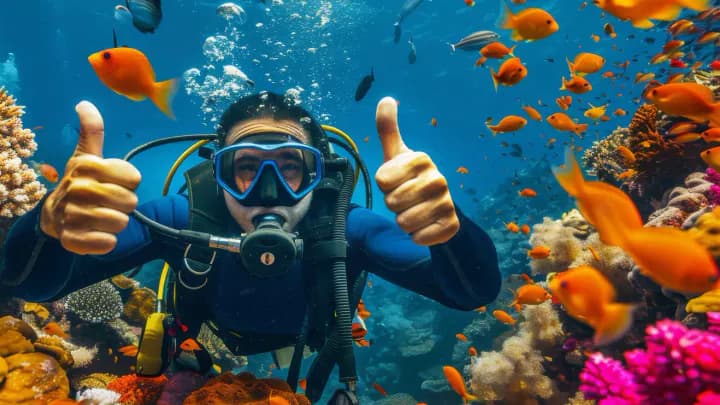
Liveaboard trips from Cairns or Port Douglas reach the outer reef, where visibility and coral health are consistently better than on inshore day-boat sites. If you are certifying from scratch, budget three to four days. The reef is also a live lesson in responsible travel: choose operators with reef-safe practices and eco-certification, and never touch or stand on coral.
Whitewater rafting the Colorado River, USA
A Grand Canyon rafting trip is not a spontaneous booking. Commercial multi-day trips sell out far in advance, and private trips require a permit allocated by lottery. The reward is rapids rated on the canyon's own 1–10 scale alongside side-canyon hikes most visitors never see. Shorter day trips upstream or in Cataract Canyon are a reasonable substitute.
Snowboarding in Niseko, Japan
Niseko's reputation rests on volume of dry powder driven off the Sea of Japan. The catch: visibility is often poor, and the best terrain is in the trees, where an intermediate rider can get into trouble quickly. Respect the gate system into the backcountry, carry avalanche gear if you go beyond it, and finish in an onsen.
Rock climbing in Kalymnos, Greece
Kalymnos is bolted limestone above the Aegean, with hundreds of well-maintained sport routes across a wide grade range. It is unusually welcoming to newer climbers because approaches are short and grading is honest. Spring and autumn beat summer — the south-facing walls bake in July and August.
Sandboarding in Huacachina, Peru
The desert oasis outside Ica is the cheapest genuine adrenaline hit on this list. Most trips pair a dune-buggy ride with boarding, usually lying down rather than standing. Wax the base of the board, wear eye protection, and go at sunset when the sand has cooled.
Mountain biking in Moab, Utah
The Slickrock Trail's sandstone gives astonishing grip but punishes poor line choice and has almost no shade. Beginners should start on the Klondike Bluffs or Bar M trails. Carry far more water than you think you need — desert dehydration arrives without the usual warning of feeling hot.
Volcano boarding on Cerro Negro, Nicaragua
You hike about an hour up an active cinder cone carrying a reinforced wooden board, then ride the ash slope down. Advertised top speeds are high; realistically most riders travel considerably slower, and control comes from your heels. Expect to be coated in black grit — bring goggles and clothes you don't love.
Paragliding in Ölüdeniz, Turkey
Tandem flights launch from Babadağ, roughly 1,900 meters above the Blue Lagoon, giving unusually long air time for a commercial tandem. Morning flights are smoother; midday thermals are bumpier but longer. Confirm your pilot's certification and the operator's insurance, and skip flying in strong wind even if it costs you the booking.
Trekking to Everest Base Camp, Nepal
The trek tops out around 5,364 meters at base camp, with Kala Patthar higher still. It is a walking route, not a climb, but altitude is the real obstacle. A sensible itinerary includes acclimatization days at Namche Bazaar and Dingboche and limits sleeping-altitude gain to a few hundred meters per day above 3,000 meters. Lukla flights are frequently delayed by weather — build in buffer days on both ends.
Will my travel insurance actually cover this?
Probably not by default. Standard travel policies carry a "hazardous activities" exclusion that commonly names skydiving, paragliding, scuba diving beyond a set depth, off-piste skiing and trekking above a stated altitude — often 4,500 or 5,000 meters, which cuts straight through an Everest Base Camp itinerary.
Three checks before you pay a deposit:
- Named activity, named limits. The policy should list your activity explicitly, with depth, altitude or piste conditions spelled out.
- Evacuation, not just treatment. In Nepal, Nicaragua or the Australian outer reef, the expensive event is the helicopter or boat transfer, not the clinic.
- Guided vs. independent. Some policies cover an activity only when you are with a licensed operator. Renting a bike and riding Slickrock alone may void it.
Keep a photo of the policy number and the insurer's emergency line offline on your phone. Coverage you cannot prove at 4 a.m. with no signal is coverage you do not have.
How do I train for high-altitude or high-effort trips from a flat city?
Train the duration, not the intensity. Long, repeated days on your feet matter more than peak fitness, so build toward back-to-back weekend hikes of five to seven hours carrying the pack and wearing the boots you will actually use. Stair repeats and loaded incline walking substitute reasonably well for hills.
What you cannot simulate is altitude. No amount of cardio prevents acute mountain sickness; only a gradual ascent profile and adequate hydration reduce the risk, and medication should be discussed with a qualified medical professional well before departure. Break boots in at least a month out — new footwear on day one of a two-week trek is one of the most common and most trip-ending mistakes we see.
Arrive rested, too. Adventure days start early and stack fatigue quickly; if you land jet-lagged, prioritize catching up on sleep before the first big day.
What mistakes cost adventure travelers the most money?
The costliest errors are scheduling errors, not gear errors. Four worth internalizing:
- Booking a flight too soon after diving. Divers Alert Network guidance generally advises at least 12 hours after a single no-decompression dive and at least 18 after repetitive or multi-day diving. Book the dive days early in the trip, never the day before you fly.
- Treating a weather-dependent activity as a fixed appointment. Skydiving, paragliding and Lukla flights all cancel. One spare day converts a lost deposit into a rescheduled jump.
- Chasing the peak-season photo. Peak means crowds, higher guide ratios and pressure to run marginal conditions. Shoulder-season planning usually buys smaller groups and calmer decision-making.
- Stacking too many destinations. Adventure activities need recovery days. A tighter, deeper itinerary produces better conditions and fewer injuries than a six-country sprint.
When does this advice not apply?
It does not apply if you have an uncontrolled cardiac, respiratory, ear or pressure-related condition, if you are pregnant, or if you take medication affecting balance or blood pressure — in those cases, clearance from a qualified healthcare professional comes before any booking, and some activities will simply be off the table. Scuba, in particular, has a formal medical questionnaire for a reason.
It also does not apply if you are traveling somewhere with an active advisory, or if your operator cannot produce licensing and insurance documentation. Walking away from a non-refundable deposit is cheaper than every alternative.
If you are heading out alone, the risk calculus shifts again: you lose the built-in buddy check that partners provide. Our solo travel guide for first-timers covers check-in routines and emergency contacts that pair well with adventure itineraries.
Key takeaways
- Sort activities by skill, season and lead time first — the destination is the easy part.
- Anything requiring certification, a permit or acclimatization should be the trip, not an add-on.
- Standard travel insurance usually excludes hazardous activities; confirm named coverage plus emergency evacuation before paying.
- Respect the flying-after-diving interval and build spare days around weather-dependent activities.
- Train duration and break in your footwear; no fitness level substitutes for a gradual ascent profile at altitude.
- Get medical clearance for pressure-, altitude- or cardiac-sensitive activities from a qualified professional.
Frequently asked questions
What counts as an adventure travel activity?
An adventure travel activity is a trip experience that combines physical effort, an element of managed risk, and an unusual natural environment — skydiving, scuba diving, whitewater rafting, high-altitude trekking and similar pursuits. The defining feature is that the outcome depends partly on your own skill and preparation, not just on a ticket.
Does standard travel insurance cover adventure sports?
Usually not. Most standard policies exclude "hazardous activities," which often includes skydiving, scuba diving below a certain depth, and trekking above a stated altitude. You typically need an adventure sports rider or a specialist policy, and you should confirm that emergency evacuation — including helicopter rescue — is covered in the specific country.
Which adventure activity is best for a complete beginner?
Tandem paragliding and tandem skydiving are the most beginner-friendly, because a licensed pilot or instructor manages the technical work while you supply only nerve. Sandboarding and guided rafting on moderate rapids are the next step up, requiring basic fitness but no certification.
How long should I wait to fly after scuba diving?
Divers Alert Network guidance generally recommends waiting at least 12 hours after a single no-decompression dive and at least 18 hours after repetitive or multi-day diving. Many operators advise a full 24 hours. Build this buffer into your itinerary before booking your outbound flight.
Do I need a certification to scuba dive on the Great Barrier Reef?
Not for an introductory dive, which many operators offer under direct instructor supervision to a shallow depth. To dive independently with a buddy you need an entry-level certification such as PADI or SSI Open Water, which typically takes three to four days including pool and open-water sessions.
How fit do you need to be for the Everest Base Camp trek?
You need the ability to hike five to seven hours a day on uneven ground for roughly two weeks, with a light daypack. Raw fitness matters less than acclimatization — the route reaches about 5,364 meters, and ascending too quickly causes altitude sickness regardless of how strong you are. Consult a qualified medical professional before booking.
When is the cheapest time to book an adventure trip?
Shoulder season — the weeks bracketing peak — usually gives the best combination of price, availability and conditions. Guides are less rushed, group sizes are smaller, and permits are easier to secure, though weather windows can be narrower.