The Cartographer of Borrowed Rooms
Vesna maps rented rooms for people who cannot bear to forget them. When a client requests a map of a room she has never entered, she must trust a different kind of memory.
Drafted with AI. This version has not been reviewed by an editor, so it is kept out of search results and carries no ads — how we work.
Vesna kept her ink in seventeen small jars, and each jar was labeled with a room she had loved and lost. She had been a cartographer of borrowed rooms for eleven years, and in that time she had mapped one hundred and forty-two of them.
The work had come to her sideways, the way most useful trades do. A woman had once stopped her in the street — this was in the second winter after Vesna's mother died — and asked if she was the girl who drew the little plan of the boarding house on Aleman Street. Vesna admitted she was. She had drawn it for herself, to remember the shape of the room where her mother had spent her last spring, because the landlord had already painted over the walls and rented it to a music student. The woman on the street said her father had lived above a tailor's shop for forty years, and she would pay Vesna anything, anything at all, to have the floor plan drawn before the building came down.
Vesna had gone to see the room. She had measured the window with a string knotted at the intervals of her own hand. She had drawn the water stain on the ceiling in the exact shape of a hare. She had noted, in a small script along the baseboard, Here he kept his radio. Here his slippers. Here the chair the cat preferred. The woman had wept when Vesna handed her the map, and had paid her twice what they'd agreed.
After that, the commissions came like snow: quietly, and then all at once.
Her clients were, without exception, people mid-loss. A daughter emptying her mother's flat. A man whose brother had died in a rented studio above a bakery. A widow leaving the apartment she and her husband had never owned but had inhabited so fully that the walls remembered the shape of their arguments. They did not want architectural drawings. They wanted the smell of the linoleum near the stove, the exact angle at which the afternoon light struck the reading chair, the corner where the child had once been sick and the stain had faded but never quite gone.
Vesna gave them what they asked for. She used a fine nib for furniture and a broader one for the routes people walked from bed to window to kettle. In the margins she noted the sounds: pipes at 6 a.m., pigeons on the sill, downstairs neighbor practicing scales, always the same three that she never got right. She had learned that a room was not its walls. A room was the pattern of use worn softly into it, the way a stone step is worn by feet.
She was thirty-four the winter a man named Ilya wrote to her. His letter was one paragraph long and neatly typed.
I would like to commission a map of a room I have never been inside. It was my sister's. She kept it locked to me for eleven years. She died in October. The landlord has agreed to let you in, but not me. I understand if this is not the sort of work you do.
Vesna read the letter three times. Then she wrote back to say she would try.
The Room on Vetrov Street
The building was narrow and yellow, with a stairwell that smelled of cold stone and old cooking. The landlord met her with a key on a piece of red thread. He was apologetic in the way of men who have not done anything wrong but have been near sadness.
“She was quiet,” he said, unlocking the door. “Paid on time. I saw her maybe twice a year.”
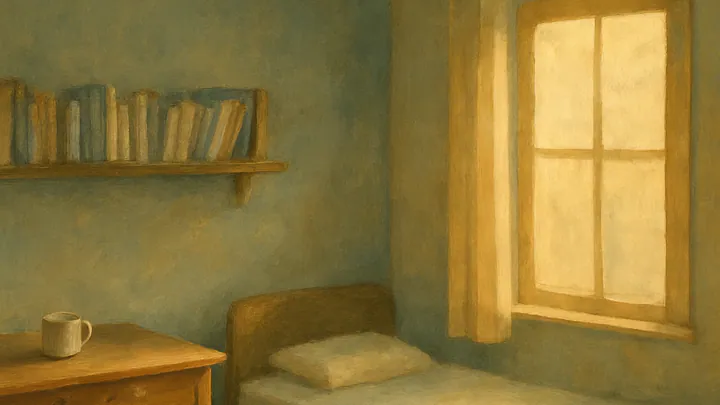
The room was small and very clean. A single bed under the window. A desk. A chair. A shelf of books arranged not alphabetically but by the height of their spines, so that they made a soft blue wave from left to right. A kettle. Two cups. A folded blanket the color of wet moss. On the wall above the desk, a single photograph: two children at the edge of a lake, the older one holding the younger's hand.
Vesna set down her satchel and began to measure.
She worked slowly, as she always did. She drew the bed and the desk and the chair. She drew the shelf and marked, in her small script, books arranged by height, tallest at the window end. She noted the mug on the desk, still there, with a residue of tea gone to lace at the bottom. She noted the position of the reading lamp, tilted slightly toward the chair rather than the desk, which told her the sister had preferred to read sitting up, feet tucked. She noted the second cup on the shelf, unused, dust-ringed, kept.
She stood at the window and looked out at what the sister had looked at: a courtyard, a bare linden, a woman on the third floor across the way watering a plant. She wrote in the margin: view of courtyard. Linden. Neighbor waters cyclamen at approximately four.
Then she sat down in the chair and did nothing for a long time.
She had promised Ilya a room he had never been in. But she could not, of course, give him that. She could only give him the room as it had become without him — arranged around his absence like furniture around a stove. The second cup on the shelf. The photograph above the desk, the younger child's hand held tight. The books shelved not for finding but for looking at, a soft blue wave a person could rest her eyes on when the day had been too much.
Vesna took out a fresh sheet and began the map again.
She delivered it to Ilya in a café near the station. He was younger than she had expected, and his hands shook a little when he unrolled the paper.
He read it the way people read maps of borrowed rooms: not left to right but in loops, returning to certain corners, lingering. When he came to the notation about the second cup, he put his hand flat over it, as if to keep it from flying away.
“She kept a cup for me,” he said.
“Yes.”
“All those years.”
Vesna did not answer. It was not her place to. She had learned, over one hundred and forty-two rooms, that the map was only ever half the work. The other half belonged to the person holding it, unfolding what had been folded, walking the small ink corridors of a place they were finally allowed to enter.
Ilya rolled the map carefully and tied it with the same red thread the landlord had used on the key. He thanked her. He paid her. He walked out into the afternoon.
Vesna stayed at the table a little longer, watching the light move across the empty chair opposite her. Then she took out her notebook and began, as she always did after a delivery, to draw the café: the salt cellar, the angle of the window, the exact place where a stranger had, for one hour, unfolded his sister.