
The Watchmaker's Apprentice and the Tide
When an apprentice is sent to repair a clock that has only ever told the wrong time, she discovers a coastal town keeping a stranger schedule than her own.
Drafted with AI. This version has not been reviewed by an editor, so it carries no ads — how we work.
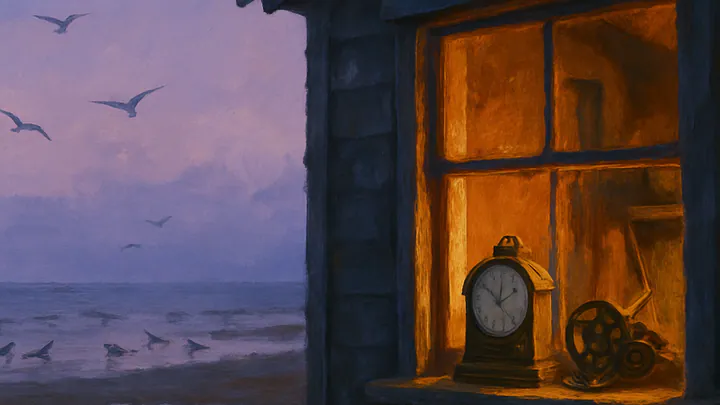
The letter arrived on a Tuesday, which Pell distrusted, because Tuesdays in the workshop were when Master Aderyn pretended to nap and instead listened for who was honest about their work.
Pell was not, that afternoon, being honest. She had been filing the same escapement wheel for an hour because she did not want to admit she had cut the pivot too thin. When the bell rang she nearly leapt from her stool.
Master Aderyn opened one eye. "Read it aloud."
The envelope smelled of salt and something mineral, like wet stone. Pell broke the wax and read.
To the workshop of A. Aderyn: A clock here has told the wrong time for sixty-one years. We would like, finally, to have it corrected. Send your best. We will pay in whatever currency travels. — The Town of Lirrow-by-Sea.
"Lirrow," said Master Aderyn, as if tasting the word. "I haven't heard that name since I was younger than you." She closed her eye again. "You'll go."
"Me?"
"You cut that pivot too thin and thought I wouldn't notice. A long journey will give you time to consider why you lied about it."
Pell flushed. "Yes, Master."
"Take the brass case kit. Take the loupe with the chipped rim — it sees better than the new one, whatever the catalog claims. And Pell." The old woman's eye opened once more, sharp as a needle. "Listen to the clock before you touch it."
Lirrow-by-Sea was two days by train and one by cart, and the cart driver would not speak of the town except to say, "They keep their own hours there. Don't be cross with them about it."
She arrived at low tide. The town crouched along a curve of pale sand, its houses leaning slightly inland as if braced against a wind that wasn't blowing. A woman in a green oilcloth coat was waiting at the bottom of the cart path.
"You're the watchmaker?"
"Apprentice," said Pell, before she could decide whether to lie.
The woman nodded as if this was the more useful answer. "I'm Mara. Mayor, when we need one. Mostly I run the bakery. Come."
They walked past shuttered shops and a square where no one seemed to be in a hurry, though plenty of people were out. A boy was painting a fence very slowly. A man was repairing a net with the calm of someone who had all afternoon, and possibly all week.
"There it is," Mara said.
The clock stood in the square on a stone plinth, brass and weathered green, taller than Pell by a head. Its face read twenty past four. Pell drew out her pocket watch. Twenty past one.
"It's three hours fast," she said.
"It always has been," Mara said. "That's not the problem."
Pell waited.
"The problem is it's beginning to be right."
The Listening
Pell had been taught to listen to clocks the way a doctor listens to a chest. She set her ear to the brass case and closed her eyes.
The tick was steady. Too steady, in fact — a clean, even pulse with no wobble at all. A clock this old should have some character to its beat: a small limp where a tooth had worn, a held breath at the top of the hour where the mainspring took a moment to gather itself. This one ticked like a metronome in a quiet room.
And underneath the ticking, faintly, she could hear the sea.
Not through the brass — through the mechanism. As if somewhere inside the clock a small tide was going out.
She straightened. Mara was watching her carefully.
"Tell me about the sixty-one years," Pell said.
Mara sat down on the plinth's step. "My grandmother was the one who set it wrong. On purpose. There was a storm coming — the worst anyone could remember. The fishing boats were due back at four. She moved the hands forward three hours and rang the bell as if it were seven, and the boats that were close enough to hear came in early. The ones that weren't —" She paused. "Well. The ones that weren't didn't come in at all."
"And after the storm she didn't move it back."
"She said the town owed those hours. To the sea, or to the people who didn't make it, or to itself. She wasn't specific. She just said: we live three hours ahead of the world now. And we did. We do." Mara looked up at the face. "School begins when the clock says nine. The bakery opens when it says six. We marry and bury by it. The tide ignores us, but everyone else has learned to."
"Then why fix it?"
"Because it's been slipping. A minute a month, this past year. Pulling itself back toward the real hour. And none of us know how to feel about that."
Pell thought of the small sea inside the mechanism. She thought of her thinned pivot, and of Master Aderyn's eye opening like a shutter.
"May I open it?"
"That's why we sent for you."
Inside the clock, everything was in beautiful order. The gears were clean, the mainspring sound, the escapement crisp. There was no fault to find. The clock was, mechanically, telling the truest time it knew how to tell.
Pell sat back on her heels. The square had filled, quietly, with townspeople. They did not crowd her. They simply stood at a respectful distance, the way one stands near a sleeping child.
"There's nothing broken," she said.
Mara's face did something complicated.
"It's correcting itself," Pell went on. "Because nothing is holding it wrong anymore. Your grandmother set it forward. Someone has to keep setting it forward, or it drifts back to honest."
"No one's touched it in sixty-one years."
"Then something else was holding it. And whatever it was is letting go."
A long silence. A gull cried once, far off.
"What do we do?" Mara asked, and Pell realized the mayor was asking her — the apprentice with the too-thin pivot, the liar of Tuesdays — as if she had any authority at all.
Pell thought for a long time. She thought about the small tide inside the gears, going out and not, it seemed, coming back. She thought about owing hours, and about how a town might decide one day that it had paid enough.
"I think," she said slowly, "you can let it. If you want to."
Mara was quiet.
"Or," said Pell, "I can shim the escapement. Hold it three hours fast for another sixty years. It's a small piece of brass. It would be honest work — done on purpose, not by accident. You'd be choosing it this time."
A man at the edge of the crowd — older, with a fisherman's hands — said, "My father was one who didn't come back."
Everyone turned. He did not look at the clock. He looked at the sea, which was beginning, distantly, to come in.
"I think," he said, "he wouldn't mind being on time again."
No one spoke against him. After a while, Mara nodded.
Pell closed the clock without adding the shim. She wound it gently, the way Master Aderyn had taught her to wind anything precious, and she stepped back.
The clock kept its three-hour lie for the rest of that afternoon, because mechanisms are patient and do not hurry their truths. But by morning, the townspeople said later, it had quietly given back a minute. And then another. And the bakery, for the first time in sixty-one years, opened when the bread was ready instead of when the bell said so.
Pell took the long way home. On the train she wrote a letter to Master Aderyn admitting about the pivot, and about a few other things besides, and she sealed it with wax that still smelled faintly of salt.