The Ferry Pilot Who Refused the Fog
On a coastal run where every captain surrenders to the mist, one stubborn pilot insists on steering by memory. Then a stranger asks him to turn back for a reason he doesn't understand.
Drafted with AI and published automatically. Our editors set the standards and fix reported errors — how we work.
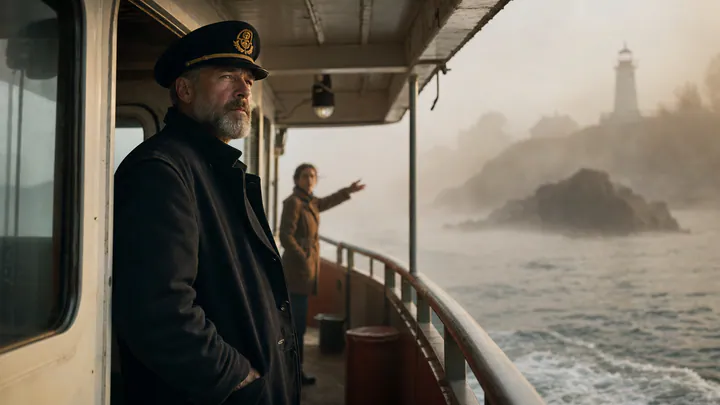
The fog came in like it always did on the Torbin run, thick as wet wool and smelling faintly of iron, and Captain Ilse Marren refused, as she always refused, to slow the ferry down. She kept one hand on the wheel and the other on the throttle and she counted, under her breath, the way her father had taught her: one Torbin, two Torbin, three, until the black shape of Cormorant Rock slid past on the starboard side exactly where memory said it would.
"You can't see a thing," said the young deckhand, Petar, who was new and still afraid of everything.
"I don't need to," Ilse said. "The channel hasn't moved in forty years. Neither have I."
She was sixty-one. She had piloted the Torbin ferry, back and forth across the strait, four times a day for thirty-eight of those years, and in that time she had come to understand the water the way some people understood their own kitchens — where the cold spots were, which drawer stuck, how the boards creaked when someone came home late. The fog was only weather. Weather was only a mood the sea was in.
Below, in the little glassed cabin where the passengers sat with their thermoses and their newspapers, there were seven people this morning. Ilse knew this without looking, the way she knew the tide. Six regulars. One stranger.
She had noticed him at the dock: a thin man in a grey coat, holding a paper envelope against his chest like it might blow away in a room with no wind. He hadn't bought coffee. He hadn't sat down right away. He had stood at the rail and watched the water as though he were trying to decide something about it.
The Passenger
Halfway across, when the fog was at its thickest and even Petar had gone quiet, the door to the wheelhouse opened, which was against the rules, and the thin man stepped inside.
"You aren't supposed to be up here," Ilse said, without turning.
"I know."
"Then go back down."
He didn't. She heard him breathing, careful and shallow, the way people breathed when they were trying not to cry in public.
"Captain," he said. "I need you to turn the boat around."
She did turn now, just enough to look at him. He was younger than she'd thought at the dock. Forty, maybe. His face had the specific tiredness of someone who had been awake for two nights in a row and had used the time badly.
"I can't turn the boat around," she said. "There's a schedule. There are people on the other side waiting."
"Please."
"Sir. Sit down."
He didn't sit down. He held the envelope tighter. "I'm going to Torbin to do something," he said, "and I've just realized I don't want to do it, and if I get off this boat on that side I'm going to do it anyway, because I've come this far, and I can't — I can't come this far again to undo it."
Ilse turned back to the fog. Four Torbin, five Torbin. The bell buoy off Halgen Point should ring in about ninety seconds. If it didn't, she was wrong about everything.
"What's in the envelope?" she asked.
"A letter."
"To?"
He was quiet a long time. "My brother. We haven't spoken in nine years. I wrote him a letter that — that I shouldn't send. I meant it when I wrote it. I don't mean it now. I only realized on the water."
The bell buoy rang. Right on time. Ilse allowed herself a small, private satisfaction, and then she allowed herself, less privately, to think.
Petar, in the corner, was watching her the way deckhands watch captains when they suspect the captain is about to do something that will end up in a story told at the dock bar for years.
"I have never," Ilse said slowly, "turned this ferry around. Not for weather. Not for engine trouble. Not for a woman in labor, though I'll grant you we radioed ahead and the doctor met us. Not for a dog that jumped overboard, though we circled for the dog. Circling isn't turning."
"I know it's a lot to ask."
"It is a lot to ask."
"I have money."
"Don't insult me."
He flinched. She hadn't meant it as sharply as it came out. The fog was making her old.
The Turn
She thought about her brother, then, which she did not usually allow herself to do while piloting. Her brother had died at forty-four of a heart that had simply stopped one Tuesday afternoon, and the last thing Ilse had said to him, six months before, had been unkind, and about money, and small. She had planned to fix it. She had assumed there would be a ferry back.
"Petar," she said. "Radio the Torbin dock. Tell them we're delayed twenty-two minutes. Mechanical."
"But we aren't —"
"Tell them mechanical."
Petar picked up the radio.
Ilse eased the wheel to port, slow and wide, the way you turned a boat full of people who were drinking hot coffee and didn't want it in their laps. The fog swirled and reformed. Somewhere below, a passenger would notice the light was coming through the windows from the wrong side now, and would frown, and go back to their crossword.
"You can tear it up on the deck," she said to the man. "The wind will take it. If you throw it in the water, it'll wash up somewhere and someone will read it. Tear it small."
He nodded. He was crying now, quietly, the way grown men cry when they haven't practiced.
"And then what?" he said.
"Then I'll take you back to the mainland," Ilse said, "and you'll buy a return ticket at the window like everyone else, and you'll get back on this ferry when you're ready. Could be tomorrow. Could be a year. The ferry runs."
"I don't know if I'll be ready."
"Then you won't come."
He went out onto the deck. Through the wheelhouse window she watched him tear the letter into pieces so small they looked, at last, like snow, and let the wind take them off the stern in a long grey trail into the fog.
Petar, who was still afraid of everything but slightly less afraid now, said, "Captain. There's no mechanical issue."
"There is," Ilse said. "Something wasn't running right. It's running better now."
She counted, under her breath, the seconds back to Halgen Point. The bell buoy rang again, on the other side this time, which was the same buoy but a different rung, and Ilse Marren, who had refused the fog for thirty-eight years, guided her ferry home through it one more time, gently, and on time enough.