Gender-Neutral Fashion: How to Actually Wear It Well
Gender-neutral fashion is less about oversized everything and more about how a garment is cut, sized, and sold. Here's how unisex sizing really works, which pieces travel across bodies, what tailoring costs, and where the idea stops being practical.
Rewritten with AI and republished automatically. Our editors set the standards and fix reported errors — how we work.
TL;DR: Gender-neutral fashion means garments cut, sized, and sold without a gender label. It works when you shop by measurement and proportion instead of by tag — shoulder width, chest, rise, and inseam. Most "unisex" clothing is still drafted on a men's block, so tailoring, not oversizing, is what makes it look deliberate.
What exactly is gender-neutral fashion, and how is it different from unisex?
Gender-neutral fashion is a design and retail approach in which clothing is cut, sized, and merchandised without reference to the wearer's gender, so garments are selected by fit and preference rather than by a men's or women's label. It is a category logic, not a look.
Three related terms get used interchangeably, and they are not the same thing:
- Unisex usually means one pattern block sold to everyone. In practice this is very often a men's block with the label swapped.
- Androgynous describes an aesthetic — deliberate ambiguity in silhouette, hair, and styling. You can dress androgynously in strictly gendered clothes.
- Gender-neutral is the umbrella: it includes unisex blocks, dual-block sizing offered without gendered names, made-to-measure, and simply ignoring which section of the store a garment hangs in.
That distinction matters the moment you start spending money. A brand that sells "gender-neutral" but grades sizes from a single men's block is selling you a fit problem alongside the shirt.
Why has genderless clothing grown so fast in the last decade?
Because three forces arrived at once: younger shoppers treating identity as expressive rather than fixed, social platforms making non-binary styling visible daily, and retailers discovering that a single SKU sold to everyone is cheaper to produce and inventory than two.
Cultural visibility did real work. Harry Styles wearing a dress on the cover of Vogue in December 2020 became a mainstream reference point; Janelle Monáe's tuxedo-led wardrobe and Billie Eilish's deliberately volume-heavy silhouettes did similar work for different audiences. None of this invented genderless dressing — Comme des Garçons, Yohji Yamamoto, and Rick Owens have been working this territory since the 1980s — but it moved it from subculture to shopping mall.
The commercial motive is worth naming honestly. Merging two ranges into one halves pattern development and simplifies stock. That is a legitimate efficiency, but it is also why some "gender-neutral capsules" appear for one season and quietly disappear.
Which garments genuinely work across bodies, and which don't?
Garments with few fixed contact points travel best. The more places a pattern has to meet a specific body shape, the worse a single block performs.
Travel well: drop-shoulder shirts and overshirts, boxy tees, crewneck and hooded sweatshirts, unstructured chore and utility jackets, wide-leg and straight trousers with a mid-to-high rise, cardigans, knit beanies, most outerwear one layer up from body-skimming.
Travel badly: anything with a set-in shoulder seam and a close armhole, single-breasted blazers with a defined waist, button-front shirts across a full bust (the placket gaps), low-rise trousers, and fitted knitwear. These need either dual blocks or alteration.
The same logic runs through denim. A straight or wide leg with a mid-to-high rise reads as genderless on almost anyone, which is one reason those cuts keep dominating the jeans worth buying now. A skinny low-rise, by contrast, is a body-shape-specific garment no matter what the label says.
How do I find my size when the tag just says "unisex"?
Stop reading letters and start reading the size chart. Two measurements decide almost everything: your chest or bust circumference, and your shoulder-point-to-shoulder-point width across the back.
Unisex tops commonly grade around a 34–37 inch chest for small, 38–41 for medium, and 42–45 for large, but this varies enough between brands that you should always check the specific chart. For shoes, a US women's size runs roughly 1.5 sizes larger than the men's equivalent — a women's 9 is approximately a men's 7.5 — and width, not length, is what usually fails.
The shoulder rule: if the garment has a set-in sleeve, the shoulder seam should land within about half an inch of your actual shoulder point. If it is drop-shouldered by design, ignore the shoulder entirely and size on chest alone. Getting this backwards is the single most common reason a unisex jacket looks borrowed rather than chosen.
| Approach | How it fits | Best for | Watch out for |
|---|---|---|---|
| Men's block relabeled "unisex" | Straight waist-to-hip, wide shoulder, long sleeve and rise | Straighter frames; anyone wanting volume | Gaping at the waist, sleeves 1–2 in. too long, tight across a full bust |
| Purpose-built neutral block | Deeper armhole, higher rise, narrower shoulder than menswear | The widest range of bodies off the rack | Rare, and usually priced above basics |
| Dual block, non-gendered names (e.g. Fit A / Fit B) | Two hip-to-waist ratios, same styling | Curved frames who still want neutral styling | Sizes sell through unevenly; less stock available |
| Made-to-measure or tailored | Exact — nothing is assumed about your shape | Suiting, coats, anything structured | Highest cost and longest lead time |
What does a starter genderless wardrobe look like in practice?
Ten to twelve pieces will cover most lives. A working list: two heavyweight tees, one drop-shoulder overshirt, one fine-gauge crewneck, one hoodie or sweatshirt, straight-leg jeans, wide-leg trousers in a matte wool or wool blend, an unstructured blazer, a utility or chore jacket, one pair of low-profile sneakers, and one pair of derbies or loafers.
Worked example. Take a person with a 40-inch bust, 33-inch waist, and 41-inch hip buying a unisex chore jacket. Sizing to the bust gives a medium that pulls across the front; sizing up to a large fits the chest but leaves the shoulder seam an inch past the shoulder point and the sleeve past the knuckle. The working answer is the large, plus a sleeve shortening and a light take-in through the side seams — roughly two alterations, and the jacket then fits better than either size did alone.
This is the same discipline behind any tight wardrobe. If you want the arithmetic of which pieces repeat, our guide to a 30-piece capsule wardrobe maps out how few items you actually need before outfit combinations stop increasing.
What does it cost, and where does tailoring pay for itself?
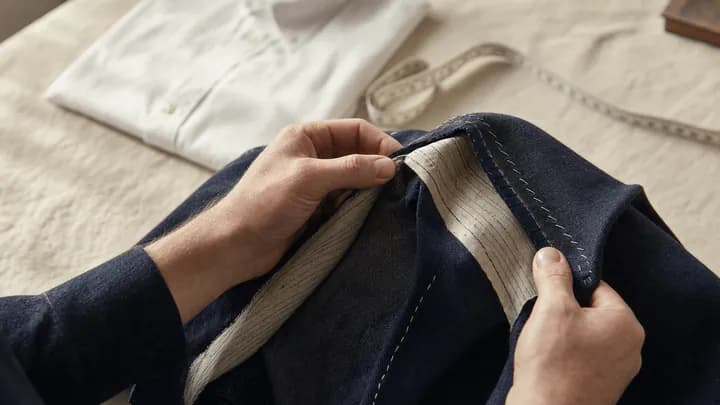
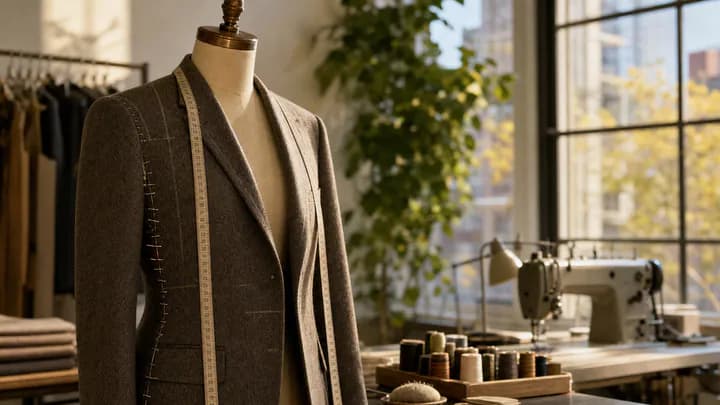
The garments themselves are not inherently more expensive; the alterations are the hidden line item. In most US cities, a trouser hem, a sleeve shortening, and a side-seam take-in each land in the modest double digits, with jacket shoulder work costing several times more — which is exactly why you should never buy a structured jacket that fails at the shoulder.
Decision rule: alter anything that is too long or too wide. Never buy anything that is too narrow through the shoulder or too tight across the chest, because there is no fabric to give back. Length and width are cheap; structure is not.
Neutral palettes also stretch the budget, since fewer colors means more combinations from the same pieces. That overlaps heavily with the logic of building a timeless, quiet-luxury wardrobe — material quality and cut doing the work that logos and gendered signaling used to do.
What are the most common and costly mistakes?
- Oversizing everything. Volume on volume reads as shapeless, not neutral. Pair one loose piece with one piece that has a defined line — wide trousers with a fitted knit, or a boxy shirt with a straight-leg jean.
- Trusting the word "unisex" over the measurements. Always open the size chart. Brands using the same word can differ by two full sizes.
- Buying the sale size. A garment that is one size off in the shoulder will stay one size off forever.
- Forgetting the rise. Rise — the distance from crotch seam to waistband — determines where the whole silhouette sits. A men's-block trouser sized to your hip will usually sit low and short in the rise on a curved frame.
- Assuming neutral means beige. Color is not gendered. Pink, chartreuse, and bold print are as genderless as gray; the neutral palette is a convenience, not a rule.
When does gender-neutral dressing not apply?
It stops being practical in three situations, and pretending otherwise helps no one. First, uniformed and regulated workplaces — aviation, healthcare, some legal and military settings — where dress policy still names gendered garments. Second, strict formal codes, where "black tie" carries specific expectations; a sharply tailored dark suit in a matte fabric satisfies almost all of them while remaining neutral in cut. Third, contexts where cultural or religious dress carries meaning that a stranger's styling choice can flatten rather than honor.
There is also a safety dimension. In some places and some workplaces, visibly non-conforming dress carries social risk. That is a real constraint on real people, and choosing where and when to dress a particular way is a legitimate decision, not a failure of conviction.
Who is doing this well, and how does it look outside the West?
Telfar built an entire brand identity on the line "Not for you — for everyone," with a bag sold at one price to anyone. Collina Strada cuts and casts across genders as a default. The Phluid Project opened one of New York's first explicitly gender-free stores in 2018 and pushed the retail conversation forward even though its physical footprint was short-lived. Several mass-market chains have run gender-neutral capsules with varying commitment.
Outside Western fashion capitals, the idea is frequently older than the label. Japanese design houses have treated volume-led androgyny as a serious formal language for decades. In South Asia, draped and unstitched garments such as the dhoti, lungi, and various shawl forms have always sat across genders, and contemporary designers are reworking kurtas and drapes on that basis. Several West African tailoring traditions likewise build around drape and print rather than gendered body lines. The Western "genderless" capsule is, in that light, less an invention than a rediscovery.
Key takeaways
- Gender-neutral fashion is defined by how clothes are cut and sold, not by a specific aesthetic — you can do it in gray sweats or a printed suit.
- Most "unisex" garments are still drafted on a men's block; shop by chest, shoulder width, rise, and inseam rather than by letter size.
- Drop-shoulder, unstructured, and mid-to-high-rise pieces travel across bodies; set-in shoulders and defined waists usually need alteration.
- Alter length and width, never buy narrow through the shoulder — shoulder work is the most expensive repair there is.
- Budget for tailoring as part of the purchase price, and let a neutral core carry the bold pieces.
- Dress codes, uniforms, and personal safety are real limits; working within them is a practical choice, not a compromise of identity.
Frequently asked questions
What is gender-neutral fashion?
Gender-neutral fashion is clothing designed, sized, and merchandised without reference to the wearer's gender, so garments are chosen by fit, proportion, and preference rather than by a men's or women's label. It covers everything from plain unisex T-shirts to tailored suiting cut on a single block for all bodies.
Is unisex the same as gender-neutral?
Not quite. Unisex usually describes one garment block sold to everyone, which in practice often means a men's pattern relabeled. Gender-neutral is the broader idea: it can include dual-block sizing, made-to-measure, or simply shopping every section of a store and ignoring the tags.
How do I convert my size to unisex sizing?
Ignore letters and use measurements. Compare your chest or bust circumference and your shoulder-point-to-shoulder-point width against the brand's size chart; unisex small often runs around a 34–37 inch chest, medium 38–41, and large 42–45, though this varies by brand. For shoes, a US women's size is roughly 1.5 sizes larger than the men's equivalent.
Does gender-neutral clothing work if I have a larger bust or hips?
Often not straight off the rack, because most unisex blocks are drafted with a straight waist-to-hip line and narrow armhole placement. Size up for the chest or hip and have the shoulders, waist, and sleeve length altered — that combination usually costs less than buying a second garment.
Which brands make genuinely gender-neutral clothing?
Telfar built its identity around the line "Not for you — for everyone," Collina Strada casts and cuts across genders, and Comme des Garçons, Yohji Yamamoto, and Rick Owens have worked with genderless silhouettes for decades. Several mass-market retailers have also run gender-neutral capsules, with mixed longevity.
Can I wear gender-neutral clothing to a formal or corporate event?
Yes, but read the dress code literally first. Where an invitation specifies black tie or a uniform policy names gendered garments, your safest route is a sharply tailored suit in a dark, matte fabric — it satisfies almost every formal code while remaining genderless in cut.
Is gender-neutral fashion more expensive?
The garments themselves usually are not, but the total cost can be higher because a single block rarely fits perfectly, so tailoring becomes part of the purchase. Budgeting roughly the cost of a hem and a sleeve shortening on top of each tailored piece is a realistic planning rule.