The Woman Who Ironed Other People's Days
In a quiet basement laundry, Perla presses the wrinkles out of more than shirts. When a stranger brings her a Tuesday too creased to wear, she discovers a limit she never expected.
Drafted with AI and published automatically. Our editors set the standards and fix reported errors — how we work.
The sign in the stairwell said PERLA — PRESSING & MENDING in letters that had been painted over three times, each in a slightly different blue. You had to go down four steps below the sidewalk, then push open a door that stuck against the linoleum, and then you were in a room that smelled of steam and lavender water and the faint, clean scorch of a hot plate on cotton.
Perla was already there. She was always already there.
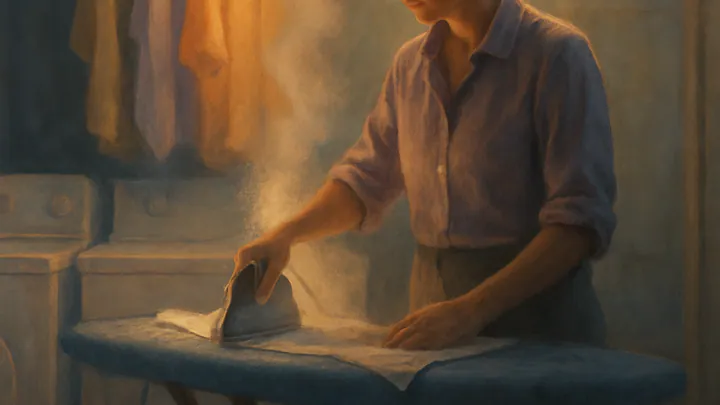
She stood at a padded table under a single bright bulb, her sleeves rolled to the elbow, and she was ironing a Wednesday. It belonged to a bus driver named Kwame who lived on the third floor above the bakery. He had brought it down that morning folded badly under his arm, apologizing for the state of it — a fender bender before dawn, a passenger who had wept the whole way to the hospital, a phone call from his sister that he had not been ready to answer. All of it had wrinkled the day past wearing.
“Leave it with me,” Perla had said, the way she always said it, and Kwame had gone back upstairs lighter by one crumpled afternoon.
Now she worked the iron in long, slow passes. Steam rose in a soft column. Under her hands the Wednesday flattened, softened, gave up its sharp folds. She did not remove what had happened — she could not do that, and would not have if she could. She only pressed the creases out so that a person could put the day on again without it chafing.
When she was finished she hung the Wednesday on a wooden hanger by the pipe that ran along the ceiling, and she moved on to a Monday from the woman in 2B, and then to a Friday from the boy who delivered groceries, and then to a small, stubborn Sunday morning that a widower named Alden had been carrying folded in his coat pocket for eleven years.
That Sunday she worked on for a long time. She always did.
The stranger came in just after four, when the light through the barred window had gone the color of weak tea.
He was young — younger than Perla by a good three decades — and he was carrying a Tuesday balled up in both hands like something he had pulled out of a storm drain. It was so creased she could barely see the shape of it. Corners jutted where corners should not have been. One edge looked burned.
“They said you could fix things,” he said. His voice had the flat, careful quality of a person who had not slept.
“Set it down,” Perla said, gently, and he set it down on the padded table, and then he sat on the little stool by the door as if his knees had made the decision for him.
Perla looked at the Tuesday. She turned it over once. She smoothed one corner with the flat of her palm and felt it resist her, spring back, refuse.
She had ironed thousands of days. Bad ones, jagged ones, days that had been rained on and stepped on and left crumpled at the bottom of a bag for a week. She had a sense for what a day would give up under heat and what it would keep. This Tuesday, she understood immediately, was going to keep a great deal.
“What happened on it?” she asked.
The young man — his name, he said, was Teodor — told her. He told her plainly and without decoration, the way people tell things when they have already told them to themselves too many times. A hospital. A phone that would not stop ringing. A sister he had promised to call back and hadn’t. A hallway with a green stripe painted along the floor that he now could not stop seeing when he closed his eyes.
Perla listened without moving her hands. When he was finished she said, “I can’t take that out.”
He nodded once, as if he had known.
“I can press it,” she said. “I can make it lie flatter. It will still be there, under your shirt, where you feel it. But it won’t catch on every doorway.”
“How much?” he said.
She shook her head. “For Tuesdays like this, nothing.”
The Long Pressing
She worked on his Tuesday until well past dark.
The iron hissed. The pipes above her ticked as the building cooled. Upstairs, someone practiced scales on a keyboard, badly, the same four notes over and over with a stubborn hopefulness. Teodor sat on the stool and did not speak. Once she looked up and saw that he had fallen asleep sitting upright, his head against the doorframe, his mouth a little open, and she felt something in her own chest press flatter too.
The Tuesday fought her. Whole regions of it would smooth beneath the iron and then, when she lifted the plate, would ruche back into ridges. The burned edge she could not mend at all; she folded it carefully under so it would not show. In one corner she found a crease so deep it had become almost a seam, and she understood that this was the moment he had not called his sister back, and she left it alone. Some creases were the shape a person needed in order to remember. To iron them out would be a theft.
Near midnight she was finished. The Tuesday was not beautiful. It would never be beautiful. But it lay flat on the padded table now, and its edges were true, and a person could fold it into the drawer of their life without it snagging every other garment there.
She woke him with a hand on his shoulder.
“Take it home,” she said. “Wear it gently for a while. Bring it back if the creases rise.”
He looked at the Tuesday for a long moment. Then he looked at her.
“Who irons yours?” he said.
The question surprised her. She had been asked many things, in this basement, over the years — whether she could take out a Thursday, whether a Saturday could be shortened, whether last April could be re-hemmed — but no one had asked her that.
“I hang mine by the window,” she said, after a moment. “The sun does a little. The rest I wear as they are.”
He nodded, as if this were an answer he could carry. He took the Tuesday under his arm — folded now, not balled — and he climbed the four steps to the sidewalk, and the door stuck against the linoleum as it closed behind him.
Perla stood a while at her table. Then she reached up to the pipe along the ceiling and took down, from the very back where she kept it, a small crumpled Wednesday of her own from a long time ago. She laid it on the padded board. She plugged the iron back in. She waited for the light on its handle to glow.
Outside, somewhere above her, the badly played scales began again, and this time they climbed one note higher than before.