The Inventor of Almost-Useful Things
In a workshop crowded with brilliant failures, a tinkerer receives a commission she cannot refuse. The catch: the customer wants something that has never almost-worked before.
Drafted with AI and published automatically. Our editors set the standards and fix reported errors — how we work.
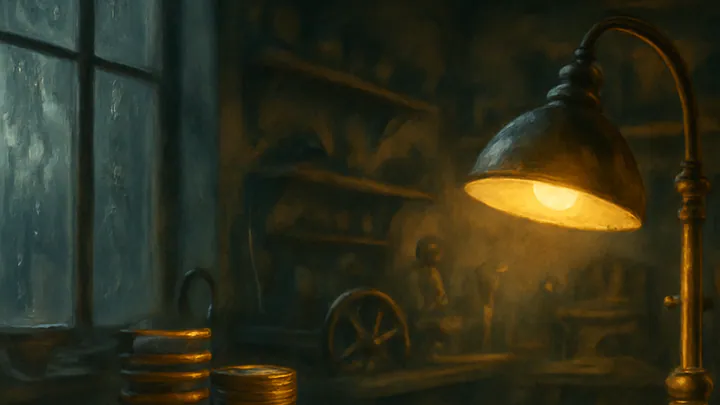
The sign above the door read Bex Hallow, Inventor of Almost-Useful Things, and underneath, in smaller letters someone had scratched with a key: No Refunds, Some Regrets. Bex had not put the second part there, but she had also not painted over it, which she considered a kind of honesty.
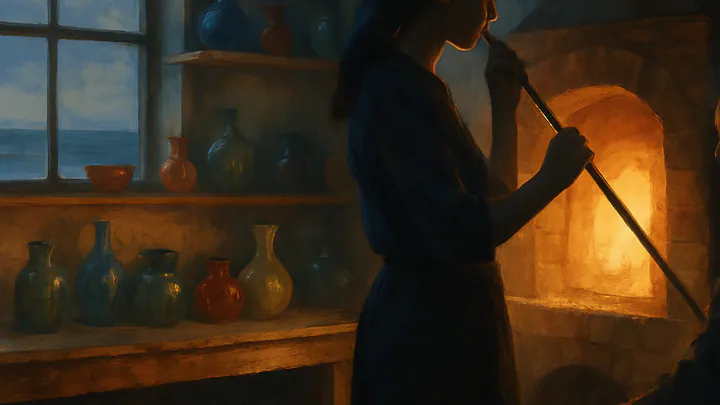
The shop sat between a barber who only cut hair on Tuesdays and a shoemaker who had been retiring for eleven years. Inside, the air smelled of brass shavings, lemon oil, and the particular electric tang of solder. Shelves climbed the walls like ivy, weighed down by Bex's life work: a kettle that whistled in three-part harmony but refused to boil; a compass that pointed steadily toward whoever in the room was lying; an umbrella that opened only in fair weather.
People came from two villages over to browse. They rarely bought. "It's marvelous," they would say, turning a self-winding hourglass over in their palms. "What does it do?"
"It runs," Bex would answer. "Just not on time."
And they would laugh, set it down gently as if it were a sleeping bird, and leave with a pastry from the baker across the square instead.
This had been fine. For a while.
The man who came in on Thursday wore a coat the color of wet slate and carried no umbrella, though it had been raining since dawn. He did not browse. He walked the length of the shop once, hands folded behind him, and stopped at the counter where Bex was filing a tiny gear no bigger than a lentil.
"I need you to build something," he said.
"I build a lot of somethings."
"I need you to build something that works."
Bex set down the file. She had been called many things by customers — charming, impractical, a menace to the household budget — but no one had ever asked her, plainly, to make a thing that worked. It felt like being asked to sing in a language she had only ever read.
"What sort of something?" she said.
The man produced from his coat a small wooden box and set it on the counter between them. Inside, on a bed of green felt, lay a key. It was iron, plain, the bow shaped like a simple trefoil. Nothing about it suggested magic or money or menace. It looked like the kind of key that opened a pantry.
"This key," the man said, "belonged to my mother. She used it every day of her life. I do not know what it opened. The lock is gone — house sold, door replaced, everything painted over. I have walked through that house three times. There is nothing left of her in it." He paused. His hands, Bex noticed, were trembling very slightly, the way the surface of tea trembles when a cart rolls by outside. "I would like you to build a lock for this key. A lock that, when opened, returns something. Anything. A smell. A sound. One minute."
Bex looked at the key for a long time.
"I make things that almost work," she said carefully.
"I know."
"This is — I don't even know what this is. I don't know if it's a clock or a door or a — "
"I know," he said again. "That is why I came to you. Anyone can build a thing that works. I need someone who is comfortable with almost."
He left a deposit on the counter — more than Bex had earned in the previous season — and the box, and his name, which was Ansel, and the address of an inn where he would wait two weeks.
The Two Weeks
Bex did not sleep much. This was not unusual. What was unusual was the quality of her not-sleeping. Normally she lay awake delighted by problems, turning them in the dark like river stones. Now she lay awake afraid.
Because the thing about almost-useful things, she had come to understand over the years, was that they were a kindness she had granted herself. If a kettle was not meant to boil, it could not fail to boil. If a compass pointed at liars, no one expected it to find north. She had spent a decade building a shop full of inventions that could not disappoint anyone, including her.
And now a man in a slate coat wanted her to build something that, if it failed, would fail at giving a grieving son one minute of his mother.
She started three times. The first attempt was a music box that played whatever song you had last heard your beloved hum; it worked beautifully, except it only played the song Bex's grandmother had hummed, which was not useful to Ansel. The second was a lock made of mirrored glass; she broke it on purpose on the fourth day because looking at it made her feel like a fraud.
On the seventh day she sat on the floor of her workshop, surrounded by gears and felt and small failures, and admitted aloud to the empty room: "I don't know how to make this."
The compass on the shelf swung gently toward her and held there.
Bex laughed, and then she cried a little, and then she got up.
What she built, in the end, was not clever. It was not even particularly beautiful. It was a small iron lock, the size of a fist, with a chamber inside lined with the green felt from Ansel's box. She fitted the keyhole exactly to the trefoil. She added nothing else — no chimes, no springs, no harmonics, no whistle. She did not understand why, only that every time she tried to add something the work felt wrong, like over-salting bread.
When Ansel returned on the fifteenth day, she set the lock on the counter beside the key and folded her hands so he would not see them shake.
"I have to tell you," she said, "I don't know if it does anything. I built it as honestly as I could. I left room inside for — for whatever wanted to come. But I can't promise. It might be just a lock."
Ansel picked up the key. He fit it into the keyhole. The mechanism turned with the quiet certainty of a thing that had been waiting.
He opened the lock.
For a long moment, nothing happened. Bex's stomach dropped through the floorboards.
Then Ansel breathed in, very slowly, and his eyes filled, and he said, without looking up, "Bread. She used to bake on Sundays. I haven't — I couldn't remember the smell."
Bex smelled nothing. Only brass and lemon oil and rain.
Ansel closed the lock gently. He pocketed the key. He paid the rest of what he owed, and a little more, and at the door he turned.
"You said you make things that almost work," he said. "I think you may have been undercharging."
After he left, Bex stood for a long time at her counter. Then she took down the sign above her door, carried it into the workshop, and began, very carefully, to scrape away the word Almost. She got halfway through before she stopped, looked at it, and put down the knife.
Some words, she decided, were worth keeping. Even if you no longer believed them quite the same way.