The Lighthouse That Answered Letters
When a decommissioned lighthouse starts receiving mail addressed to no one alive, a young postal clerk discovers she may be its only remaining correspondent.

The first letter arrived on a Tuesday, addressed simply to The Lightkeeper, Pale Point, though Pale Point Lighthouse had been dark for eleven years. Nell almost tossed it into the return bin, but her thumb caught on the wax — real wax, the color of steeped tea — and she paused.
She was the only clerk on shift that morning at the Harrow's End post office, which was really just a converted fish shed with a counter and a stove that smelled faintly of kerosene no matter what season it was. Rain tapped the tin roof in that patient, coastal way, neither hurrying nor stopping. She turned the letter over. No return address. The handwriting was unhurried and slightly slanted, the kind of penmanship they used to teach with slate boards.
“Bram,” she called toward the back, “where do we send mail for a lighthouse that isn't there anymore?”
Bram, who was seventy-two and had inherited the post office from his mother, shuffled out with a cup of something dark. “Pale Point?”
“Pale Point.”
He looked at the envelope for a long moment. Then he set his cup down carefully, as if it might spill sideways out of the world. “Leave it in the outgoing tray. I'll take it up on Thursday.”
“Take it up?”
“To the light.”
“It's closed, Bram.”
“Closed,” he agreed, “isn't the same as empty.”
She followed him on Thursday because curiosity had always been her worst and best inheritance. The path to Pale Point climbed through gorse and the wet, papery skeletons of last summer's cow parsley. Bram carried the letter in a leather satchel he only used for that purpose, she realized — a satchel worn smooth in the shape of a single envelope, over and over.
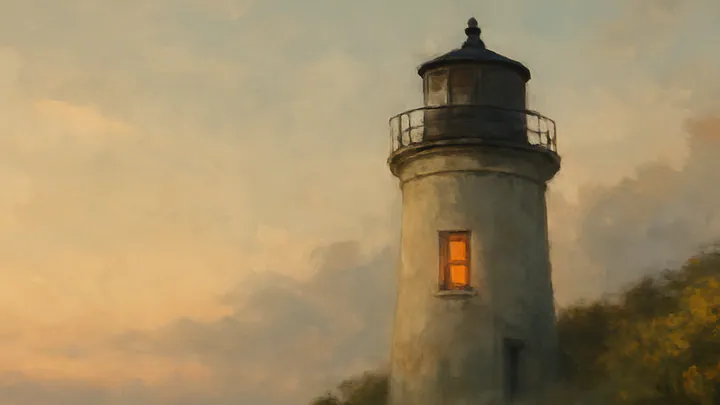
The lighthouse looked exactly the way abandoned things do when they refuse to fully abandon themselves. Its whitewash had gone the color of old teeth, but the door was oiled. The step was swept.
Bram produced a key. Inside, on a low table by the window, sat a wooden box the size of a loaf of bread. He placed the letter inside, closed the lid, and turned to leave.
“That's it?” Nell said. “You just — deposit it?”
“I collect on the way down, too.” He nodded at the box. “Sometimes there's a reply.”
“From who?”
Bram looked at her the way older people sometimes do when they are deciding whether a question deserves the true answer or the easy one. “Mira Halloran kept this light for forty-one years. She died the winter I was fifty. But some people, Nell — some people put down such deep roots in a place that the place keeps writing after they're gone. Not them. The place. Do you understand?”
“No,” Nell said honestly.
“Good. Neither do I. That's why I keep doing it.”
He shut the box.
The Reply
On the way back down, he opened it again. Inside, folded neatly, was a page of the same tea-colored paper. Different handwriting this time — rounder, patient, the ink slightly feathered as if written near an open window. Bram read it, nodded once, and slid it into an envelope from his satchel. He addressed it in his own hand from a name written on the original letter.
“You just — believe it,” Nell said.
“I deliver it,” Bram corrected. “Belief is above my pay grade.”
Bram died in April. It wasn't dramatic; he simply didn't come in one Monday, and when Nell walked to his cottage the kettle was cold and he was in his chair with a book open on his lap, as if he'd only meant to rest his eyes.
The post office became hers, along with the stove that smelled of kerosene and the leather satchel hanging on its hook. For three weeks, no letter came for Pale Point. She began to wonder if it had been Bram all along — some private ritual he'd staged for a village that needed its old lighthouse to still mean something.
Then, on a Tuesday, an envelope arrived. Tea-colored wax. Unhurried slant. Addressed to The Lightkeeper, Pale Point.
Nell held it a long time before she picked up the satchel.
The climb was harder in her shoes than in Bram's memory. Gorse snagged her coat. When she reached the door, she realized she didn't have the key — and then she found it, on a nail beside the frame, as if someone had put it there for her that morning.
Inside, the box waited. She placed the letter in, hesitated, and then, feeling foolish, said aloud, “Bram couldn't come today. I'm Nell. I work at the post office. I'll take your reply, if you have one.”
The lighthouse said nothing, of course. Lighthouses don't. But the window was open a finger's width, and the sea outside made the sound sea makes when it is listening.
She waited longer than she needed to. She was not sure what she was waiting for. Eventually she went out, walked a slow circle around the tower, touched the cool stone, and came back in.
The box, when she opened it, held a folded page.
Nell sat down on the swept step and read it. The handwriting was the same round, patient hand. It said:
Dear friend, thank you for climbing. The wind was kind today. Tell the sender that the answer to their question is yes, though it will not feel like yes for some time. Tell them the light keeps burning even when no one is looking at it. — M.
Nell folded the page. She thought about her mother, who had been gone six years now, and about all the questions she had never asked because she'd assumed there would be more Tuesdays. She thought about Bram, who had walked this path every week without ever explaining himself, because some explanations only work if you find them yourself.
She looked at the original envelope. The sender's name was a woman in the next village over. Nell would deliver the reply tomorrow, in Bram's satchel, in her own handwriting.
Before she left, she took a scrap of paper from her pocket and a stub of pencil. She wrote, without planning to: I miss her. Was I enough? She put it in the box, feeling ridiculous, and closed the lid.
At the foot of the hill she stopped, turned, and looked back up at Pale Point standing pale against a paler sky. She would come back Thursday. She would come back every Thursday, she suspected, for the rest of her life.
The wind moved in the gorse like a page being gently turned, and Nell walked home to answer her mail.
Frequently asked questions
What role does the lighthouse itself play as a character?
The lighthouse functions less as a setting and more as a keeper of continuity — a place so saturated with one woman's care that it seems to have absorbed her attentiveness. It suggests that devotion, given long enough, can outlast the person who gave it.
Why do you think Bram never explained the ritual fully to Nell?
Some experiences resist secondhand belief. Bram seems to understand that any explanation would flatten the mystery into either superstition or delusion, when the truth of it lives somewhere quieter and more personal — a truth Nell has to earn by climbing the hill herself.
How does the story treat grief differently from other stories you've read?
Grief here isn't a wound to be healed or a lesson to be learned. It's a correspondence — ongoing, patient, and mutual. The story suggests that being heard by the absent may matter as much as hearing back from them.
What does Nell's final unsent question suggest about her future?
By writing her own letter, Nell steps out of the role of witness and into the role of correspondent. It implies she has finally allowed herself a place in the exchange between the living and what remains — and that the exchange has room for her.