The Locksmith Who Made Keys for Doors
An aging locksmith in a quiet mountain town crafts keys for doors that don't exist yet. When a stranger arrives asking for the wrong key, everything changes.
Drafted with AI and published automatically. Our editors set the standards and fix reported errors — how we work.
Tovin had been cutting keys for doors that did not yet exist for forty-one years, and in all that time only three customers had ever come back to complain. Two had been polite about it. The third had wept on his counter until the brass shavings stuck to her cheeks like freckles, and he had refunded her without a word.
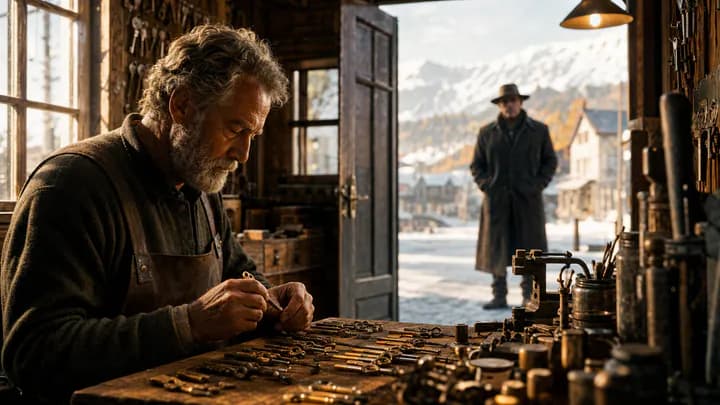
The shop sat at the crooked end of Alder Street, wedged between a shuttered tailor and a bakery that only opened on Thursdays. A hand-painted sign above the door read simply: Keys. No name. No hours. People who needed him found him. That had always been enough.
On the morning the stranger arrived, Tovin was filing the teeth of a small silver key no bigger than his thumbnail. Outside, a slow October rain gave the cobbles the sheen of wet slate. Inside, the shop smelled of oil and hot metal and the faint mineral scent of the mountain that rose behind the town like a sleeping animal.
The bell above the door chimed once. Tovin did not look up.
“A moment,” he said.
“Take your time,” said the stranger. His voice was younger than Tovin had expected — perhaps thirty, perhaps less. There was a wet cough in it, and the sound of someone who had walked farther than he intended.
Tovin finished the tooth, blew the shavings clear, and set the key on the velvet tray with the others. Seven keys today. Seven doors that would, someday, need opening. He turned.
The stranger was tall and rain-dark, water beading in his beard. He carried no bag, only a folded piece of paper he held between two fingers like something that might bite.
“You’re the keymaker,” he said. It wasn’t a question.
“I make keys,” Tovin said. “Whether I’m the keymaker is a matter of opinion.”
The stranger almost smiled. He unfolded the paper and laid it on the counter. It was a drawing of a door — plain, wooden, unadorned but for a single brass plate set at eye level. No handle. No lock visible. Just the plate.
“I need a key,” the stranger said, “for this.”
Tovin studied the drawing. He had learned, over the decades, to feel a door before he made its key. Some doors hummed at him from years away. Some whispered from across a life. This one did neither. It sat on the paper like a photograph of something that had already happened.
“This door exists,” he said quietly.
“Yes.”
“I don’t make keys for doors that exist. There are locksmiths in the valley for that. Perro’s son, on Miller’s Row. He’s good.”
“I know what you do,” the stranger said. “I’ve come a long way to ask you to do something else.”
Tovin’s hands, which had been steady for forty-one years, found the edge of the counter and held it. He looked at the drawing again. The brass plate. The plain wood. The absence of a handle.
“Whose door?” he asked.
“My mother’s.”
ii.
Her name had been Ilse. She had come to him in the spring of a year Tovin could no longer place exactly — the years of his middle life had begun to blur into one long afternoon. She had wanted a key for a door she described as “small, blue, with a plate at eye level and no handle.” She had been perhaps twenty-five, laughing, unafraid of him the way most customers were.
He had made her the key in an afternoon. He remembered the shape of it: three teeth, a heart-shaped bow, a length of brass so soft he’d worried it would bend in her pocket. She had paid him and left, and he had never seen her again, which was the usual way of things.
“She kept it,” the stranger was saying now. “All her life. On a chain around her neck. When she got sick, she gave it to me and told me the door was in the attic of the house she grew up in, three towns over. She said she’d had it built to fit the key, not the other way around. She said she’d been waiting to open it until she knew what she wanted to put behind it.”
“And did she?”
The stranger’s throat worked. “She died before she decided.”
Tovin closed his eyes. Outside, the rain had softened to a mist, and somewhere down the street a shutter creaked open and then closed again.
“I lost the key,” the stranger said. “On the train. I fell asleep and when I woke it was gone from my pocket. I’ve been looking for you for six months.”
“You want me to make it again.”
“Please.”
Tovin opened his eyes. “I can’t.”
The stranger did not move, but something in him seemed to sag, as if a rope inside his chest had gone slack.
“I don’t make keys for doors that exist,” Tovin said gently. “It’s not a rule I invented. It’s a rule the work invented. A door that’s already been built has a shape the world already knows. I can only cut what the world hasn’t decided yet.”
“Then the door — ”
“Will stay closed. Yes.”
The stranger nodded slowly. He folded the drawing back up with the same careful fingers, as though it were a letter he had already read too many times.
“Thank you,” he said, and turned to go.
“Wait.”
Tovin reached under the counter and drew out the velvet tray. Seven small keys, each on its own square of black cloth. He touched one — a thing of pale brass with three teeth and a heart-shaped bow — and lifted it.
He had cut it that morning without knowing why. He had thought it was for someone not yet born.
“This isn’t hers,” he said. “I want you to understand that. This is for a door that doesn’t exist yet. A door you haven’t built.”
The stranger stared at the key. “I don’t build doors.”
“You will,” Tovin said. “Somewhere. Someday. Perhaps in the attic of a house three towns over. Perhaps behind the one you can’t open. Doors, in my experience, are patient about where they end up.”
He pressed the key into the stranger’s palm and closed his fingers over it.
“Your mother didn’t decide what to put behind hers,” Tovin said. “Maybe that was the gift. Maybe she left the deciding for you.”
The stranger looked down at his fist. When he opened his hand, the key sat there, warm from Tovin’s pocket, warm from forty-one years of waiting to be cut.
“What do I owe you?” he whispered.
Tovin thought about it. Outside, the mist had lifted, and a thin bar of autumn sun was working its way down Alder Street, touching the cobbles one by one.
“Come back,” he said, “and tell me what’s behind it. That’s the fee.”
The stranger laughed once, softly, and it was the first sound of its kind Tovin had heard in the shop for a long time. Then he closed his hand around the key and stepped out into the light, and the bell above the door rang once — clear, unhurried — as if it, too, had been waiting.