The Sound Engineer for an Empty Theater
Every night, Pell mixes a flawless show for a house with no audience. Then one Tuesday, somebody coughs in row F.
Drafted with AI and published automatically. Our editors set the standards and fix reported errors — how we work.
The marquee outside the Orpheum still lit up at 7:42 every evening, even though no one had bought a ticket in eleven years. Pell knew, because she watched the box office logs scroll past on the same monitor where she watched the empty house.
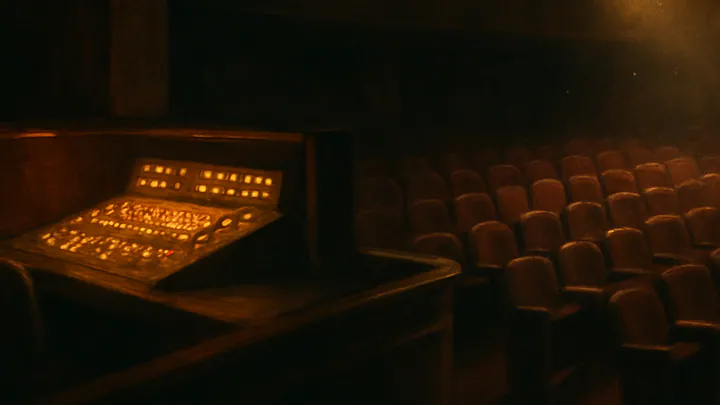
Her booth was a small dark room at the back of the balcony, soundproofed with foam the color of old bread. From here she ran the sound for a show that no longer existed, in a theater that the city had quietly forgotten to demolish. The pay arrived every other Friday from a trust that had outlived the man who'd set it up. The instructions, framed beside the console, were three lines long:
Mix the show as written. Every performance. Until further notice.
She was forty-one years old and had been doing this since she was thirty.
The show was called The Quiet Hour. It had run for one preview night in 2013 to lukewarm reviews and then closed when the lead actress walked out and the playwright, a man named Aldo Vesh, died of a stroke three days later in the lobby. Pell had been the sound assistant. She had been the one who found him.
The trust paid her to keep mixing it. So she did.
She cued the pre-show music at 7:55. House lights to half at 7:58. At 8:00 sharp she brought up the opening soundscape — wind through a wheat field, a distant train, a dog barking twice — and watched the empty stage as if actors might walk on. Sometimes she imagined them. After eleven years, she had imagined them so completely that she could hear their footsteps land on the beats Aldo had marked in the script.
It was a Tuesday in October when somebody coughed in row F.
Pell froze with her fingers on the fader. The cough had been small, polite, the kind of cough a person makes into their sleeve so as not to disturb anyone. She leaned forward and pressed her face against the booth glass.
Row F was empty. Every row was empty. The stage was empty. The wheat field hissed quietly out of the house speakers, exactly as written.
She told herself it was the building settling. Old theaters made all kinds of noises, and the Orpheum was older than her grandmother. She brought up the next cue — a woman humming, off-stage left — and tried to steady her breath.
At the end of Act One there was applause.
Not a full house. Maybe twenty pairs of hands. Scattered, uneven, the way real applause sounds when an audience isn't sure yet whether they like what they're seeing but wants to be encouraging. It rolled up from the orchestra section and lingered against the proscenium and then faded as the house lights came up for intermission.
Pell sat very still in her booth. The seats below her were empty. They had been empty for eleven years. She could see the dust on them from here.
She did not call anyone. Who would she call? She walked down to the lobby instead, where the concession stand had been dark since before she started, and she stood under the chandelier and listened. The building was quiet. A radiator ticked. Outside, a bus sighed past on the avenue.
She went back up and ran Act Two.
The Second Night
On Wednesday, the cough in row F came again, in the same place — the fourth minute, just after the soundscape softened to let the imaginary lead deliver her first monologue. This time Pell was ready for it. She did not flinch. She kept her hands on the board and she listened.
There was a rustle of a program, two rows back. Someone shifted in their seat. A man cleared his throat near the aisle.
Pell closed her eyes.
She had spent eleven years mixing a show for no one, and she had told herself, in the way you tell yourself things you need to believe to keep getting up in the morning, that the work was its own audience. That the sound was a gift she was giving to the air. That Aldo, wherever he was, could hear it.
But the truth, which she had not let herself say out loud, was that she had been lonely in a way she could not name. The kind of lonely that comes from doing careful work where no one is watching. She had begun to suspect, around year seven, that she was not a sound engineer anymore but a kind of caretaker for a grave.
And now the grave was full of people.
She ran the show clean. She did not push any cue too hard or hold any moment too long. She gave them what Aldo had written, exactly as he had written it. At the curtain — there was no curtain, but at the place where the curtain would have fallen — the applause came up like weather. It went on for a long time.
When the house lights came up, the seats were empty.
What She Decided
On Thursday she brought a thermos of tea and a notebook. She mixed the show. She listened. Between cues she wrote down what she heard: a child whispering a question to a parent in row J; someone laughing too early at a line that wasn't a joke; a woman in the back crying, very quietly, during the scene where the lead remembers her sister.
By Friday she understood that she was not going to tell anyone. Not the trust, not the building manager who came by once a month to check the locks, not the few old friends she still spoke to. If she told, somebody would come. They would bring meters and microphones and explanations. They would either find nothing, which would break her heart, or they would find something, which would take it away from her.
She thought about Aldo, who had died in the lobby before anyone got to tell him the show was actually quite good. She thought about the lead actress, who had walked out because she couldn't bear to be looked at, and who had been right to walk out, and who had also been wrong.
She thought about all the careful work in the world, done in rooms where no one was watching, and how maybe somebody had been watching the whole time, and just hadn't found a way yet to cough politely from row F.
On Saturday night Pell mixed The Quiet Hour for the eleven-years-and-two-hundred-and-thirty-first time. The wind moved through the wheat. The train passed in the distance. The dog barked twice.
And from somewhere in the dark below her, an audience leaned forward to listen.