The Cartographer of Empty Rooms
When a quiet woman is hired to map a house that keeps forgetting itself, she discovers the rooms are waiting for someone to remember them properly.
Drafted with AI and published automatically. Our editors set the standards and fix reported errors — how we work.
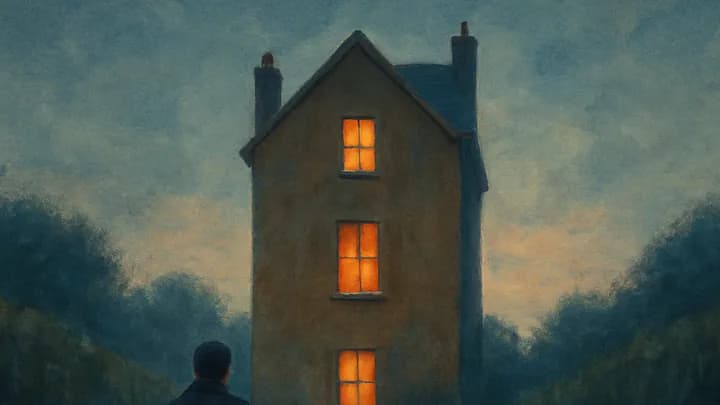
The letter arrived in a cream envelope thick enough to stand on its edge, and inside it Mireille Acheson was offered more money than she had ever made to draw a map of a single house. The client's name was unfamiliar. The address was three trains and a taxi away. The postscript said, in tight blue ink: Please bring pencils that are willing to be wrong.
She accepted by telegram, which the client had requested, and which the post office clerk had to look up in a binder.
The house sat at the end of a road that pretended to be a driveway. It was tall and narrow and the color of weak tea, with a slate roof that sagged like a thinking forehead. A woman in a gardener's apron met Mireille at the gate. She was perhaps seventy, perhaps a little more, and she carried a pair of secateurs as if they were a small, useful dog.
"You're the cartographer," the woman said. It was not a question. "I'm Edith. The house is shy. Please don't compliment it on the first day."
"I wasn't planning to."
"Good. The last one called the staircase charming and we lost the second floor for a week."
The First Survey
Mireille had mapped many things. Vineyards. A monastery garden. Once, a library whose owner wanted every shelf catalogued by the angle of afternoon light. She had a steady hand and a habit of not asking why.
She set up in the front hall with her board, her tape, her compass, and a tin of pencils she had inherited from her father, who had drawn coastlines for a living and had never once drawn his own kitchen.
The hall was modest. A coat rack. A console table with a bowl for keys. A door to the left, a door to the right, and a staircase that climbed straight and unembarrassed to a landing.
She measured the hall and wrote down its numbers. She opened the left door.
It was a kitchen. Sunlight through gingham curtains. A kettle just beginning to think about whistling. She closed the door, opened it again. It was a small library, no kettle, no curtains, the smell of paper and pipe tobacco from a pipe nobody had lit in decades.
Mireille closed the door a third time and stood with her hand on the knob.
"It does that," Edith said behind her, mild as weather. "Tea?"
Over tea, which appeared in the room that had decided, for the moment, to be a kitchen, Edith explained what she could.
"My brother lived here forty-one years," she said. "He was a careful man. He kept the house in his head — which room was which, which window faced which tree, where the cold spot was on the landing in February. When he died last spring, the house began to forget. Not all at once. The attic went first. Then the music room misplaced its piano for three days, and when it came back, it was a different piano."
"Different how?"
"Younger. The one he had as a boy." Edith stirred her tea. "I don't want to sell a house that can't remember itself. It isn't fair to the buyer, and it isn't fair to the house. I thought — perhaps if someone made a proper map. Something it could lean on."
Mireille turned this over. "Maps don't usually do anything. They describe."
"My brother believed description was a kind of kindness," Edith said. "He believed if you wrote a thing down clearly enough, it stopped being lonely."
The Second Week
Mireille worked slowly. She drew the hall first, then the staircase, then the landing, with its February cold spot marked by a small blue asterisk. She did not try to fix the rooms in place. She drew what was there when she was there. When the kitchen became a library, she drew the library beside the kitchen on the same page, and she labeled the door Door (undecided).
She found a room on the third floor that nobody had mentioned. It contained a child's bed, a model ship half-finished on a desk, and a window that looked out onto a garden that was not the garden currently outside. In the map-garden, a younger Edith, unmistakable, was kneeling in the dirt with a boy of about ten. The boy was laughing at something the girl had said.
Mireille drew the room. She drew the window. She did not draw what was in the window. That felt like trespassing.
When she came down for supper, Edith was at the table with bread and soup and a face that had been crying quietly and was now finished.
"You found his room," Edith said.
"I think so."
"He always said it would come back if someone was patient." Edith broke bread. "He was the patient one. I was the one with the secateurs."
On the last day, Mireille spread the finished map across the dining table. It was not a tidy map. It had marginalia. It had small notes in pencil: this door prefers mornings, the cold spot moves in leap years, the third-floor room answers to the name Tomas.
Edith read it the way one reads a long letter from someone loved. Then she folded her hands.
"What do I owe you for the extra pages?"
"Nothing," Mireille said. "They were already there. I only drew them."
Edith pressed the map flat with both palms, as if settling a tablecloth, or a small animal. The house, around them, made a sound that was not a creak and not a sigh, but something in the family of both. The kitchen door, which had been undecided all afternoon, clicked softly and chose.
Mireille walked back down the driveway in the long blue light. She had her tin of pencils and a check folded into her notebook and the strange light feeling of having drawn something that was, for once, willing to be wrong with her.
On the train home she opened her notebook to a clean page. She wrote, at the top, in her steadiest hand: A map is a promise to keep noticing. Then she underlined it, twice, because some promises like to be told they have been heard.