The Tide Is Due Before the Plane Is
A short story about a flight information officer on Barra's beach airstrip, an overdue air ambulance gone quiet on the radio, and a tide that will not wait.
Drafted with AI. This version has not been reviewed by an editor, so it carries no ads — how we work.
Story Time is original short fiction. The characters, places and events in this story are invented.
The Islander was eleven minutes past its position report and the radio gave Morag nothing but a sound like fat in a pan. She keyed the microphone again. "Kilo Victor, Barra Information, how do you read?" She let go. Fat, frying. A long sigh of static, then nothing.
She wrote 15:02 no call abeam Coll in the daily log in pencil, because pencil could be rubbed out if he came on in the next minute. The kettle on the filing cabinet clicked off. She did not pour it.
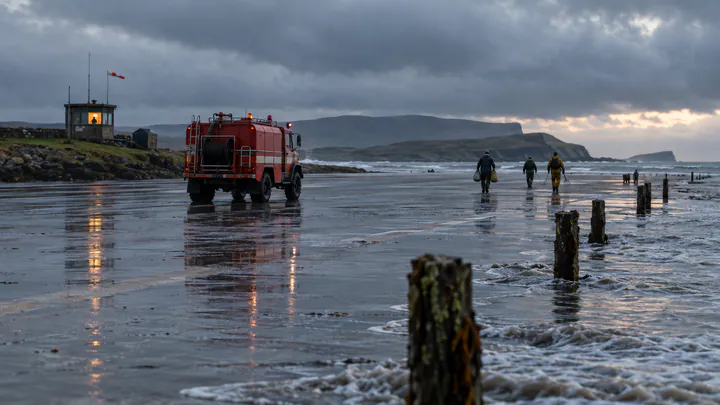
Out of the tower window the Cockle Strand ran flat and pewter-coloured for a mile, the three runways marked by nothing but wooden posts and the memory of tyre tracks. The cockle-pickers were already working back toward the road, bent under their sacks, rakes over their shoulders like rifles. Old Lachie MacKinnon was last, as always, stopping to toss a few undersized ones back into a pool. At the far north end the sand had begun to shine.
The tide table was taped to the desk under a sheet of perspex gone yellow at the edges. High water 16:51. Strand closes when the sea reaches the third marker on the northern runway, which by her own reckoning from twenty-two years on the ferries and nine in this chair would be twenty to four, give or take the wind. The wind was southwest and freshening. Take, then, not give.
She lifted the telephone and rang Scottish Information at Prestwick.
"Barra here. I've an air ambulance charter, Kilo Victor, Glasgow to Barra, gone silent on me. Have you him?"
A young man, unhurried. "We had him twenty minutes ago, very scratchy. He's reporting a radio fault and stronger headwinds than forecast. Revised estimate for you, fifteen forty-five."
Five minutes past the third post. She thanked him and put the phone down very gently, as if it might go off.
At 15:09 the stairs creaked and Peigi MacNeil put her head round the door with a tartan flask held in both hands like an offering.
"I'm not to come up, I know," she said, coming up. "I only thought you'd be wanting tea."
"I've a kettle, Peigi."
"You've a kettle you never pour, Morag Campbell. I've seen you." Peigi set the flask on the edge of the desk, nowhere near the radio, a woman who knew where not to put things. "He's late."
"Headwind."
"Hector says they'll not let him eat anything but jelly." She looked out at the strand. "He'll want his own chair. Four weeks in that Glasgow bed and he's been on the phone every night about the chair."
Morag knew what the surgeon had taken out of Hector MacNeil and what he had left in, because everyone on Barra knew. She knew, too, that a man three weeks past that kind of operation should not be bounced round the Minch in a ten-seater for longer than he had to be.
"Go down to the waiting room, a ghràidh," she said. "I'll shout."
Peigi went. She left the flask.
At 15:14 the radio coughed, and in the cough there might have been a word. Morag pressed the headset to her ear with the heel of her hand. "Kilo Victor, Barra, say again." Static, and under it a pulse that could have been a carrier wave or her own blood. She wrote 15:14 possible weak transmission, unreadable. Pencil still.
The fire tender's radio crackled in on the ground set, clear as a bell, which felt like an insult.
"Morag, it's Donnie." Donnie MacLean, crew chief, forty years old and still drove the tender as if it were a tractor at a show. "I'm sat at the second post. The sand's good here yet. I could stay out for him."
"The water's at the first post on the north side."
"Aye, I can see it. I'm saying the second post is high ground. Twenty minutes more, I'd be fine."
"You'd be fine until you weren't."
A pause. She could picture him with his elbow out the window, his nephew Ruaraidh beside him in the cab chewing the inside of his cheek, nineteen and three months on the crew.
"It's Hector," Donnie said.
"I know who it is."
She had seen a tender go into the sand once, in her second winter. Not here; at an exercise down at the south end, a soft patch nobody had marked. The wheels had gone in to the hubs in the time it took to say so. They had dug for an hour and the sea had come and stood around the vehicle like a crowd at an accident, polite, interested, and in the end they had walked away from it and watched the water climb the doors. Nobody hurt. A new tender from the mainland in the spring, and a report that ran to eleven pages, and it had not been her report.
Four more weeks of this season. Then a cottage at Eoligarry, a dog, maybe, and a radio she could switch off.
"Hold where you are, Donnie," she said. "Don't move toward the north end. I'll tell you."
At 15:26 Prestwick rang back. Kilo Victor had been heard again, faint, passing Tiree. Fuel fine. Patient stable but tired. Estimate unchanged: fifteen forty-five.
"Does he know about my tide?" Morag asked.
"He's asking about it," the young man said. "That's mostly what he's asking about."
She looked at the strand. The water had passed the first post and was coming the way the sea always came here, not in waves but in a sheet, the sand going dark and then going glass, a few inches at a time that added up to yards. The cockle-pickers' van pulled out of the lay-by. Lachie lifted a hand to the tower without looking up. He did that every day; she had never once known whether he was waving at her or at the building.
At 15:31 the third post had a ring of shine around its foot that wasn't water yet, only the sand going soft. She knew that look. She had seen it from the car deck of the ferry at a hundred slipways, the moment before a ramp stopped being a ramp.
"Donnie."
"Aye."
She held the key a moment longer than she needed to. Then she said it.
"Bring the tender in to the apron. The strand is closed."
He did not argue. That was worse. "Coming in," he said, and she watched the red shape turn and crawl up toward the dunes, leaving two dark lines that filled with silver behind it.
She wrote 15:38 water at third marker, strand closed, and she wrote it in ink.
At 15:41 Kilo Victor came on frequency loud and close, as if the radio had only been waiting for her to make up her mind.
"Barra, Kilo Victor, we're ten miles southeast, you have us now?"
"Kilo Victor, Barra, reading you five. Fergus, the strand is closed. Water's over the northern runway. I can't give you a landing."
A silence that had no static in it at all.
"Morag, I've got Hector in the back." Fergus Rennie's voice, Aberdeen vowels flattened by the headset. "He's grey. He's been asking was that Barra yet since Islay."
"I know. Benbecula's open, wind two-two-zero at eighteen knots, cloud broken at fifteen hundred. Steer three-five-zero, it's thirty-four miles. Benbecula on one-one-nine decimal two. I'll ring them now for an ambulance on the apron."
Another silence. She could hear the engines behind his breath.
"Three-five-zero," he said finally. "Tell Peigi."
"I'll tell her."
She talked him up the Sound of Barra and past Eriskay, read him the Benbecula weather twice more because the cloud was dropping, gave him the frequency change, and heard him go. She rang Benbecula. She rang the ambulance station. She did not pour the tea.
Then she went down the stairs.
Peigi was standing at the window of the waiting room with her coat already on. She had watched the tender come in. She did not need to be told much.
"Benbecula," Morag said. "There'll be an ambulance at the aircraft. There's a bed for him at the hospital in Balivanich tonight."
Peigi buttoned the top button of her coat, unbuttoned it. "His brother's in Benbecula," she said. "They've not spoken since nineteen eighty-one."
"Well," said Morag. "There's a thing."
"There's a thing," said Peigi.
At 15:58 the phone in the tower was ringing when she reached the top of the stairs. Alasdair at Benbecula: Kilo Victor down at fifty-six, patient complaining about the jelly, ambulance on its way to Balivanich. They'd have him on the morning boat from Ludag across to Eoligarry if the doctor signed him off.
Morag shouted it down the stairwell. She heard Peigi say something in Gaelic that was not a prayer.
Then she opened the bottom drawer of the desk, where the incident forms had sat for nine years in their cellophane, and slit the packet with the paper knife. She uncapped her good pen. Date, aerodrome, aircraft registration, time. Under Nature of Occurrence she paused, then wrote, in letters as round and level as she had ever made them: Aircraft unable to land due to tide. Strand closed at 15:38. Diverted to Benbecula. All persons safe.
She read it over once. Then she poured Peigi's tea from the flask, still hot, and drank it at the desk while the sea filled in the tyre tracks.