The Understudy of Rehearsal Room B
For eleven weeks, Mira has understudied a role she will never perform. Then, on a rainy Thursday, the leading actress hands her a key and asks for a favor.
Drafted with AI. This version has not been reviewed by an editor, so it carries no ads — how we work.
Mira had been an understudy for eleven weeks, and in that time she had learned that waiting is a kind of muscle. It ached in her jaw more than in her legs.
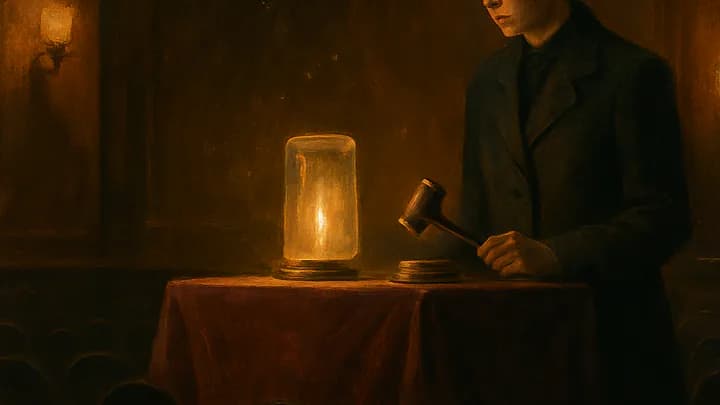
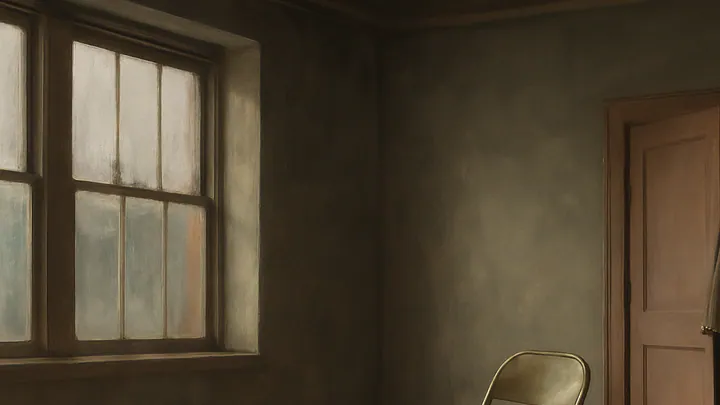
Rehearsal Room B sat at the end of a corridor that smelled faintly of lemon cleaner and old radiator paint. She arrived every afternoon at four, took the folding chair nearest the door, and opened her script to the pages she had already memorized in September. She mouthed the lines silently while Elena — the actual Nora, the reviewed and photographed Nora — stood in the taped rectangle at the center of the floor and did the play for real.
Elena was not unkind. That was the trouble. If she had been cruel, Mira could have made a private theater of resentment and lived comfortably inside it. Instead, Elena brought her a paper cup of tea on Tuesdays and once complimented the way Mira had underlined a stage direction. "You've thought about it," she said, tapping the page. "Most people just highlight the words they say."
Mira had thought about it. She had thought about almost nothing else since August. She knew where Nora ought to breathe, where the second act asked her to keep her hands very still, where the director wanted a laugh that Elena delivered instead as a small, tired sigh. She thought Elena's choice was better. She hated that she thought so.
A Thursday in November
The rain that Thursday was the sort that made the windows in the corridor look like poured tin. Mira arrived early and found Elena already there, coat still on, standing at the taped rectangle with her arms folded.
"Mira," Elena said. "I need a favor."
Mira set down her bag. In eleven weeks, Elena had never asked her for anything more than the loan of a pencil.
"My sister," Elena said. "She's in from out of the country tomorrow, only for the day. I promised her years ago I'd take her to the coast for her birthday and I have kept promising and not keeping it. Tomorrow is Friday. We rehearse Friday afternoon."
"You want me to cover," Mira said. Her voice came out level, which surprised her.
"I want you to rehearse," Elena said. "Not perform. There's no audience Friday. It's just Petar and the blocking notes and the new lighting cues. But he'll only do it if there's a body in the rectangle. I've told him you know it. He grunted. That's a yes."
Petar was the director. He grunted at most things.
Elena drew a small brass key from her coat pocket and offered it. "For the dressing room. My robe is in there. I keep it hanging on the door — it helps me think. You can use it if you like. Or don't. Only, don't leave it on the floor."
Mira took the key. It was warm from Elena's pocket.
"Thank you," Elena said, and she said it as if Mira had already agreed to something larger than a Friday afternoon.
That night Mira did not run her lines. She had run them enough. Instead she made a small dinner, ate it standing at the counter, and stood a long time at her window watching the wet street below. A man in a yellow slicker was walking a dog that refused to move. He waited. The dog waited. Eventually one of them decided.
She thought about the eleven weeks. She thought about the way her mother, when told Mira had been cast as understudy, had said Oh, sweetheart, that's wonderful in a voice that meant I don't know what that is but I love you. She thought about the friend who had asked, gently, whether understudying counted as a job or a hobby. She thought about the small, unglamorous fact that she had been paid — not much, but paid — to learn a role and be ready.
Ready for what, exactly. That was the question that had been chewing at her since October. Ready for an accident, an illness, a missed train. Ready to be a substitute for someone else's evening. It had begun to feel less like preparation and more like a superstition, the way people carry umbrellas in cities where it never rains.
She turned the brass key over in her palm. The trick of it, she thought, was that she had been treating readiness as a kind of debt. As if all the hours she had put in were owed back to her, in the currency of a stage and an audience. But that ledger did not exist. No one was keeping it.
The hours were hers. That was the whole of it.
Friday
Rehearsal Room B at two in the afternoon had a different quality of light than at four. The rain had thinned to a mist. Petar was already there, one boot up on a folding chair, reading something on his phone with the expression of a man who suspected the phone of lying.
"You know it?" he said, without looking up.
"I know it," Mira said.
"Good. Start from the top of two. I want to see the new cross to the window."
She went to the dressing room first. Elena's robe hung on the back of the door, a soft grey thing with a frayed cuff. Mira did not put it on. She touched the sleeve, once, and then went out.
She stood in the taped rectangle. It was smaller than it had looked from the folding chair. The tape was scuffed at one corner where Elena always pivoted. The window Petar wanted her to cross to was not a window — it was a chalk mark on the wall, with a number written next to it in Petar's crabbed hand.
"Whenever you're ready," Petar said.
Mira breathed. She thought about the sigh instead of the laugh. She thought about where Nora's hands ought to be. She thought, briefly and without bitterness, of Elena on a train to the coast with her sister, watching flat wet fields go by.
Then she spoke the first line.
It was not a performance. There was no audience, no lights, no reviewer with a notebook. There was only Petar, and the chalk mark, and the scuffed tape, and her own voice moving through a room that smelled of lemon cleaner and old paint. She crossed to the window. She kept her hands very still in the second act. When she reached the sigh, she gave it a fraction more air than Elena did, and Petar looked up from his phone.
He did not say anything. He watched. When she finished the scene he made a small mark in his notebook and said, "Again. From the cross."
She did it again. And again. By the fourth pass the light through the tin-colored windows had shifted, and she had stopped noticing that she was in a taped rectangle at all.
At four o'clock Petar closed his notebook. "Same time Monday," he said, as if she had been coming to rehearsal as herself all along. Then, at the door, he paused. "You've thought about it," he said, and left.
Mira stood alone in Rehearsal Room B for a moment longer. She returned the brass key to her pocket. She had not needed the robe. She had not, it turned out, needed very much at all.
Outside, the mist had lifted, and the street below the corridor windows was beginning, slowly, to dry.