Smart Storage Solutions: Declutter Your Home Like a Pro
Smart storage only works if you declutter first, measure second, and buy last. Here's a room-by-room plan with real dimensions, honest cost ranges, renter-safe fixes, and the expensive mistakes almost everyone makes on their first pass.
Rewritten with AI and republished automatically. Our editors set the standards and fix reported errors — how we work.
TL;DR: Smart storage isn't a shopping list — it's a sequence. Declutter first, measure second, buy last. Then match each room's storage to how you actually move through it: vertical space in small rooms, pull-outs in deep cabinets, and renter-safe fixes where you can't drill. Skip that order and you'll own expensive bins full of things you don't need.
Smart storage is any system that puts an item within easy reach of where it's used while taking up space you weren't otherwise using. That definition matters, because it rules out a lot of what gets marketed as organization. A stack of matching bins in a garage isn't smart storage if nobody remembers what's inside them. A drawer divider that turns a utensil jumble into three seconds of reaching is.
This guide is built around what actually changes a home: dimensions, sequence, cost brackets, and the failure modes nobody warns you about.
Where should I start if my entire home feels cluttered?
Start with the horizontal surfaces in the room you use most — counters, coffee table, nightstand, entryway console. Visual clutter is overwhelmingly a surface problem, so clearing flat planes delivers the biggest perceived change for the least effort. You'll feel the difference within an hour, which is what keeps the project alive.
Only after that should you open a closet or cabinet. Closets are slow, emotionally loaded work; surfaces are fast wins. Beginning with the hardest zone is why most decluttering projects stall on day two, with the contents of a wardrobe spread across the bed at 9 p.m.
A useful decision rule when you're stuck holding something: if you haven't used it in a year and could replace it cheaply and quickly should you ever need it again, let it go. The cost of storing an item — in space, in searching time, in the container you buy for it — usually exceeds the small risk of needing it later.
How much does smart storage actually cost to set up?
Anywhere from almost nothing to several thousand dollars, and the expensive end is rarely the effective end. Below are the most common brackets. Prices swing by region and retailer, so read them as ranges rather than quotes.
| Tier | Typical spend | What it buys | Best for |
|---|---|---|---|
| Zero-spend | $0 | Decluttering, relocating items closer to point of use, repurposing existing boxes and jars | Everyone, as a mandatory first pass |
| Bins and dividers | Tens of dollars per room | Drawer dividers, fabric bins, hooks, tension rods, shelf risers, labels | Renters, small fixes, kitchens and bathrooms |
| Furniture that stores | Low hundreds per piece | Storage ottomans, lift-up bed frames, benches with cubbies, TV units with drawers | Living rooms, bedrooms, entryways |
| Modular closet systems | Low to mid hundreds | Adjustable shelving, hanging rods, drawer towers you install yourself | Owners and long-term renters with landlord approval |
| Custom built-ins | Thousands | Cabinetry made to your wall, with pull-outs and integrated lighting | Awkward architecture — under stairs, sloped ceilings, alcoves |
If a storage overhaul is going to cost real money, plan for it rather than reaching for a credit card mid-project. Setting aside a fixed monthly amount for household projects keeps a closet system from becoming a debt. This is general household budgeting, not financial advice.
What are the best bedroom storage solutions for a small room?
Under-bed containers, a lift-up or drawer bed frame, and vertical closet dividing are the three that consistently pay off. The bed is the largest unused volume in most bedrooms, and closets are almost always half-empty above eye level.
Measure before you buy anything. Run a tape from the floor to the lowest point of the frame — including any center support rail, which is often lower than the side rails — and subtract about half an inch for wheels and carpet pile. Standard frames give roughly 7 to 12 inches. Low-profile containers are around 6 inches tall; risers can add several inches more, but only if your frame's legs are solid and the manufacturer permits it.
In the closet, the fastest capacity gain is a second hanging rod beneath shirts and jackets. Shirts need about 40 inches of vertical space, so a single 84-inch closet often wastes two feet of air. A tension rod or a hanging double-rod attachment doubles that section for very little money.
Storage is only half the equation, of course — owning less clothing is the other half. Our bedroom refresh ideas cover the lighting and textile changes that make a decluttered room feel finished rather than bare.
How do I organize a kitchen with no pantry?
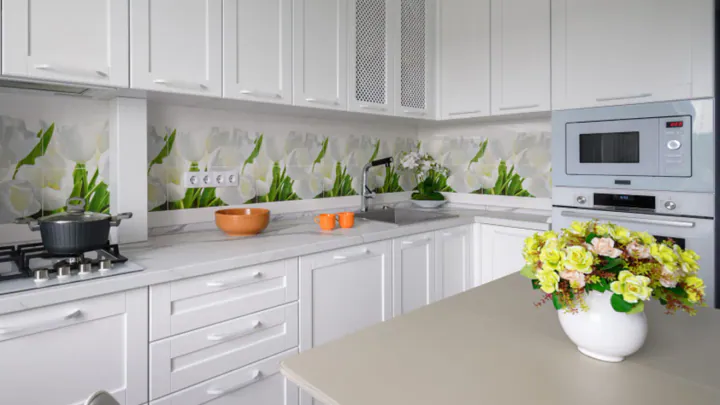
Convert depth into access. Standard base cabinets are about 24 inches deep, which means the back third is functionally invisible. Pull-out wire or wooden trays retrofit into most base cabinets and turn that dead zone into usable shelf space — usually the single highest-value kitchen upgrade per dollar.
Then go vertical and magnetic. Upper cabinets are typically only 12 inches deep, so shelf risers add a genuine second tier for mugs and cans. A magnetic knife strip frees an entire drawer or block. Over-the-door racks work on most pantry and cabinet doors if you have roughly 1.5 to 2 inches of clearance between the door and the nearest shelf — measure this, because it's the most common return.
One honest caveat: decanting everything into matching glass jars looks wonderful and costs you time forever. If you cook daily, keep the original packaging for anything with cooking instructions, and decant only the staples you refill on a schedule. Fewer, simpler systems survive a busy week; a kitchen built around fast weeknight meals needs speed more than it needs symmetry.
What storage works in a rental where I can't drill into walls?
Tension rods, over-the-door organizers, freestanding shelving, rolling carts, adhesive hooks, and furniture with storage inside it. None of these touch the structure, and all of them move with you.
- Tension rods work in shower alcoves, under sinks (for spray bottles), and inside closets for a second hanging tier.
- Rolling carts fit the 8–12 inch gaps beside refrigerators and washing machines that otherwise collect dust.
- Over-the-door racks suit standard 30–32 inch interior doors, but check the door closes freely with the rack loaded.
- Adhesive hooks and strips are rated for modest weights only. Respect the rating, clean the wall with rubbing alcohol first, and let the adhesive cure for the full time on the packet before hanging anything.
Two rental-specific warnings. First, adhesive strips fail in humidity — bathroom installations often peel within months, taking paint with them. Second, photograph every wall at move-in and before you attach anything. That five-minute habit has settled more security-deposit disputes than any organizing product ever will.
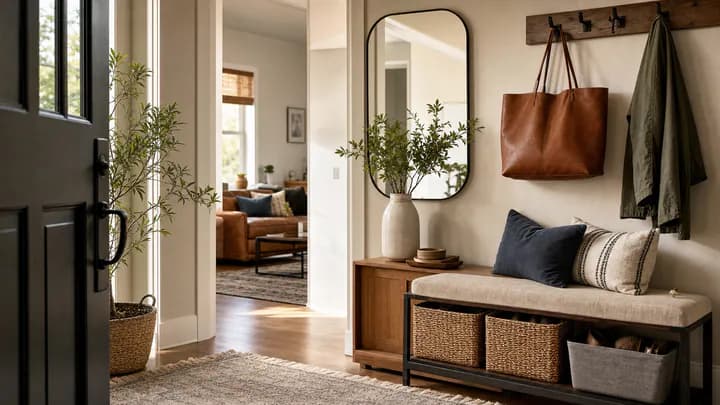
The entryway is where rental clutter concentrates fastest, because it's where everything enters the home. Our guides to small entryways that work hard and making the first three feet count cover the hook-height, bench-depth and basket details that stop a hallway from becoming a dumping ground.
How do I keep kids' rooms organized without constant nagging?
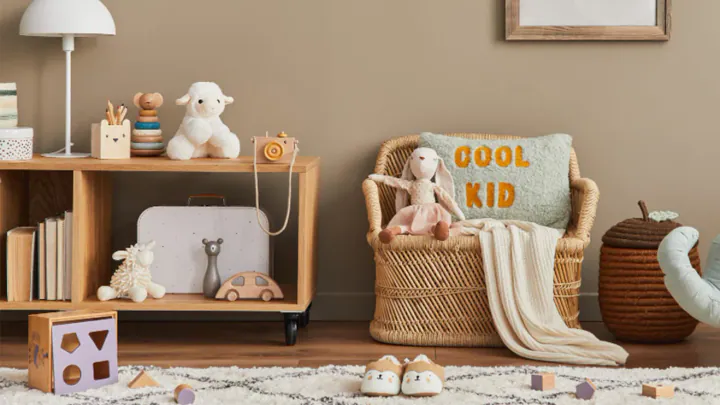
Lower the effort required to put something away to under three seconds. Open bins beat lidded boxes; storage at the child's height beats a high shelf; picture labels beat word labels for pre-readers. Children don't resist tidying — they resist multi-step tidying.
A worked example. A bedroom with a toy chest produces the same result in most homes: everything goes in, the chest becomes a geological record, and the bottom layer is never touched again. Replace it with four or five open bins on a low shelving unit, each with a photo of its contents taped to the front, and cleanup becomes sorting rather than excavating. The toys at the bottom re-enter circulation, which also reduces the pressure to buy new ones.
Rotate rather than expand. Keeping roughly half the toys in a closed bin in a closet and swapping every few weeks cuts visible clutter immediately and makes returning items feel novel. This does not apply to comfort objects and current favorites — those stay out, always.
What are the most common and costly storage mistakes?
Buying containers before decluttering, ignoring depth, and building systems that require maintenance you'll never do. Each one costs money, and the third costs money twice.
- Bins before sorting. You size storage for the volume of the mess rather than the volume of what you're keeping — then you fill the extra space, because empty space in a bin is an invitation.
- Shelves deeper than about 16 inches without pull-outs. Anything past arm's reach becomes archive, not storage. Shallow and visible beats deep and hidden, every time.
- Anchoring into drywall without a stud. US wall studs are typically 16 inches on center. For anything holding real weight — a floating shelf of books, a wall cabinet — find the stud or use a rated toggle anchor. Plastic expansion plugs are not sufficient for heavy loads, and a failure takes a chunk of wall with it.
- Systems that assume your best day. A labeled, color-coded, alphabetized pantry designed on a Sunday afternoon will not survive a Wednesday. Build for the version of you who is tired.
- Storing near where things are stored, not where they're used. Batteries belong near the remotes. Dish towels belong within reach of the sink. Almost every recurring mess is a placement problem wearing a clutter costume.
Which DIY and eco-friendly storage ideas are actually worth it?
The ones using materials you already own for containment you genuinely need — glass jars for dry goods, sturdy shipping boxes cut down as drawer dividers, crates as open shelving. The worthwhile DIY projects solve a measured problem; the wasteful ones create new objects to store.
On sustainable purchases: bamboo, FSC-certified wood, and recycled-content organizers are all reasonable choices, but the greenest storage decision is buying less and buying once. A solid secondhand dresser outperforms three flat-pack units bought over five years, both environmentally and structurally. Check local marketplaces and restore-style charity shops before retail — solid wood casegoods are one of the few categories where used is routinely better than new.
Two practical cautions for DIY. Repurposed crates often carry rough edges and staples — sand and seal before they go near a child's room. And untreated bamboo or wicker in a bathroom will absorb moisture and eventually mildew; either seal it or keep it out of the splash zone.
How do I stop clutter from coming back?
Fix the entry points and set one recurring reset. Most clutter arrives through predictable doors: mail, packages, school papers, and impulse purchases. Give each of those a destination within ten feet of where it enters the home, and the accumulation rate drops sharply.
Then schedule a single weekly reset — fifteen minutes, one lap of the house, returning strays to their homes. That's the maintenance layer that separates a home that stays organized from one that gets organized every spring and unravels by June. Pair it with a habit you already have, the way a short walk anchors a morning sunlight routine, and it survives without willpower.
Finally, adopt a one-in, one-out rule for categories that breed: mugs, tote bags, phone cables, kids' craft supplies. It's not austerity. It's just refusing to let the volume creep past the storage you've built.
Key takeaways
- Sequence beats shopping. Declutter, measure, then buy. Reversing that order is the most expensive mistake in home organization.
- Measure the real numbers: under-bed clearance to the lowest rail, cabinet-door clearance for over-the-door racks, and stud spacing before you anchor anything heavy.
- Shallow and visible beats deep and hidden. Depth over roughly 16 inches needs pull-out hardware or it becomes an archive.
- Renters have real options — tension rods, rolling carts, freestanding shelving and storage furniture — but adhesive products fail in humid rooms.
- Store things where they're used, not where storage happens to exist. Most recurring messes are placement problems.
- One weekly fifteen-minute reset preserves more order than any annual overhaul.
Frequently asked questions
Should I declutter before buying storage containers?
Yes — always declutter first. Buying bins before you know what you're keeping is the single most common and most expensive storage mistake, because containers get sized for the mess rather than for the belongings you actually use. Sort and reduce, then measure, then buy.
How much clearance do I need for under-bed storage?
Measure from the floor to the lowest point of the bed frame, then subtract about half an inch for wheels and carpet. Most standard frames give 7 to 12 inches; low-profile containers are around 6 inches tall, and bed risers can add several more inches if your frame allows them.
What storage works in a rental where I can't drill holes?
Tension rods, over-the-door organizers, freestanding shelving, rolling carts, adhesive hooks and strips, and furniture that stores things inside it. These all add capacity without touching the walls. Check your lease before drilling anything, and photograph walls at move-in.
How much does it cost to organize a home?
A room's worth of bins, dividers and hooks typically runs in the tens of dollars; a modular closet system commonly falls in the low hundreds; custom built-in cabinetry runs into the thousands. Prices vary widely by region and retailer, so treat these as rough brackets, not quotes.
Are deep shelves better than shallow ones for storage?
Not usually. Anything deeper than about 16 inches without pull-out hardware creates a dead zone at the back where items are forgotten. Shallow shelves that show everything at a glance beat deep shelves that hide half their contents.
How do I get kids to keep their rooms organized?
Lower the effort required: open bins instead of lidded boxes, storage placed at the child's height, and picture labels for pre-readers. If putting something away takes more than a couple of seconds, it won't happen consistently, no matter how many times you ask.
What is the fastest way to make a small home feel less cluttered?
Clear the horizontal surfaces — counters, the coffee table, the entryway console and the nightstand. Visual calm comes overwhelmingly from empty flat surfaces, so relocating even a dozen items to a drawer or basket changes how a room reads within minutes.