The Weather Forecaster for a Town of One
On the smallest broadcast station in the country, Idris reads the weather to a single listener he has never met. Then one morning, the listener calls back.
Drafted with AI and published automatically. Our editors set the standards and fix reported errors — how we work.
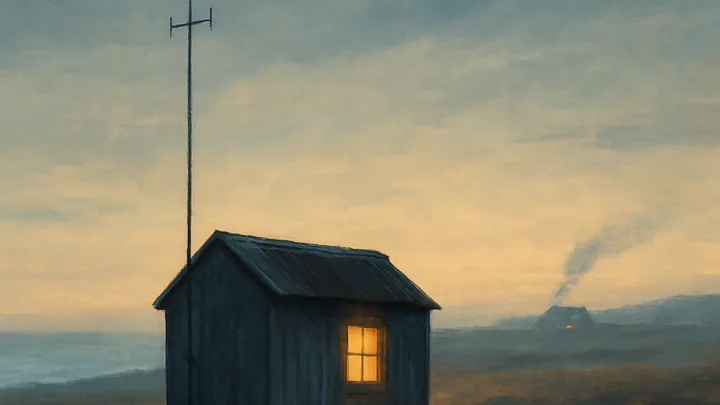
The transmitter shed on Brae Holm was the size of a garden shed because it had once been a garden shed. Idris unlocked the padlock at five-fifty every morning, ducked under the lintel, and lit the kettle before the equipment, because the equipment, like him, preferred warm tea before being asked to do anything.
The station was called Holm FM, and as far as the licensing board was concerned, it served a permanent population of one.
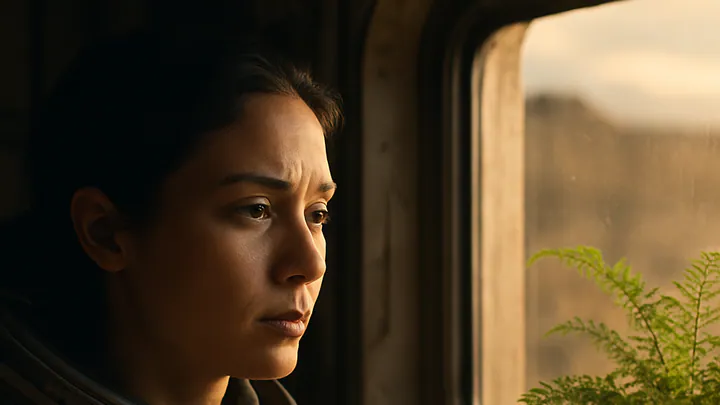
That one listener was a woman named Marta Vellis, who lived in the only other inhabited house on the island, two miles across the heather on the windward side. She was eighty-one. She had requested, when the mainland council tried to close the relay, that the relay stay open. The council had written back saying that maintaining a broadcast for a single citizen was not financially defensible. Marta had written back saying that neither was she, and yet here she still was.
So they had compromised. They would keep the transmitter, if someone local volunteered to staff it. Idris, who had moved to the holm three winters ago to get quieter and had instead gotten louder inside his own head, volunteered.
He had never met Marta. The track to her cottage was washed out in two places, and she did not, the postman said, receive visitors. She received post and she received radio.
Idris read the weather at six, at noon, and at six again. Between forecasts he played records from a milk crate the previous volunteer had left behind: fiddle music, mostly, and one strange album of whale recordings that hissed like rain.
“Good morning, holm,” he said into the microphone. The mug warmed his palm. “It is the fourteenth of October. We have a southwesterly at fifteen knots, easing by afternoon. Cloud cover thinning around three. Sunset at six-eleven, and I would recommend it. Tide is out until quarter past nine, so if you are walking the cockle bed, walk early.”
He paused, the way he always did, in case anything else wanted to be said.
“Wear the green scarf,” he added. “The wind will find your neck otherwise.”
He did not know if Marta owned a green scarf. He hoped she did. He hoped, generally.
The Call
The telephone in the shed was an old cream-colored thing bolted to the wall. It had not rung in Idris's tenure. He had assumed, in a vague way, that it was decorative, the way some doors in old houses open onto bricked-up walls.
On the morning of the seventeenth, after he had given the forecast (northerly, brisk, a chance of squall after lunch), the telephone rang.
He stared at it for three rings before he understood what the sound was. Then he picked up.
“Holm FM,” he said, which felt absurd, like announcing yourself to your own kitchen.
“You were wrong about Tuesday,” said a woman's voice. It was thin but unhurried, the voice of someone who had been saving her words. “You said the rain would hold off until evening. It came at two.”
“Mrs. Vellis,” he said.
“Marta is fine. I had washing out.”
“I'm sorry.”
“Don't be sorry. Be more careful.”
He found he was smiling. “I'll be more careful.”
There was a long pause, but it did not feel like an empty one. It felt like she was deciding something.
“You said wear the green scarf,” she said. “On Monday. How did you know I had a green scarf?”
“I didn't.”
“Hmm,” she said. And then: “Tomorrow's forecast.”
“Yes?”
“Tell me to open the back door at eleven.”
“Why?”
“Because I won't otherwise, and I should.”
She hung up.
Idris stood with the receiver against his ear for a while longer, listening to the dial tone, which sounded, he thought, a little like the whale record.
The next morning he said: “Light frost on the grass, clearing by ten. Wind almost nothing, which is rare and worth noticing. At eleven, the holm would like you to open your back door. Just for a minute. Just to let the morning in.”
He did not know if she did. But at five past eleven, walking back from the postbox, he saw a thin scroll of woodsmoke rise from the chimney on the windward side, which meant she had at least stoked her fire, which meant she was upright and moving, which on an island of two people counted as news.
The phone rang at noon.
“There was a wren,” she said. “On the step. It looked at me as if I were the unusual one.”
“You probably were.”
“Tomorrow,” she said. “Tell me to find the photograph of my husband on the dresser and turn it the right way up. I put it face down in March and I have been a coward about it since.”
“That isn't weather, Marta.”
“Everything,” she said, “is weather, if you live alone long enough.”
So that is how the broadcasts changed.
He still gave the wind and the tide and the cloud cover, because those things mattered, and because the licensing board, in theory, listened. But he began to add, at the end, a small instruction. Marta requested them by telephone the evening before, and he read them out the next morning as if they were perfectly ordinary meteorological events.
At ten, eat the pear before it goes. At two, write the letter to your sister, even the short version. At four, sit on the bench by the gorse and notice that you are still here.
He thought, at first, that he was doing her a kindness. After a month he understood he was doing himself one as well. He began to follow some of the instructions too. He ate the pear. He sat on his own bench, on his own side of the holm, and watched the sea do what the sea did, which was keep arriving.
Spring
In March a council inspector came over on the supply boat to assess whether Holm FM was still “reasonably necessary.” He was a kind young man with a clipboard and the haunted look of someone who spent most of his life closing things.
“The listenership,” he said apologetically, “is… one.”
“Two,” said Idris. “I listen as well.”
The inspector wrote something down. “Even so.”
“Ask her,” said Idris.
“The track is washed out.”
“Telephone, then.”
The inspector telephoned from the shed. He spoke for eleven minutes. Idris did not eavesdrop, but he could hear, from the kettle corner, the inspector going very quiet in the particular way people go quiet when they realize they have walked into something larger than their clipboard.
When he hung up, the inspector wrote for a long time. Then he closed the clipboard.
“She says,” he reported, “that the station provides essential local information not available elsewhere.”
“That's true,” said Idris.
“She also says that if we shut it down she will personally walk to the mainland across the water, and I am to write that down verbatim.”
“Did you?”
“Verbatim,” the inspector said, and almost smiled.
The supply boat left at three. Idris watched it go from the shed door, the tea warming his palm, the transmitter humming behind him like a kept promise.
At six he leaned into the microphone.
“Good evening, holm,” he said. “Wind dropping. Stars due around eight. And at half past, if you are willing, step outside and look up. There is a great deal of sky tonight, and it would like to be witnessed.”
He paused, in case anything else wanted to be said.
“Two of us,” he added, “is enough.”