Plant-Based Diet Benefits for Your Health and the Planet
A plant-based diet reliably raises fiber and lowers saturated fat, and swapping beef and dairy for legumes cuts your food footprint more than any other single change. Here is what the benefits actually are, what to supplement, and where the trade-offs hide.
Rewritten with AI and republished automatically. Our editors set the standards and fix reported errors — how we work.
TL;DR: A plant-based diet raises fiber and lowers saturated fat, which supports heart health, digestion and weight management. Environmentally, replacing beef, lamb and dairy with legumes and soy cuts land use and emissions more than any other single food swap. The catches: vitamin B12 needs supplementing, and "vegan" on a package does not mean healthy.
What exactly is a plant-based diet, and does it mean vegan?
A plant-based diet is an eating pattern in which vegetables, fruits, whole grains, legumes, nuts and seeds supply most of the calories and most of the protein. It does not have to be fully vegan. Lacto-ovo vegetarian, pescatarian and flexitarian patterns all sit under the same umbrella.
That distinction matters more than people expect. Most of the measurable health and environmental gains show up when animal foods drop from the center of the plate to the edge — not only when they disappear entirely. Framing it as all-or-nothing is the single fastest way to quit in week three.
What health benefits does a plant-based diet actually deliver?
The consistent, well-supported benefits are higher fiber intake, lower saturated fat, lower dietary cholesterol and higher intake of potassium, folate and polyphenols. Nutrition research generally associates these patterns with better cardiovascular markers, healthier blood pressure, improved blood lipids and easier long-term weight management.
Fiber is the mechanism people underrate. Most adults in Western countries fall well short of recommended intakes, and legumes, oats, barley and vegetables close that gap quickly. Fiber feeds the microbes in your colon, slows glucose absorption and increases satiety per calorie — which is why plant-based eaters often lose weight without counting anything. Our practical guide to gut health goes deeper into how fiber diversity, not just fiber quantity, shapes the microbiome.
What a plant-based diet does not do is cure disease or replace medical care. It shifts risk, and it does so gradually. If you are managing a diagnosed condition or taking medication, treat this as a conversation to have with a qualified health professional rather than a self-directed experiment.
How much does eating plant-based really help the planet?
Food accounts for a substantial share of global greenhouse gas emissions, and livestock — particularly cattle and sheep — is the largest contributor within it. Ruminants produce methane during digestion, require large amounts of grazing and feed-crop land, and drive a meaningful share of tropical deforestation through feed production.
The practical takeaway is that not all swaps are equal. Replacing beef with lentils changes your footprint dramatically. Replacing chicken with a highly processed meat analog changes it far less. If you make only one change, make it the beef-and-dairy one.
- Land: pulses and grains produce far more protein per acre than grazing livestock.
- Water: feed crops for cattle are among the most water-intensive links in the food chain.
- Methane: reducing ruminant demand is one of the few consumer levers on a short-lived but potent greenhouse gas.
- Transport: real, but usually a small slice compared with what the food is. Local beef still outweighs imported beans.
Which plant-based pattern should I choose?
Choose the strictest pattern you can genuinely maintain for a year — not the strictest one you admire. Adherence beats purity every time, and a flexitarian who sticks with it for a decade outperforms a vegan who lasts six weeks.
| Pattern | What's included | Main nutrition watch-out | Environmental impact | Ease of sticking with it |
|---|---|---|---|---|
| Vegan | No animal products at all | B12, omega-3 (EPA/DHA), iodine, vitamin D, sometimes iron and zinc | Lowest | Hardest socially; needs planning |
| Lacto-ovo vegetarian | Plants plus dairy and eggs | Iron, omega-3; easy to over-rely on cheese | Low, but dairy is the weak point | Moderate |
| Pescatarian | Plants plus fish and seafood | Sourcing and mercury in large predatory fish | Low to moderate, varies hugely by species | Easier; covers omega-3 naturally |
| Flexitarian / Mediterranean-leaning | Mostly plants, occasional meat | Portion creep — "occasional" quietly becomes daily | Moderate, still a large improvement | Easiest by a wide margin |
How do I get enough protein without meat?
Build every main meal around a legume, a soy food, seitan, or a substantial portion of nuts and seeds. Do that three times a day and the protein math takes care of itself for the vast majority of adults. The common failure is not lack of plant protein — it is meals where the protein anchor was simply never assigned.
Worked example. A 70 kg adult targeting roughly 1.2 g of protein per kg needs about 84 g daily. Oatmeal made with fortified soy milk plus three tablespoons of hemp seeds: around 20 g. A lentil soup with two slices of whole-grain bread: around 25 g. A tofu stir-fry over quinoa: around 28 g. Peanut butter on an apple as a snack: around 8 g. Total: roughly 81–85 g, without a single supplement powder.
| Food | Serving | Protein (approx.) |
|---|---|---|
| Seitan | 100 g | 25 g |
| Tempeh | 100 g | 19 g |
| Cooked lentils | 1 cup | 18 g |
| Edamame | 1 cup shelled | 18 g |
| Firm tofu | 100 g | 16 g |
| Chickpeas | 1 cup cooked | 15 g |
| Hemp seeds | 3 tbsp | 10 g |
| Quinoa | 1 cup cooked | 8 g |
| Peanut butter | 2 tbsp | 8 g |
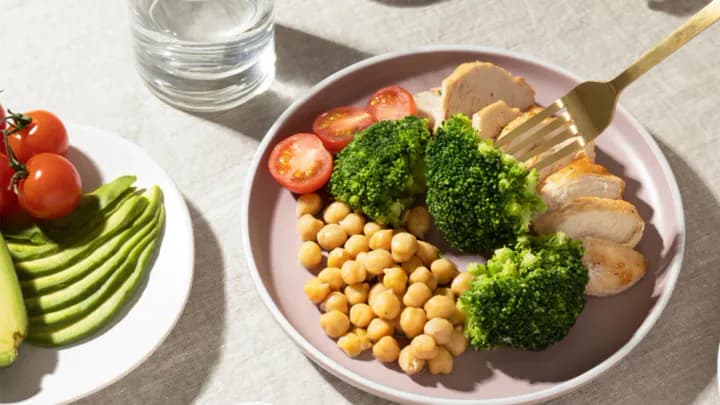
Two honest caveats the original version of this advice usually skips. First, plant proteins are generally lower in the amino acid leucine, so strength-training athletes and adults over about 60 may want slightly higher totals and a protein source at every meal rather than one large hit at dinner. Second, broccoli is not a protein source — it contains protein in the same sense that a glass of water contains minerals. Put it on the plate for fiber and micronutrients, not for grams. If you are training seriously, pair this with the aerobic base described in our Zone 2 cardio training guide and keep protein distributed across the day.
Which nutrients do plant-based eaters actually run short on?
Vitamin B12 is the only truly non-negotiable supplement on a fully vegan diet — reliable amounts occur solely in animal foods and fortified products. Beyond that, the realistic watch list is iron, iodine, omega-3 EPA/DHA, vitamin D, zinc and calcium.
- Iron: plant (non-heme) iron absorbs less efficiently. Pair beans and greens with a vitamin C source, and keep tea and coffee away from the meal itself. Menstruating adults are the group most likely to need testing.
- Omega-3: flax, chia and walnuts supply ALA, which the body converts to EPA and DHA inefficiently. Algae-derived oil is the direct vegan option.
- Iodine: easy to miss without dairy or iodized salt. Seaweed works but is wildly variable in concentration — kelp in particular can massively overshoot.
- Calcium: fortified plant milks, tofu set with calcium sulfate, kale and bok choy. Spinach is a poor source despite its reputation, because oxalates block absorption.
- Zinc and magnesium: phytates in whole grains and legumes reduce absorption; soaking, sprouting and fermenting help. Our explainer on magnesium glycinate dosing and safety covers when supplementation is and is not warranted.
Get bloodwork before and roughly a year after a major dietary shift, and let a qualified clinician interpret it. Guessing at supplements is how people end up taking six things they do not need and missing the one they do.
What is the most common — and costliest — mistake when going plant-based?
Replacing meat with ultra-processed analogs instead of with whole plant foods. A vegan burger patty, vegan cheese and fries is a plant-based meal that delivers almost no fiber, a large sodium load and refined fats. People then report feeling worse and conclude the diet failed them.
Here is a decision rule: if a plant-based main course does not contain a legume, a soy food, seitan, or a real handful of nuts and seeds, it is a side dish wearing a main course costume. Analogs are fine as a transition tool or an occasional convenience. They are a poor foundation.
The second costly mistake is under-eating. Plant foods are lower in calorie density, so the same visual volume of food can mean several hundred fewer calories. That feels great for two weeks and then shows up as fatigue, irritability, poor training recovery and disrupted sleep. If your energy drops, eat more food before you blame the diet — and check whether you have accumulated sleep debt that is being misattributed to nutrition.
How do I start without overhauling my entire kitchen?
Change one meal slot, not your whole identity. Pick the meal you eat most repetitively — usually lunch or weeknight dinner — and make it plant-based five days a week for a month. Leave everything else alone until that is automatic.
- Stock six pantry anchors: canned chickpeas, dried or canned lentils, firm tofu, rolled oats, frozen edamame, and a jar of tahini or peanut butter.
- Learn three meals, not thirty. A lentil soup, a tofu-and-vegetable tray bake, and a bean bowl with a decent sauce will cover most weeks. Our sheet-pan dinner framework adapts almost directly to tofu, chickpeas and tempeh.
- Fix the sauce problem. Most people abandon plant-based cooking because it tastes flat. Acid, salt, fat and umami — lemon, soy sauce, tahini, miso, smoked paprika, nutritional yeast — do the heavy lifting.
- Ramp fiber gradually. Going from 15 g to 45 g of fiber overnight produces bloating that convinces people they are intolerant to beans. Add roughly 5 g per week and drink more water.
- Start B12 on day one if you are going fully vegan, rather than waiting for symptoms.
When does this advice not apply?
It does not apply unmodified to pregnancy and breastfeeding, infant and toddler feeding, advanced kidney disease, or anyone with a history of restrictive eating disorders, where a new set of food rules can be genuinely harmful. In each case the answer is individualized professional guidance, not a general article.
Two specific interaction edge cases deserve naming. Anyone taking warfarin should not dramatically increase leafy greens without telling their prescriber, because vitamin K directly affects the drug's action — consistency matters more than quantity. And people on levothyroxine should separate soy foods and high-fiber meals from their morning dose by several hours, since both can reduce absorption. Neither rules out plant-based eating; both require timing.
People with IBS are a third case. Many high-fiber staples — beans, onions, garlic, wheat — are high in FODMAPs. Canned and well-rinsed legumes, smaller portions, firm tofu over other soy forms, and sourdough instead of standard bread usually make the pattern workable.
Key takeaways
- A plant-based diet is defined by what dominates the plate, not by a vegan label — flexitarian patterns deliver most of the benefit with far better adherence.
- The clearest health gains come from more fiber and less saturated fat, which is why whole foods, not analogs, drive the results.
- Cutting beef, lamb and dairy produces the biggest environmental improvement; transport distance matters much less than what the food actually is.
- Assign a protein anchor — legume, soy, seitan, nuts or seeds — to every main meal, and 80–100 g a day is easy.
- Vitamin B12 is mandatory for vegans; iron, iodine, omega-3, vitamin D and calcium are worth monitoring with bloodwork.
- Talk to a qualified health professional before a major dietary change if you are pregnant, feeding children, managing a chronic condition, or taking warfarin or thyroid medication.
Frequently asked questions
What counts as a plant-based diet?
A plant-based diet is any eating pattern built mainly around vegetables, fruits, whole grains, legumes, nuts and seeds — it does not have to be fully vegan. Lacto-ovo vegetarian, pescatarian and flexitarian patterns all qualify as long as plants make up the bulk of the plate.
Do you get enough protein on a plant-based diet?
Yes, for most adults, provided every main meal contains a legume, soy food, seitan, or a substantial serving of nuts and seeds. A cup of cooked lentils delivers roughly 18 grams of protein and 100 grams of tempeh around 19 grams, so hitting 80–100 grams a day is straightforward once you plan for it.
Which supplement is non-negotiable on a vegan diet?
Vitamin B12 is non-negotiable — reliable amounts occur only in animal foods and fortified products. Anyone eating fully vegan should take a B12 supplement or use fortified foods consistently, and discuss dosing with a qualified health professional.
Does eating plant-based really reduce environmental impact?
Yes, and the effect is largest when you replace beef, lamb and dairy rather than chicken or eggs. Ruminant meat and dairy require far more land and generate far more greenhouse gas per gram of protein than beans, lentils, tofu or grains, so those swaps do most of the work.
Is a plant-based diet automatically healthy?
No. Refined grains, sugar, fries and ultra-processed meat analogs are all technically plant-based but offer little fiber and often carry high sodium. The health benefits track with whole plant foods, not with the vegan label on a package.
Who should talk to a doctor before going plant-based?
Anyone who is pregnant or breastfeeding, feeding young children, managing diabetes, kidney disease, an eating disorder history, or taking warfarin or thyroid medication should get individualized advice first. A big shift in vitamin K, fiber or timing can affect how medications work.
Will I have more energy on a plant-based diet?
Many people do report steadier energy, but that usually comes from eating more whole foods, more fiber and more regular meals rather than from removing animal products. If fatigue increases instead, check iron, B12 and total calorie intake with a professional.