The Woman Who Sold Second-Hand Storms
On a market street where weather is bottled and traded, a reluctant vendor meets a boy searching for the exact rain his grandfather remembered.
Drafted with AI; reviewed by Azka Shahid on . How we work.
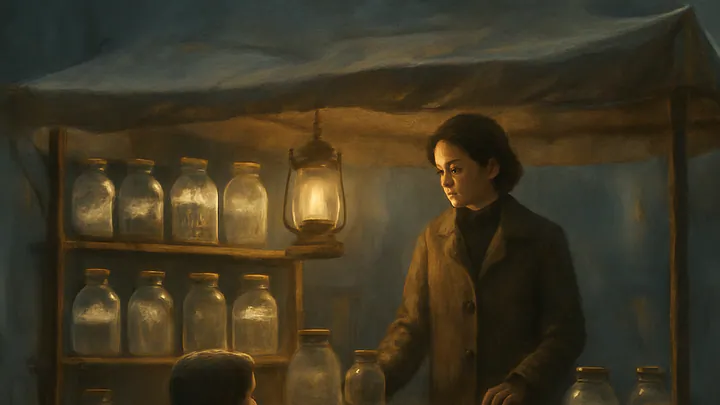
Ines had six storms left when the boy came to her stall, and none of them were the one he wanted. He stood at the edge of her tarp with the patient stubbornness of someone who had walked a long way on purpose, holding an empty jar to his chest like a small, breakable animal.
"You're the storm woman," he said. It was not a question.
"Second-hand," she corrected, because she had been correcting people about this for eleven years and it had become a kind of prayer. "I don't make them. I only resell."
She gestured at the shelves behind her, where the storms rested in various vessels — a squat blue apothecary bottle held a Tuesday drizzle from a coastal town; a wine flask contained the tail end of a mountain hailstorm, its ice still ticking faintly against glass; a perfume atomizer had captured a single humid afternoon in someone's garden, gnats and all. Each was labeled in her small, tilted handwriting: place, month, mood.
The boy studied them the way older men studied maps. He was maybe nine. His shoes were too large and his coat too small, which suggested a household where things were handed both up and down, and where someone kept track.
"I need a rain," he said. "A specific one."
"Everyone needs a specific one." Ines had learned to soften this with a smile. "Tell me."
He set the empty jar on her counter. It was an old preserving jar, the rubber seal cracked, the lid rusted at the edges. Something about its emptiness felt deliberate, as if the boy had chosen it because it was the shape of what was missing.
"My grandfather described it to me," he said. "Before he stopped talking. It rained on the afternoon he asked my grandmother to marry him. He said the drops were fat and slow and warm, and they hit the tin roof of the bus shelter like coins being counted. He said the air smelled like cut grass and diesel. He said there was a dog under the bench who didn't mind the wet."
Ines wrote none of this down. She never did. She had a memory for weather the way some people had a memory for songs; once described, a storm arranged itself in her head and stayed there, humming.
"When?" she asked.
"Nineteen sixty-one. Maybe sixty-two. A village called Portesio, in the hills. He said there was a chapel with a blue door."
"I know the chapel," Ines said, surprising herself. She had passed through Portesio once, decades ago, buying a thunderclap from a widow. "But I don't have that rain."
The boy's face did not fall, which somehow made it worse. He had clearly prepared for this. "Do you know who might?"
The Ledger of Small Weathers
Ines closed the stall early, which she had not done in a season. She led the boy down the alley behind the market to the room she rented above a bakery, where the air always smelled faintly of yeast and burnt sugar. From under her bed she pulled a ledger bound in green cloth, the corners softened by handling.
"Every storm I've ever sold or been offered," she said, opening it on the small table. "And who had it before me."
The boy leaned in. He read slowly, mouthing the place names. Aldan, February, grief-rain. Cavasso, August, the storm that broke the drought. Portesio —
His finger stopped.
"Portesio, June 1962," he whispered. "Warm rain, slow, tin roof. Sold to — " He looked up. "Sold to a man named Rulfo, in the city."
"Fifteen years ago." Ines rubbed her thumb along the ledger's edge. "He collected first rains. Wanted one for his daughter's wedding, to release into the garden. I remember because he paid in figs."
"So it's gone," the boy said. Not sad. Just accounting.
"Released is not the same as gone," Ines said, and was surprised again, because she had never quite believed this before saying it aloud. "Weather is stubborn. It goes somewhere."
She looked at him — the too-small coat, the empty jar, the grandfather who had stopped talking — and she felt something old shift in her chest, a door she had been leaning against for a long time giving a little.
"Come back tomorrow," she said. "Bring the jar."
That night Ines did something she had not done since she was young enough to believe in it. She went out past the edge of town, to the field where the wind arrived first, and she opened every bottle on her shelves. Six storms, all she had left. The Tuesday drizzle. The mountain hail. The humid garden. A snow flurry from a mountain pass. A dust squall from a southern plain. A thunderclap so old its edges had gone soft.
She released them into the dark and asked them, politely, the way one asks a stranger for directions, to look for a warm slow rain from Portesio, June of 1962, and to send it home if they found it.
Weather talks to weather. She had always suspected this. She stood in the field until her coat was heavy with someone else's mist and her hair smelled of ozone, and then she walked back to town with her empty shelves and slept better than she had in years.
In the morning the boy was waiting outside the bakery, the jar still pressed to his chest.
"I don't have it," she told him gently. "I gave away everything I had asking after it. I might have nothing for weeks. But — "
She was going to say but I tried, which was a coward's ending, when the first drop struck the jar's rim.
It was fat. It was slow. It was warm.
They both looked up. The sky above the alley was the pale, patient grey of an afternoon in the hills, and the rain came down in coins, counting itself on the bakery's tin awning above them. Somewhere, impossibly, Ines smelled cut grass and a whisper of diesel.
The boy held out the jar. The rain filled it with the unhurried generosity of a thing that had been looking for somewhere to arrive.
When it was full he screwed the lid on with both hands, careful of the cracked seal, and held the jar up to the light. Inside, the water was ordinary. Inside, the water was not ordinary at all.
"Thank you," he said.
"Take it to him quickly," Ines said. Her voice caught. "Before he forgets he was waiting."
The boy nodded and turned and ran, the jar cradled against his coat, his too-large shoes slapping the wet stones. The rain kept falling on the alley for another minute, and then, having done what it came to do, it moved on toward the hills.
Ines stood a while longer in the doorway of the bakery, letting the last of it find her shoulders. Her shelves at the stall were empty. Her ledger was one line lighter. She had never, in eleven years, felt so richly stocked.