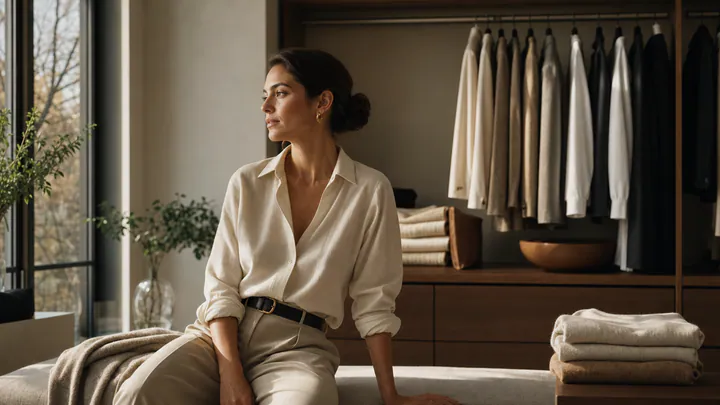
Coastal Cool: How the Beachy Aesthetic Shapes 2025 Style
Coastal cool is the quiet, texture-led version of beach style — linen, sand, seafoam, rattan. Here's how it differs from nautical and coastal grandmother, what to buy first, what it really costs, and the errors that make it read cheap.
Rewritten with AI and republished automatically. Our editors set the standards and fix reported errors — how we work.

TL;DR: Coastal cool is the restrained version of beach style — sun-bleached neutrals, real linen, rattan, and negative space, with no literal nautical motifs. In 2025 it moved from décor into mainstream fashion because it overlaps with quiet luxury. Buy fabric first, accessories last, and always add one dark anchor.
What exactly is coastal cool, and how is it different from nautical style?
Coastal cool is an aesthetic that evokes the shoreline through material and light rather than through imagery — off-whites, sand, seafoam, and slate blue rendered in linen, cotton, jute, rattan, and unfinished wood. Nautical style uses symbols (stripes, anchors, navy-and-red, brass portholes). Coastal cool deliberately removes them.
That distinction is the whole trend. A rope-handled tote with a knotted anchor detail is nautical. A plain woven basket bag with a leather strap is coastal cool. Same beach, different volume.
It's useful to place the look next to its neighbors, because most people who say they want "beachy" actually want one specific dialect of it.
| Aesthetic | Core palette | Signature materials | Tell-tale item |
|---|---|---|---|
| Coastal cool | Off-white, oat, seafoam, slate blue | Linen, raw cotton, rattan, jute, pale wood | Unstructured linen shirt, no print |
| Nautical | Navy, red, crisp white | Cotton canvas, brass, rope | Breton stripe and gold buttons |
| Tropical / resort | Turquoise, coral, palm green | Viscose, printed silk, bamboo | Large-scale botanical print |
| Coastal grandmother | Blue-and-white, cream, soft denim | Slipcovered cotton, ceramic, knitwear | Oversized cardigan and a full bookshelf |
| Quiet luxury | Camel, charcoal, ivory | Cashmere, fine wool, calf leather | Unbranded structured coat |
The overlap with the last row explains why coastal cool broke through in 2025. It gives people the neutral, logo-free discipline of a quiet luxury wardrobe at a fraction of the fiber cost, because linen and cotton are far cheaper than cashmere and calfskin.
What should I buy first to get the look on a real budget?
Buy in this order: one pair of wide-leg trousers in a neutral, one oversized long-sleeve shirt in pure linen, one fine-gauge knit in a blue-green, one woven bag, one leather sandal or loafer. Five items cover roughly a dozen outfits, and none of them are seasonal novelties.
The reason for that order is durability of relevance. Trousers and shirts stay wearable for years; the straw hat that defines the mood on a mood board is the item you'll be tired of first.
| Piece | High street | Mid-market | What the extra money actually buys |
|---|---|---|---|
| Pure linen shirt | $45–$80 | $120–$220 | Higher linen content, French seams, opaque weave |
| Wide-leg trousers | $50–$90 | $140–$250 | Lined front, real waistband, no see-through seat |
| Woven or raffia bag | $35–$70 | $150–$400 | Leather trim and stitched — not glued — handles |
| Leather sandal | $50–$90 | $160–$300 | Resolable sole, vegetable-tanned straps |
| Jute or sisal rug (5×8) | $90–$160 | $250–$500 | Tighter weave, less shedding, bound edges |
Prices move; treat these as ratios rather than quotes. The pattern that holds is that shoes and bags reward spending and shirts reward shopping carefully.
How do I tell real linen from a "linen-look" blend before I buy?
Read the composition label, not the product name. Retailers legally label "linen-blend" garments that are 30% linen and 70% viscose, and those behave like viscose: they cling, they go limp after three washes, and they trap heat. Below roughly 55% linen, you are buying the filler fiber.
Three quick in-store checks:
- Hold it to the light. Real linen shows slight slubs — thick and thin spots in the yarn. Perfectly uniform "linen" is usually rayon.
- Crush a corner in your fist for five seconds. Linen creases sharply and the crease softens as it hangs. Polyester blends barely mark; viscose blends crush and stay crushed.
- Check the seat and elbows against your hand. Lightweight shirting around 110–130 GSM is beautiful but often sheer; 150–190 GSM is the sweet spot for trousers and shirts you'll wear without an undershirt.
What is the most common mistake people make with this aesthetic?
Wearing the palette with no contrast. Head-to-toe cream, oat, and beige in similar textures reads as a hotel bathrobe, and it washes out most complexions, particularly olive and deep skin tones that need either warmth or genuine contrast to look lit rather than flattened.
The fix is a two-part rule for every coastal outfit:
- One hero texture per outfit. If the trousers are slubby linen, the top should be smooth — fine cotton, silk, or a flat knit. Two loud textures fight.
- One dark anchor. Faded indigo denim, espresso leather, driftwood gray, or black hardware. A single dark point gives the eye somewhere to land and makes the neutrals look chosen instead of accidental.
A well-cut pair of jeans is the easiest anchor most people already own — the straight and barrel shapes covered in our guide to denim worth buying now sit naturally under an oversized linen shirt.
How do I wear coastal cool in a city, or to an office?
Keep the palette and the fabrics; remove the four items that scream vacation. Swap drawstring pants for a flat-front trouser, rope sandals for a leather slide or loafer, the straw beach bag for a structured woven tote, and the wide-brim hat for nothing at all.
The version that survives a commute uses a linen-cotton or linen-wool blend rather than 100% linen, because those blends hold a crease line and resist the seat-of-the-train crush. This is one of the rare cases where a blend is the better buy.
If you're building a broader year-round closet around the same neutrals, the framework in our 30-piece capsule wardrobe guide slots in cleanly — the coastal palette is essentially a capsule palette with the blue-green accent turned up.
How do I bring it home without repainting anything?
Change light, floor, and window before you change furniture. Warm-white bulbs around 2700K, a jute or sisal rug, and unlined linen or cotton curtains hung wide and high do about 80% of the work for a few hundred dollars, with no paint and no landlord conversation.
A practical constraint: three natural materials per room, no more. Rattan plus jute plus oak is calm. Add seagrass, bamboo, driftwood, and wicker and the room stops reading as coastal and starts reading as a garden center.
Skip literal beach objects. Framed shells, rope-wrapped vases, and "BEACH →" signs are what separates the look from the theme-park version of it. If you want one focal point, choose a single large abstract in gray-blue over five small nautical prints.
Start where guests actually form an impression — the first three feet of your entryway carry more of the atmosphere than the sofa does.
Where does coastal cool genuinely not work?
It struggles in three situations, and it's worth naming them rather than pretending otherwise.
- Hot, humid climates. Linen breathes, but loose weaves plus high humidity means cling and transparency. Mid-weight, darker neutrals — oat and putty rather than white — hold up far better than the Pinterest version.
- Homes with young kids or shedding pets. Cream slipcovers and jute rugs are high-maintenance. Jute in particular stains with water and can't be wet-cleaned easily; sisal or a washable flatweave is the honest substitute.
- Cold, dark-winter regions. A pale, cool palette that looks luminous in June light can read clinical in January. Carrying it year-round usually requires adding wool, terracotta, or warm wood tones in fall.
How do I care for linen and rattan so they don't look tired by August?
Wash linen cold on a gentle cycle, skip fabric softener entirely, and pull it out of the dryer damp to hang. Softener coats the fiber and kills the dry, crisp hand that makes linen look expensive; heat-drying to completion sets permanent creases and weakens the yarn.
Linen is the rare fabric that improves with laundering — the fibers soften cumulatively, which is why a three-year-old shirt often looks better than a new one. Steam rather than press; a hot iron flattens the texture you paid for.
For rattan and cane, keep it out of direct sun and away from radiators. Both dry out and split. A light wipe with a barely damp cloth, then dry immediately, is enough for most of the year.
Is coastal cool actually a sustainable choice?
Partly, and the honest answer depends on what you replace. Flax, the plant linen comes from, generally needs less irrigation and fewer inputs than conventional cotton, and natural-fiber goods last longer than printed synthetics — but buying seven new linen items to chase an aesthetic is not an environmental win.
The genuinely low-impact moves are unglamorous: buy fewer, higher-content pieces; source baskets, ceramics, and wooden furniture secondhand, where coastal-style goods are abundant and cheap; and repair rather than replace. Look for OEKO-TEX or European Flax certification if you want a verifiable claim rather than a marketing adjective.
Why did this aesthetic surge in 2025?
Because it answered two pressures at once: fatigue with loud, logo-heavy dressing, and a broader appetite for slower, lower-stimulation living. Coastal cool is cheap to signal, photographs well in natural light, and requires no brand literacy to read — a combination that travels fast.
The lifestyle layer that grew around it — unhurried mornings, simpler skincare, time outdoors — is real but oversold as an aesthetic. If you want the part that actually changes how a day feels, start with something concrete like a ten-minute morning sunlight habit rather than a mood board.
Key takeaways
- Coastal cool suggests the coast through texture and light; the moment literal nautical motifs appear, it becomes a different, more dated aesthetic.
- Check linen content on the label — below roughly 55% linen, the garment behaves like its filler fiber, not like linen.
- Every all-neutral outfit needs one dark anchor and only one hero texture, or it flattens.
- Indoors, change lighting, rug, and curtains first; cap yourself at three natural materials per room.
- Buy trousers, shirts, and shoes; go slowly on hats, shell jewelry, and rope detailing, which date fastest.
- Wash linen cold, skip softener, and hang it damp — laundering is what makes it look expensive over time.
Frequently asked questions
What is the coastal cool aesthetic?
Coastal cool is a design and fashion aesthetic built on sun-bleached neutrals, blue-green accents, and natural fibers like linen, cotton, rattan, and jute. It suggests the coast through texture and light rather than through literal beach motifs — no anchors, no shells, no palm prints.
How is coastal cool different from coastal grandmother?
Coastal grandmother leans domestic and layered — slipcovered sofas, blue-and-white china, cardigans, cookbooks. Coastal cool is sparser and more architectural, with fewer patterns, rawer textures, and a heavier reliance on negative space. They share a palette but not a level of clutter.
Is linen worth the price compared to a linen blend?
Pure linen is usually worth it for shirts, trousers, and bedding because it gets softer with every wash and breathes better than blends heavy in viscose or polyester. Check the composition label: anything under about 55% linen behaves more like the filler fiber than like linen.
Can you wear coastal cool in a city or to the office?
Yes, if you swap the giveaway resort items. Keep the palette and fabrics, but choose a structured linen-blend trouser over a drawstring pant, a loafer or leather sandal over a rope sandal, and a woven tote with a defined shape over a straw beach bag.
What colors define the coastal cool palette?
Off-white, oat, sand, and putty as the base; seafoam, pale slate blue, and washed sage as accents; plus one grounding dark such as driftwood gray, faded indigo, or espresso brown. The dark anchor is what keeps the palette from looking washed out.
How do you get the look if you live nowhere near the ocean?
Focus on light and texture rather than nautical objects. Sheer or linen curtains, a jute or sisal rug, unpainted wood, one large piece of abstract art, and warm-white bulbs around 2700K reproduce the feeling far more reliably than decorative shells or driftwood signs.
Does coastal cool date quickly?
The core pieces don't — linen shirts, natural-fiber rugs, and neutral trousers have outlived every version of this trend. What dates fast is the accessory layer: statement straw hats, shell jewelry, and rope detailing tend to look era-stamped within a couple of seasons.