The Piano Tuner of the Empty Ballroom
Every Thursday, Isolde tunes a grand piano in a ballroom no one uses. Then one afternoon, someone answers her final chord.
Drafted with AI and published automatically. Our editors set the standards and fix reported errors — how we work.
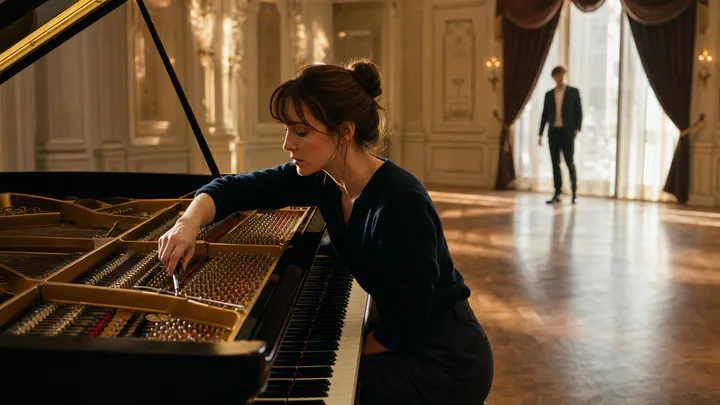
The ballroom had not held a dance in forty-one years, but every Thursday at three o'clock, Isolde arrived to tune its piano. She let herself in with a brass key the size of a spoon, crossed a parquet floor that sighed under her boots, and set her canvas satchel on the bench as if greeting a patient.
The Grand Hotel Meridian had been closed since the river changed its mind and moved a mile east, taking the summer trade with it. The owners' grandchildren, who lived somewhere warmer, paid Isolde a small sum each month to keep the piano alive. It was a kindness to an instrument no one heard, and Isolde, who had long since stopped expecting kindnesses to make sense, accepted the work gratefully.
She was fifty-nine. Her hands were the hands of someone who had spent a life listening — thin, alert, faintly ink-stained from the ledgers she kept. She wore the same grey coat in all weathers and drank her tea without sugar because sugar dulled the ear.
The ballroom had tall windows curtained in dust. Chandeliers hung above her like sleeping jellyfish. In one corner, a stack of gilt chairs waited politely for a party that would not come. And in the center, on a small dais, stood the piano — a rosewood grand with brass casters and the serial number 4417 stamped inside its lid.
She lifted the fallboard, pressed middle C, and winced. The felt had softened in the summer damp. She reached for her tuning hammer.
The Answer
It happened on a Thursday in October, when the light through the tall windows was the color of weak honey.
She had worked through the middle octaves and was testing a chord — a simple D minor, three notes stacked like a small confession — when the ballroom answered her.
Not an echo. Isolde knew echoes; she had made a career of separating a note from its ghost. This was a different chord entirely. A soft, considered F major, played from somewhere behind her, on an instrument she could not see.
She turned.
The ballroom was empty. The gilt chairs had not moved. The chandeliers still slept. A moth, disturbed by nothing she could name, wandered from one shaft of light into another.
Isolde sat very still. She had lived alone long enough to distrust her own imagination, and long enough also to know when to trust it. She waited. She counted to sixty. Then she played the D minor again.
The F major came back, gentler this time, as if apologizing for having startled her.
She laughed — a small, surprised sound she had not made in years — and closed the fallboard, and went home.
The Correspondence
The next Thursday, she brought a notebook.
She played a phrase — four bars from an old lullaby her mother had hummed while braiding her hair — and waited. The reply came after a long pause, as though the other player were considering. It was not the same lullaby. It was a slower song, in a related key, and it seemed to answer the question her lullaby had been asking without her knowing it had asked anything.
Isolde wrote in her notebook: Thursday, 3:14 p.m. I played the lullaby. It played back a song about accepting the answer.
Then she wrote: I am not frightened. Note this, for later, in case I become frightened.
Week by week, they spoke. She never saw the other instrument. She looked, of course — behind the curtains, in the cloakroom, in the kitchens where copper pans still hung in expectant rows. She found only mice, and one indignant owl, and a menu from 1962 offering veal in cherry sauce.
But the piano answered. Sometimes it played phrases she recognized — a waltz her father had loved, a hymn from a village she had passed through once as a girl. Sometimes it offered something she had never heard, and she would sit with her hand pressed to her mouth, memorizing.
She began to bring sheet music. She would play a page and leave a silence, and something would fill the silence — not always the melody continued, but a commentary on it. A countermelody. A soft dissent. Once, when she played a piece she had written herself at twenty and abandoned at twenty-one, the ballroom took the tune from her and finished it in a way she had never managed to. She wept, quietly, without stopping her hands.
The Question
In February she brought her friend Petra, who was a violinist and a skeptic and had known Isolde for thirty years.
"Play something," Isolde said.
Petra played a scale. The ballroom was silent.
Petra played a folk tune, a lament, a snatch of something modern and thorny. The ballroom listened, but did not answer.
"It's only for you, then," Petra said. She was not unkind about it. She sat on a gilt chair and watched her friend at the keyboard and said, after a while, "What do you think it is?"
Isolde had thought about this. She had thought about ghosts and about acoustics and about the small tumors that sometimes bloomed in the ears of women her age. She had thought about the possibility that she was, at last, going gently mad.
"I think," she said slowly, "that there is a great deal of listening in the world that goes unanswered. And I think that when you listen for a long time to something no one else notices — a piano no one plays, a river that moved away, a song your mother sang — the listening builds up. Like static. And eventually something in the room learns to speak back."
Petra considered this. "That's not science," she said.
"No," Isolde agreed.
"But it's not nothing," Petra said, and she meant it kindly, and Isolde understood.
The Last Thursday
Isolde tuned the piano for another eleven years. She wrote down every conversation. When the grandchildren finally sold the Grand Hotel Meridian to a developer who intended to convert it into apartments, she was seventy and her hands had begun to tremble in the mornings.
On her last Thursday, she played the lullaby from the very first day, all the way through.
The ballroom answered with the song she had written at twenty, finished the way it had been finished for her years before, note for note, unchanged. A gift returned. A goodbye that was also a receipt: I heard you. I kept it. Here.
She closed the fallboard. She rested her palm on the rosewood, where the grain rippled like water under a slow wind. She thought about all the rooms in the world with something waiting in them, patient as furniture, for someone to sit down and listen long enough.
Then Isolde picked up her satchel, and she locked the brass door behind her, and she walked home in the honey-colored light, humming a tune that no one else had ever heard, but which was, at last, entirely hers.