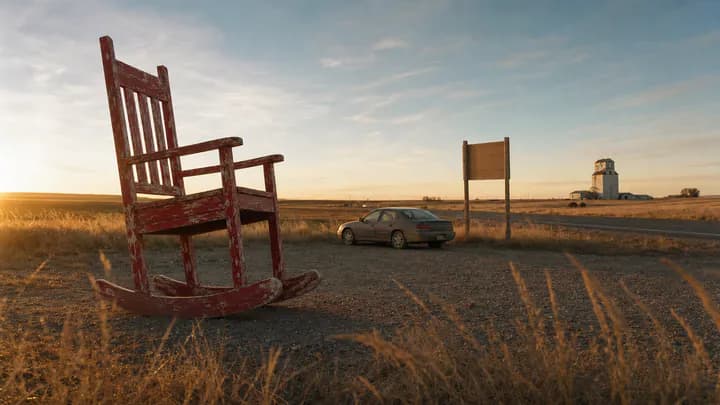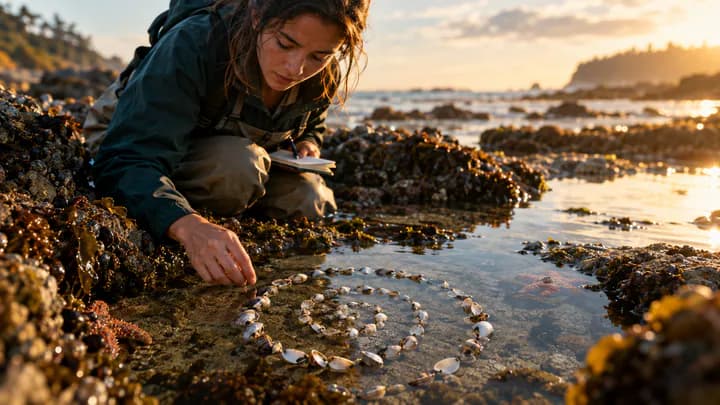
What the Caddie Saw on the Fourteenth
A short story about a Durban caddie who keeps quiet about a wealthy member's rule breach in 1995, and the choice he faces decades later as the club's head greenskeeper.
Drafted with AI and published automatically. Our editors set the standards and fix reported errors — how we work.
Story Time is original short fiction. The characters, places and events in this story are invented.
2021
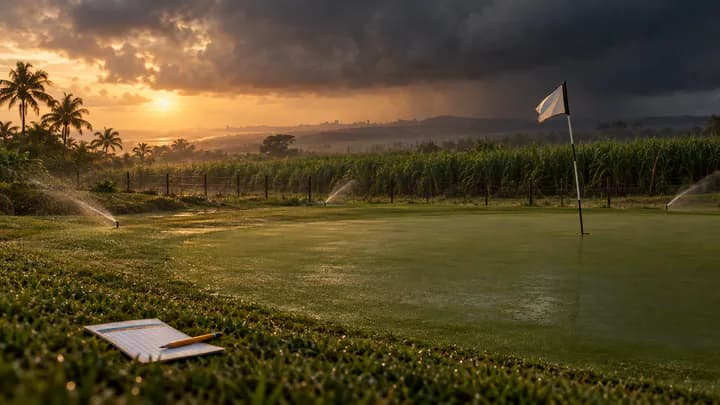
The sprinkler heads on the fourteenth started ticking at 4:40, a quarter-turn late, and Sifiso was already kneeling beside the worst of them with a flat screwdriver when the arc swung round and soaked him across the shoulders. He swore softly in Zulu and kept turning. Forty-two rotors, a weather station on a pole, a control box that sent messages to his phone. Six weeks in the ground. The brass plaque by the pump house said Gift of the Van Wyk Family, and the club captain had been photographed beside it holding a length of blue pipe like a ribbon.
Beyond the fence the cane stood higher than a man, grey-green in the half dark. By noon the heat would sit on the course like a lid, and by four there would be thunder. There was always thunder in February.
His son had left the house at five with his bag on one shoulder, eating a slice of white bread folded around polony. Junior club championship, final round. Winner nominated for the provincial trials. Lwazi was two shots behind Jared van Wyk.
"Don't come and watch," Lwazi had said at the door. "You look at me like a green you're worried about."
1995
Mr Lourens's ball had come to rest in the kikuyu left of the fourteenth, a yard from the cane fence, sitting down so deep that only a white crescent showed. Sifiso set the bag upright and waited for the club to be called. A five wood, probably. Mr Lourens liked the five wood too much.
"Water," Mr Lourens said instead, and Sifiso bent to unzip the side pocket. When he straightened, the ball was sitting up on top of the grass like an egg in a cup, and Mr Lourens's white shoe was just lifting away from it.
"Look at that. Lucky," Mr Lourens said. "Five wood."
Sifiso handed him the five wood.
He had been caddying at Mangrove Creek since he was twelve, catching the first taxi out of Umlazi at half past five, and he knew the rules better than most of the members. He had learned them from a paperback rulebook with the cover torn off that Bra Themba, the caddie master, kept in a drawer under the tea urn. Improving your lie: two strokes. He had read that one aloud to himself on the taxi.
Mr Lourens hit the five wood onto the front edge of the green. He handed the club back without wiping it.
"Your mate Themba tells me you play," he said, walking.
"A little, sir."
"Seven iron, he says. Every evening on the practice field until the security chases you off." Mr Lourens laughed, not unkindly. "He says you've got a proper swing. Natural."
Sifiso said nothing. The seven iron was Themba's, a rusted blade with electrical tape wound round the grip. Sifiso had hit perhaps ten thousand balls with it, mostly range balls he fished out of the dam, and on the dusty ground behind his mother's house he hit stones with it, which Themba said would ruin the face and which Sifiso did anyway.
2021
By half past three the sky over the cane had gone the colour of a bruise, and Sifiso drove the utility cart down the fourteenth to check the new drain grate near the fence, the one the contractor had set too high. He parked behind the cane-cutters' old shed where the carts couldn't be seen from the tee.
That was how he saw it. Jared van Wyk's drive had hooked into the kikuyu against the fence. The boy looked back once toward the tee, where his marker was still hunting for a tee peg in the grass, and then he stood on the ground behind his ball and rocked his weight. When he stepped away, the ball was sitting up.
Sifiso felt it in his stomach before he thought anything. It was the exact spot. It was almost the exact shoe, white, expensive.
The siren went at 3:52. Lightning inside six kilometres. The players marked their balls and ran for the shelters, and the rain arrived all at once, flattening the cane.
1995
The thunder had started by the time they reached the fourteenth green. Mr Lourens two-putted and then, instead of walking to the fifteenth tee, took the scorecard out of his back pocket and uncapped a pen.
"Coetzee's gone in with the heat," he said. His marker had retired at the turn, grey-faced, holding a wet towel to his neck. "Committee lets a caddie attest when the marker's out. You know that?"
"Yes, sir."
"So we'll do it as we go, in case the storm finishes us off." He wrote a 4 in the box for the fourteenth and turned the card round. "Initial there, and there."
Sifiso looked at the 4. It should have been a 6.
"Themba also tells me," Mr Lourens said, looking at the sky rather than at him, "there's a junior open in Pietermaritzburg next month. Hundred and fifty rand entry, and the bus, and somewhere to sleep. That's a lot of carrying for a boy."
It was. It was two months of carrying, and his mother's rent was already late, and his little sister needed school shoes. He had never played eighteen holes on real grass with a scorecard in his own name.
"I'd consider it an investment," Mr Lourens said. "Natural swing."
The first drops came down fat and warm on the card. Sifiso took the pen. He wrote S.M. in the box beside the 4, very small, and his hand did not shake, which surprised him.
2021
After the storm the course steamed. Sifiso was on the fourteenth green with a squeegee, pushing sheets of water off the collar, when Rajesh Naidoo came down in a cart with a clear plastic sleeve of scorecards on the seat beside him. The captain wore a club-crested rain jacket and the expression of a man who had rehearsed.
"Play's abandoned for today," Naidoo said. "We're counting it through thirteen, the committee's agreed. Jared wins by two." He paused. "Carl in the pro shop says you were down here before the siren."
"I was."
"Sifiso." Naidoo got out of the cart. "The card's signed. The marker saw nothing. It's not even a counting hole now."
"It's a two-stroke penalty. On a counting round, it's a wrong card. On a suspended round, it's still a breach." He leaned on the squeegee. "You can check. I know where the book is."
Naidoo looked at the pump house, at the plaque. "I'm going to say this once because I respect you. If the head greenskeeper, whose own son is second, goes to the committee and gets the leader disqualified, what do you think people will say?"
"That I did it for Lwazi."
"And the Van Wyks will say it louder than anyone. And then what happens to phase two? The fairway heads? You've been asking for fairway heads for eleven years."
Sifiso looked down the fourteenth, the wet kikuyu, the fence, the cane beaten flat in patches. He had played that junior open in Pietermaritzburg. He had shot 84 on Mr Lourens's hundred and fifty rand, three-putting four times, every shot feeling like it belonged to someone else. He had never entered another. After a while he had stopped hitting stones behind his mother's house and started asking Themba about the maintenance crew, where the jobs were steadier.
He had never told Lwazi any of that. He had told him only to count every stroke, even the ones nobody saw.
"Can I see the card?" he said.
Naidoo hesitated, then slid it out of the sleeve. It was damp at one corner. Jared's figures in neat blue ballpoint, the marker's signature, the empty boxes from fourteen on.
"Lwazi didn't see it," Sifiso said. "He was in the group ahead. He doesn't know I was here. If he wins it this way, he'll find out eventually, and he'll carry that. So will Jared. He's sixteen, Rajesh. Better he learns it on a Saturday at a club than somewhere it costs more."
"And the irrigation?"
"The irrigation's in the ground. It ticks a quarter-turn late on fourteen. I'll fix it either way."
He took a pencil from his shirt pocket and, on the back of an old delivery note, wrote down the time, the hole, what he had seen. Then he tucked the note behind the card, stepped off the fourteenth green onto the wet path, and began the long walk up to the committee room, the card held flat in his palm so the rain wouldn't smudge the numbers.