The Night Clerk at the Lost Watch Hotel
A quiet hotel clerk keeps a drawer of forgotten wristwatches, and one guest arrives looking for a time he can no longer measure.
Drafted with AI and published automatically. Our editors set the standards and fix reported errors — how we work.
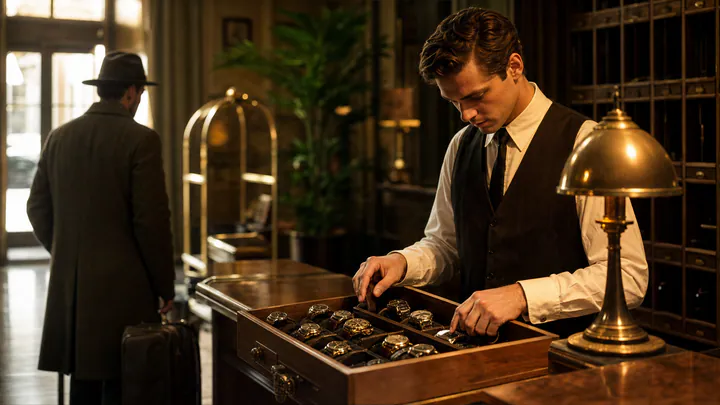
The watches came in like migrating birds, one or two a week, and Ilan kept them in the bottom drawer of the front desk because he did not know where else they belonged. Some still ticked. Most had stopped at strange, private hours — 3:11, 4:47, once a small silver one frozen at 6:02 with a bead of condensation trapped beneath the glass like a held breath.
The Lost Watch Hotel had not always been called that. Its brass sign said Hotel Verline, and the previous night clerk, a woman named Pris who had trained Ilan for exactly four evenings before retiring to a town by the sea, had shrugged when he asked about the drawer.
"Guests leave them," she said. "They come down at checkout and their wrists are lighter and they don't remember taking them off. So we keep them. In case."
"In case of what?"
Pris had considered this. She wore no watch herself. "In case someone comes back for the time they lost."
That had sounded, to Ilan, like the sort of thing older people said to make younger people feel that the world was still mysterious. He had smiled politely and filed it away. Then he had worked the desk for eleven months, and in that time forty-three watches had accumulated in the drawer, and no one — not once — had ever come back for one.
The Guest in the Grey Coat
He arrived on a Tuesday in November, which is the softest night of the week to arrive anywhere. Rain had been falling since afternoon, the kind that does not announce itself but simply is, gluing leaves to the pavement outside the revolving door.
The man was perhaps sixty. He wore a grey wool coat too heavy for the lobby's warmth, and he carried a small leather case that looked as though it had been packed and unpacked so many times it had forgotten the shape of its own contents.
"I don't have a reservation," he said. His voice was low and courteous. "I was hoping you might have a room anyway."
Ilan checked, though he already knew. On a Tuesday in November the Verline had rooms the way a forest has trees. "Room 214," he said. "Quiet side. Rain-facing."
The man signed the register slowly. His name, in careful letters, was Osrin Delahaye. Ilan had never seen the name before, and yet writing it down felt like copying a word from a book he had read as a child and lost.
"How long will you be with us, Mr. Delahaye?"
The man paused with the pen still touching the paper. "I'm not certain. I'm looking for something. When I find it, I'll go."
Ilan handed him the key. He was practiced at not asking questions. Night clerks who ask questions do not last; the hours are too long and the answers are too heavy. But something about the man's stillness — the way he seemed to be standing at the edge of himself — made Ilan hesitate.
"If it helps," he said, "we do keep a lost and found. In case what you're looking for was left behind."
Osrin Delahaye smiled for the first time. It was a small, tired smile, the kind you give a stranger who has, without knowing it, said exactly the right thing.
"Perhaps in the morning," he said.
He did not come down in the morning. He came down at 2:14 a.m., in the same grey coat, and he crossed the empty lobby with the deliberate quiet of a man who does not wish to wake the building.
Ilan was reading. He set the book down.
"You mentioned a lost and found," Osrin said.
"I did."
"Might I see it?"
Ilan opened the drawer. He had not opened it in front of a guest before, and he was surprised by how the sound of it — the small dry rustle of forty-three watches shifting on their velvet lining — seemed to fill the whole lobby, as though the drawer were larger inside than out.
Osrin leaned forward. His face changed. Not dramatically; Ilan would later find it difficult to describe. It was the change that comes over a person when they see, after many years, the house they grew up in, and find it smaller than they remembered, and exactly the right size.
"May I?"
"Please."
He did not rummage. He looked, slowly, at each watch, the way a person might look at faces in a crowd. He picked up the little silver one with the bead of condensation and turned it over. On the back, engraved so faintly that Ilan had never noticed, were two initials and a date.
"Ah," Osrin said, very softly.
He set it down again. He kept looking.
Ilan watched him examine watches for what might have been ten minutes and might have been an hour; the lobby clock, he noticed with a small chill, had stopped.
Finally, Osrin lifted a plain leather-strapped watch from the back of the drawer. It was, Ilan thought, one of the least interesting ones. The face was scratched. The hands had stopped at 4:47.
"This one," Osrin said.
"You're certain?"
"I am." He turned it in his palm. "My wife gave it to me. I took it off in a room in this hotel forty-one years ago, the morning after she told me she was leaving. I was so careful, that morning. I folded my shirt. I paid the bill. I walked out into a very bright day." He looked up. His eyes were not sad; they were something quieter than sad. "I forgot to put it back on. And then I forgot that I had forgotten. And then I spent forty-one years feeling that I was late for something without knowing what."
Ilan did not know what to say. He said the only true thing he could think of.
"It stopped at 4:47."
"Yes," Osrin said. "That was the hour."
He fastened it onto his wrist. The strap was stiff with age but it went, and as it settled against his skin the second hand — Ilan saw this and would swear to it for the rest of his life — gave one small, tentative tick. Then another. Then it began, patiently, to move.
Osrin closed his eyes. He breathed out. When he opened them again he looked, somehow, younger and older at once, like a man who has finally caught up with himself.
"Thank you," he said. "I'll check out now, I think."
"It's the middle of the night."
"I know. But I've kept myself waiting long enough."
Ilan prepared the bill. Osrin paid it in cash, in old bills that smelled faintly of cedar, and he left through the revolving door into the rain, which had softened to almost nothing, and he did not look back.
In the morning the lobby clock was ticking again. Ilan had not touched it.
He opened the drawer. Forty-two watches now, resting on the velvet, each one holding its private hour. He thought about the woman by the sea who had trained him for four evenings, and about how she had said in case someone comes back, and how he had smiled politely and not believed her.
He closed the drawer gently, the way you close the door of a room where someone is finally, after a long time, asleep.
Then he sat down at the desk, and he waited, in the patient way of night clerks, for whoever might arrive next looking for the time they had misplaced.