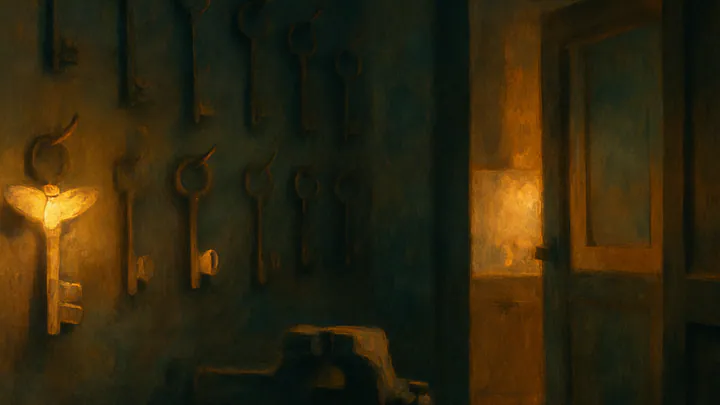
Seventy Minutes of Silence in Hall Four
A short story about an exam invigilator in Daejeon who, during the silent listening section of Korea's college entrance exam, must decide what to do about a glow under a student's sleeve.
Drafted with AI and published automatically. Our editors set the standards and fix reported errors — how we work.
Story Time is original short fiction. The characters, places and events in this story are invented.
The first question began with a doorbell, and the boy in the third row touched his wrist again.
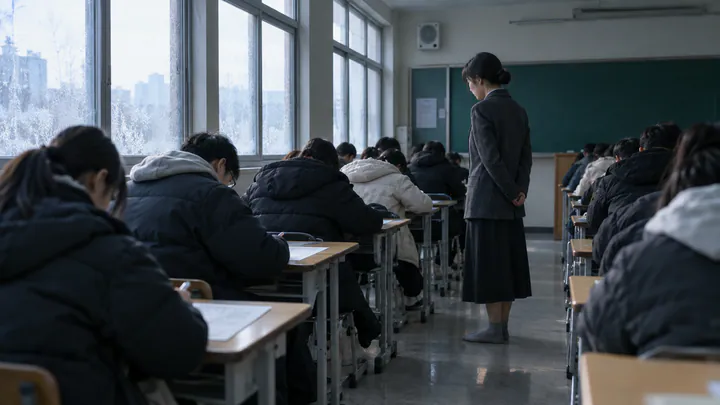
Bo-ra watched him from the front of Hall Four with her hands folded over the attendance binder. A man's voice came out of the speaker above the blackboard, pleasant and unhurried, asking a woman whether she had remembered to return the library books. Thirty heads went down. Thirty computer-sign pens hovered over thirty answer cards. Somewhere above Daejeon, every aircraft in the country was holding on the ground so that nothing would roar over a school while this recording played, and in Hall Four the only sound besides the voices was the tick of the radiator cooling. They had shut the heating off at five past one so it would not knock.
The boy wore a black padded coat zipped to the chin, like half the room. The windows had frosted along the bottom edges since morning; the exam-day cold had arrived on schedule, the way it did every year, as if the weather also sat the test. When he lifted his left hand from the desk and pressed two fingers against the inside of his right wrist, the cuff of his coat lit from within. A faint blue-green, the color of a fish tank at night. Then it faded.
Bo-ra's stomach tightened in the precise, familiar way it did before a fire drill.
Electronic devices of any kind. She had read the phrase aloud at ten past eight that morning, holding up the laminated card, while students filed forward to drop phones into the plastic tray. Smartphones, smartwatches, digital watches, electronic dictionaries, wireless earphones. Analog watches only, without communication functions. Possession during the examination, whether used or not, whether switched on or not, would result in the invalidation of all the candidate's results for this year. She had read it slowly, twice, because a boy in the back had been yawning the first time.
Question two. A woman describing a poster for a school festival. The boy did not touch his wrist during question two. Bo-ra let out air through her nose.
She looked at the back of the room. Mr. Kang, her co-invigilator, a history teacher from a boys' school across the river, stood against the rear wall with his arms crossed and his chin resting on his chest. His eyes were closed. His thermos of barley tea was on the windowsill beside him, lid off, no longer steaming. He had told her at the lunch break that he'd been up since four with a colicky baby, and she had said, "You'll be standing all afternoon," meaning you had better manage it, and he had laughed as if she'd made a joke.
Now his head dipped, caught itself, dipped again.
Question three. The boy's fingers went to his wrist. The glow came and went.
Bo-ra had been doing this for four years. She was a science teacher at a middle school in Yuseong, and she knew how to watch a room: which students were thinking, which were pretending, which were copying the shape of thinking off the person in front of them. In her first year of invigilation, a girl's phone had gone off inside a bag at the front of the hall, an alarm set for her mother's medicine, a cheerful marimba in the middle of the Korean section. The girl had not touched it. The bag had been in the correct place. It did not matter. Bo-ra had filled out the form in her neatest handwriting, and the girl had signed it, crying without making any sound, because even then she had not wanted to disturb the others.
Bo-ra had been right. She had gone over it many times since and she had always been right.
She could not call out. During the listening section, invigilators did not speak, did not walk unless necessary, did not so much as turn the pages of the binder. If she was going to act, she would have to act before the voice from the speaker said This is the end of the listening section, because after that the room would breathe again, pens would scratch, chairs would shift, and Mr. Kang would wake up and look at her, and whatever she decided would have to be explained. And if she reported a device and it turned out to be nothing, a reflective strip, a trick of the light, she would have frightened a boy out of his concentration during the one twenty-five minutes of his life that could not be replayed.
And if she ignored it and it was something, then she was the invigilator who had watched a candidate cheat in Hall Four and done nothing.
Question six. The man in the recording asked the woman what she wanted him to do. The boy pressed his wrist and held it this time, longer, his head bowed, lips not moving.
Bo-ra checked the seating chart. Third row, fourth seat. The admission ticket taped to the corner of his desk would show his photograph and his name. She had matched it against his face at the start of the first period, eight hours ago, when the room was still dark outside and the juniors had been at the gate in the cold, shouting and drumming and pressing hand warmers into everyone's pockets. She remembered nothing about him. That was how it should be. The boys she remembered were the ones who caused trouble.
She bent, slowly, and slipped off her shoes.
The floor was very cold through her socks. She stepped off the platform onto the linoleum and started down the aisle between the second and third columns of desks, placing each foot heel first, the way her grandmother had taught her to walk across a room where a baby was sleeping. A girl in the first row glanced up and immediately back down, alarmed, as if she might be the target. Bo-ra kept her eyes forward.
Question eight. A conversation about a broken printer. The voices seemed very loud now, and her own heartbeat seemed louder.
She stopped just behind his left shoulder. His neck was pink above the collar of the coat. His answer card was half filled in, the ovals shaded carefully, not a single stray mark outside them. On the desk sat the regulation pen, the regulation eraser, the admission ticket. Yoon Tae-min. His photograph looked about twelve.
His right sleeve had ridden up an inch when he reached to mark question seven, and she could see it.
It was a watch. Not a smartwatch, not anything with a screen worth the name. A cheap digital watch with a square gray face, the kind sold in stationery shops beside the erasers and stickers. The strap was pink plastic, sized for a child, fastened on the very last hole and pressing a pale groove into his skin. The glow came from its backlight button, which he must have been pressing with his fingertip through the fabric. On the strap, in thick black marker, in the enormous careful letters of someone who had only recently learned to write, it said: OPPA FIGHTING.
The time on the face was wrong by two hours. Nobody had ever set it.
Bo-ra stood there through the whole of question nine. She knew exactly what the rulebook said, because she had read it more closely than anyone in her school. A digital watch was a digital watch. There was no provision for handwriting. There was no category on the form for the device appears to belong to a little sister. If she tapped his shoulder now and gestured for him to hand it over, the year was finished for him, and he would go home to a small girl who had tied something to her brother's wrist for luck.
At the back of the room, Mr. Kang's head was still bowed. His breathing had gone slow and even.
Bo-ra reached down with one finger and drew the cuff of the boy's coat down over the pink strap until it covered the watch completely. She did it briskly, the way she straightened a student's name tag before an assembly.
Tae-min went rigid. He looked up at her, and she saw his face understand what it thought it understood: a strict teacher, a fidgety boy, a reprimand without words. His ears went red. He tucked both hands flat under the edge of the desk, then remembered question ten and quickly picked up his pen, and did not touch his wrist again.
She walked back to the front in her socks, stepped into her shoes, and folded her hands over the binder.
The listening section ran another fourteen minutes. A man asked for directions to a museum. A woman described the rules of a recycling program. At twenty-five past one, Mr. Kang jerked awake, looked around wildly, found Bo-ra watching him, and straightened against the wall with his arms tighter than before.
"This is the end of the listening section," said the speaker, and outside, far off, the first plane of the afternoon began to climb.
Thirty students exhaled. Pages turned. Bo-ra opened the binder to the incident log for the third period, uncapped her pen, and in the box marked Irregularities observed, in her neatest handwriting, she wrote None.
When she came down the aisle forty minutes later to stamp the answer cards, Tae-min kept his eyes fixed on his desk and his sleeve pulled down to his knuckles, and he did not look at her at all.