The Boy Who Traded Shadows at Dusk Market
In a market that only opened at twilight, a boy named Ori learned that the price of a borrowed shadow was steeper than he'd been told.
Drafted with AI and published automatically. Our editors set the standards and fix reported errors — how we work.
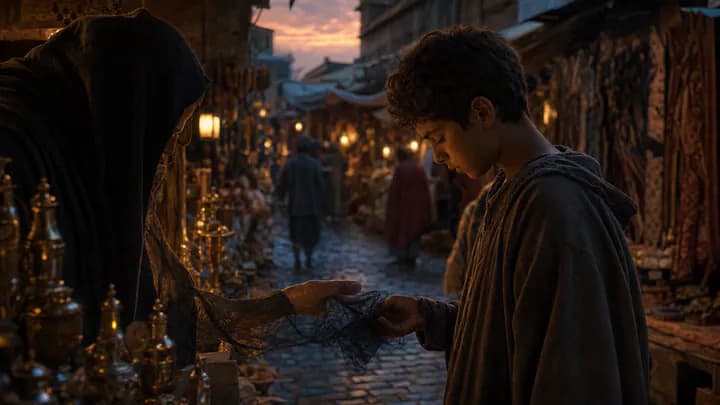
The market opened only when the sun was halfway drowned, and closed the instant a star could be counted. Ori had been warned about it since he was old enough to hold a coin, which is to say, since he was old enough to lose one.
He was twelve, and he had a hole in his pocket and another one, harder to name, somewhere behind his ribs. His mother had been coughing for weeks. The good doctor lived three towns away and would not travel for less than a silver stamped with the old king's face, and Ori's family had only copper stamped with nothing at all.
So on a Thursday, when the light went the color of steeped tea, Ori walked down the alley behind the tannery, past the hedge that pretended to be a hedge, and into the Dusk Market.
It was not loud, the way ordinary markets were loud. It murmured. Lanterns hung from nothing and swayed anyway. The stalls sold things Ori could not have named in daylight: a jar of small regrets, labeled by year. A folded map of a river that no longer ran. A cage of held breaths, humming faintly. A woman was selling laughter by the spoonful and doing brisk business among the tired.
Ori kept his head low. He had come for one stall in particular.
The Shadow Broker
She sat behind a table draped in gray silk, and her own shadow pooled around her feet like a well-trained cat. She was neither young nor old; her face kept forgetting to decide. In front of her, folded neatly as handkerchiefs, were shadows. Some were small — a child's, a cat's, the narrow shade of a heron. Others were long and stately, the kind cast by tall men at sunset.
“You've come to sell,” she said, without looking up.
“I've come to trade,” Ori said, trying to make his voice deeper than it was. “My shadow. For a silver coin. The old kind.”
She looked at him then. Her eyes were the color of tea leaves settling. “Your whole shadow?”
“My whole shadow.”
“For how long?”
Ori hesitated. He had not thought there were pieces to this. “How long can I go without it?”
“People have gone a lifetime,” she said. “People have gone an hour and come back weeping.” She tapped one long finger on the silk. “A shadow is not just a dark shape on the ground, child. It's the part of you that remembers where you've been. Sell it, and you'll walk lighter. You'll also walk lost.”
Ori thought of his mother. Of the rattle in her chest that sounded like a small door trying to close. “A month,” he said. “I need a month.”
The broker considered him. “A month is fair. And I will give you a silver, old-king stamp, if you agree to one condition.”
“What condition?”
“You must not, in that month, look for your shadow. Not in mirrors. Not in ponds. Not in the mouths of dogs, who sometimes carry them. If you look, the trade breaks, and both of us lose.”
Ori nodded, because he would have nodded to almost anything.
The broker stood. She walked around the table, knelt, and with a small silver hook she lifted his shadow from the packed earth as easily as peeling a sticker. It came away with a soft tick, like a lock giving up. She folded it into a square no bigger than a letter and tucked it into a wooden drawer.
Then she pressed a coin into his palm. It was warm.
“Go,” she said. “And Ori — walk carefully in bright rooms. People notice.”
He had not told her his name.
The doctor came. He was a stooped man who smelled of aniseed and clean linen, and he did what doctors do, which is to say he listened, and frowned, and left a bottle of something bitter and a bottle of something sweet, and instructions to burn eucalyptus at night. Within a week Ori's mother could sit up. Within two, she could laugh, quietly, at his impressions of the goat next door.
She did not notice, at first, that her son cast no shadow. It was winter, and the light was thin, and shadows were shy things anyway. But by the third week she began to look at him strangely when he stood by the window.
“Ori,” she said one evening, “come sit by the lamp.”
He sat. She looked at the wall behind him for a long moment.
“What did you do?” she asked. Not angrily. Just tired, in the way she got tired now, which was less than before but still often.
He told her. He told her all of it, the alley, the hedge, the woman with tea-leaf eyes. He told her about the month.
His mother was quiet for so long that he began to count the ticks of the kettle on the stove. Then she said, “Oh, my little fool. Oh, my brave little fool.”
“It comes back,” he said. “In a week. She promised.”
“I hope so,” his mother said. “I hope she is the kind of woman who keeps promises.”
The Return
On the last day of the month, Ori went back to the alley behind the tannery. The hedge parted. The market murmured. The lanterns swayed.
The broker's stall was there, and so was the broker, and so — he could see it, folded in her drawer — was his shadow. But she did not look pleased to see him.
“You kept the bargain,” she said.
“I did.”
“You did not look. Not once. Not even when your mother asked you to stand by the lamp.”
“How do you know that?”
She smiled, and for the first time her face settled on an age: somewhere near his mother's. “Because I have been carrying it,” she said. “A shadow, when it is away from its person, gets heavier the longer it's alone. I've felt yours for a month. It is a good weight. It remembers a woman singing to you when you had a fever. It remembers a goat you named badly. It remembers a coin you polished on your sleeve before you spent it.”
She lifted the folded square from the drawer, unfolded it, and laid it gently on the ground at his feet. It sighed, and stretched, and knew him again.
“Why does it hurt you to give it back?” Ori asked, because he could see, now, that it did.
“Because I sold mine once,” the broker said, “and the person I sold it to did not come back.”
Ori did not know what to say to that. So he said the only true thing he could think of: “Thank you.”
The broker nodded. “Go home to your mother. Walk in the light. Cast long.”
He did. And on the way out of the alley, as the first star bullied its way through the dusk, Ori looked down and saw his shadow walking beside him — a little longer, he thought, than before, as though it had grown in his absence, or perhaps only learned to stand up straighter.
He did not tell his mother he had returned. She saw it, though, the next morning, when he stood by the window and the wall behind him remembered him. She did not say anything. She only touched the back of his neck, the way she used to when he was smaller, and put another log on the fire.