The Brick Wall Has Been Keeping Notes
A sign painter hired to restore a faded ghost sign finds something small and handwritten in the corner of the wall her late father once painted. It sends her back up the scaffold with a choice.
Drafted with AI (Claude) and published automatically. Our editors set the standards and fix reported errors — how we work.
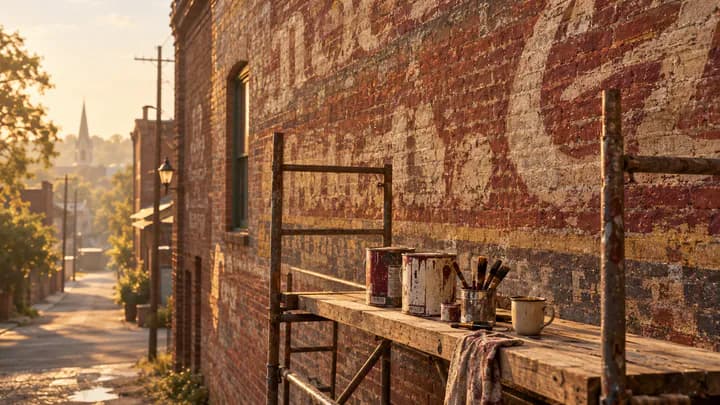
The heritage committee wanted the prettiest ghost on the wall, and Adele Marsh had been hired to raise it from the dead. She stood in the alley behind the old Dunmore building at seven in the morning, a coffee going cold on the scaffold plank, looking up at forty feet of brick that couldn't decide what century it belonged to.
The letters bled through one another like voices in a crowded room. A cream-and-oxblood PELLHAM'S FEED & SEED arched across the middle. Over it, blunter and more faded, sat DUNMORE TIRE & BATTERY. Beneath both, if you tilted your head, a woman in a long skirt held up a tin of something that promised lighter biscuits. Nobody alive had ever tasted them.
"That's a lot of words," said Marcus.
Marcus was the building owner's grandson, fifteen, paid ten dollars an hour to hold the ladder and not look at his phone. He was doing roughly half the job.
"It's four walls stacked in one," Adele said. "Every twenty years or so, somebody painted over the last guy."
"And you're painting over all of them?"
"I'm bringing back the feed store. That's the one the committee voted for."
She didn't tell him the tire shop was her father's. Walt Marsh had painted it in 1974, when she was eight and still allowed to sit on the bottom rung of his ladder and stir the paint. At the committee meeting, Mr. Halvorsen had cleared his throat and said, "No offense to your dad, Adele, but nobody puts a tire shop on a postcard," and she had said, "None taken," because it was easier than the truth.
The truth was that her father had been the most exacting man she'd ever known, and he had died four years ago still telling her, in one way or another, that her red was in a hurry.
"Your red's in a hurry, Dell." He'd said it about her brushwork, her driving, the year she moved to the city, the year she moved back. She'd painted signs for thirty years and never once felt she'd satisfied him.
Before any restoration, you document. Adele set up in the bottom right corner, the spot where sign painters have always hidden their signatures, and began a test window: a four-inch square cleaned with soft brushes, a mild solution, and more patience than anyone ever budgets for.
The grime came away in gray threads. Beneath it, where she expected a name and a date, there were sentences. Small ones, lettered in a steady single-stroke hand, stacked like a column of figures.
She stopped breathing for a moment, then kept cleaning.
By noon she had a window the size of a cereal box, and she was sitting on the lowest plank with her knees drawn up, reading.
A. Fenwick, 1912 — First coat on a new wall. May it outlast me.
M. Duarte, 1938 — It did. Rained all week. Worked anyway.
J. Pike, 1951 — Home from the war. Painting chicken feed. No complaints.
And then, in lettering she would have known in the dark, because she had learned her own alphabet by copying it:
W. Marsh, 1974 — Copied as found. Whoever's next: add yours and pass it on. This wall takes a slow red. Don't rush it for anybody.
P.S. If that's you, Dell — told you you'd end up up here.
Marcus had drifted over, sandwich in hand. "Is that a signature?"
"It's a conversation," Adele said, and her voice did something she didn't approve of.
He crouched and read it, lips moving slightly. "Wait. How is it all on one layer? Didn't they paint over each other?"
"They did." She touched the air just above the letters, not quite daring to touch the paint. "So each one copied it. Before they covered the old wall, they copied down what was in the corner, and then they added a line." She pointed. Copied as found. "My father copied Pike. Pike copied Duarte. Duarte copied Fenwick. Sixty years of painters who never met, passing a note down the row."
"Your dad did the tire one?"
"He did."
Marcus looked at the P.S. for a long time. "Who's Dell?"
"Me."
"Told you you'd end up up here," he read aloud. "What's that mean?"
Adele laughed, and it came out wet. "When I was eight, I told him I'd never climb a scaffold as long as I lived. I was going to be a lawyer. I was going to have an office with carpet and sit down all day." She wiped her face with the back of her wrist and left a gray streak. "He must've come home and painted this the same week."
That night she didn't sleep much. She sat at her kitchen table with the photographs spread out and read the line about the red until it stopped being words.
This wall takes a slow red. Don't rush it for anybody.
All those years of your red's in a hurry, and she had heard it as a verdict. But here it was, written to a stranger he'd never meet, and it wasn't a verdict at all. It was advice. It was the most important thing he knew about this particular wall, handed forward like a tool. Maybe it had always been that. Maybe he just hadn't known how to say it to her face without it sounding like a complaint, and she hadn't known how to hear it without it sounding like one.
In the morning, she called Mr. Halvorsen.
"The corner," she said. "Bottom right. There's historical lettering I need to preserve. It's about the size of a paperback."
"Does it affect the feed store?"
"It'll be under the feed store. Like a footnote."
"Then do what you need to," he said, sounding like a man who had never once in his life looked at the bottom right corner of anything.
She spent the next two weeks bringing Pellham's back. She rebuilt the cream arches letter by letter, reset the drop shadows, coaxed the serifs out of the brick. Marcus held the ladder and, somewhere in the second week, stopped looking at his phone entirely. He started asking questions instead: why she pulled the brush that way, why she waited between coats, why the edges looked soft from the ground but crisp up close.
On the last morning she climbed down to the corner with her smallest liner brush and a tin of cream.
She copied it as found. Fenwick, Duarte, Pike. She slowed down for her father's lines, matching his rhythm stroke for stroke, and it was like holding a hand she hadn't held in four years. She kept the P.S. exactly as he'd written it. Then, underneath, in her own hand:
A. Marsh — Copied as found. Still standing. Took it slow.
She considered a P.S. of her own and decided he already had the last word on that front. He'd earned it.
Marcus read it over her shoulder. "Can I add one?"
"When you paint the wall."
He looked up the forty feet of brick, squinting. "Maybe I will."
"Careful," Adele said. "That's how it starts."
Then she climbed back up to the big letters, pried the lid off the oxblood, and, for once in her life, gave the red the whole afternoon.