The Cyclist Who Delivered Wrong Numbers
Every morning, Oren delivers phone numbers that don't quite work. Until the afternoon a stranger dials one anyway and hears exactly the voice she needed.
Drafted with AI and published automatically. Our editors set the standards and fix reported errors — how we work.
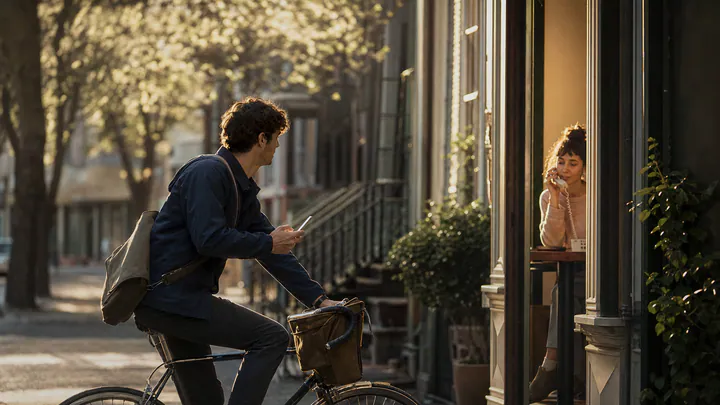
Oren delivered numbers that did not work, and he had been doing it for eleven years. He rode a green bicycle with a wicker basket, and inside the basket, every morning, he found a small stack of folded slips waiting for him — no one knew who left them there, not even Oren, though he suspected the answer might be him and simply preferred not to press the question.
Each slip carried one phone number in careful pencil, and beneath it, an address. His job — self-appointed, unpaid, and yet impossible to abandon — was to deliver the slip to the address. That was all. He never rang the bell. He tucked the paper under the door, or beneath a flowerpot, or into the slot of a mailbox, and rode on.
The numbers, he had confirmed early on, did not connect. He had called several himself in the first months, from a payphone near the depot, back when there were still payphones. He heard only the tone that meant the line was not in service, or the recorded voice of a woman he did not know saying please check the number and try again. He had stopped calling after that. It felt, obscurely, like eavesdropping.
The Route
His route on Thursday took him past the community garden, where the sunflowers had begun to bow their heavy heads, and down the long slope of Aster Street, where the linden trees dropped their sticky yellow blossoms onto parked cars. He delivered four slips before noon. One went to a duplex with a plastic frog by the mailbox. One went to an apartment above a shoe repair shop. One went to a small blue house whose windows were always closed.
The fourth address was new to him, which was rare. In eleven years he had memorized most of the town's streets and many of its back alleys, and he could tell you, without being asked, which houses had dogs and which had wind chimes and which had no one home for weeks at a time. But 44 Meridian Lane he had never delivered to.
The house was narrow and pale yellow, set back from the street behind a hedge that needed cutting. A woman sat on the porch, drinking something from a mug. She looked up as he coasted to the curb.
“Are you lost?” she called.
“No,” Oren said. He held up the slip. “Delivery.”
She set the mug down. “For me?”
“For the address.”
He walked the slip up the path and held it out. Up close, she looked tired in a soft, unhurried way, like someone who had not slept badly, exactly, but had slept alone for a long time. She took the paper and unfolded it.
“It's a phone number,” she said.
“Yes.”
“Whose?”
“I don't know.”
She turned the slip over as if the back might explain. “Do people usually call?”
“I don't think so,” Oren said. “The numbers don't work.”
She looked at him for a long moment, and he braced for the question he had never quite figured out how to answer — then why deliver them? — but she didn't ask it. She only nodded, slowly, as though he had confirmed something she already suspected about the shape of the world.
“Thank you,” she said.
He got back on the bicycle.
The Call
Her name was Ines, and she waited until Oren was gone before she went inside. She set the slip on the kitchen counter and looked at it while she made another cup of tea. The number had ten digits and the town's area code. The pencil marks were slightly smudged, as though whoever wrote it had brushed the paper before the graphite had settled.
She had moved to Meridian Lane six weeks earlier. She did not know anyone yet. She had told herself this was fine — she was forty-one, she had lived alone before, she liked her own company — but the truth was that the evenings had begun to feel like large rooms she couldn't quite furnish.
She dialed the number.
It rang. This surprised her so much that she almost hung up. It rang twice, three times, and then someone answered.
“Hello?”
The voice was a woman's, older, warm in the way of voices that have spent a lot of time reading aloud. Ines opened her mouth and found she had prepared nothing.
“I'm sorry,” she said. “I think I have the wrong number.”
“Oh,” the voice said. “That's all right. Who were you trying to reach?”
“I don't know,” Ines said, and to her own astonishment she began to laugh, and then to cry, quietly, into the receiver. “A man on a bicycle brought me this number. I don't know why I called. I'm sorry. I'll hang up.”
“Please don't,” the woman said. “Not on my account. It's a slow afternoon here.”
Ines wiped her face with the back of her wrist. “Where is here?”
“A bookshop,” the woman said. “A very small one. On Kettle Street, if you know it.”
“I don't.”
“Well,” the woman said, “now you do.”
They talked for twenty-three minutes. About the weather, and about the linden trees, and about a novel the woman was reading that she thought Ines might like. When Ines finally hung up, she stood for a while at the counter, listening to the small, ordinary sounds of her own house — the hum of the refrigerator, a car passing — as though she had never really heard them before.
The Basket
The next morning, Oren found his basket lighter than usual. Only three slips. He rode his route in the pale gold light and delivered them without incident: the duplex, the apartment above the shoe repair, the blue house with the closed windows.
At the blue house, for the first time in eleven years, a curtain moved. He glanced up and saw a face — a man, perhaps his own age, hair uncombed. The man raised one hand in a small, uncertain wave. Oren, surprised, waved back.
He rode on, past the community garden, past the leaning sunflowers, and thought about Ines on her porch, and about the number he had brought her, and about the woman on Kettle Street he had never met. He thought about how a wrong number, delivered patiently enough, over enough years, might eventually become the only right one.
The bicycle whirred softly beneath him. In the basket, tucked into the corner where he had not noticed it before, was a single folded slip he was almost certain had not been there a moment ago.
He did not open it. He pedaled toward the next address, whistling, into a morning that had, without warning, become his.