
The Switchboard Operator Who Heard Tomorrow
On her overnight shift at a sleepy mountain exchange, a small-town operator begins routing calls that haven't been placed yet. What she does with them will decide more than one life.
Drafted with AI and published automatically. Our editors set the standards and fix reported errors — how we work.
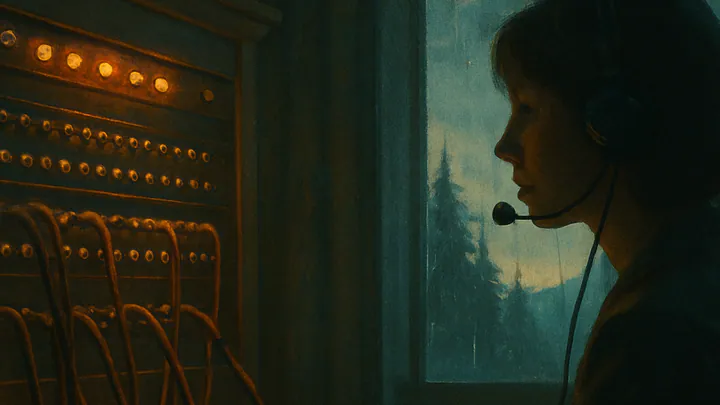
The first call from tomorrow came in at 2:14 a.m., and Edith almost missed it because she was eating a pear. She set the pear down on the brown paper it came in and pressed the front cord into the jack like she had ten thousand times before.
"Pine Hollow Exchange, operator speaking."
There was the small hush a line makes when it is alive, and then a man's voice, hoarse and apologetic. "I need Dr. Avery's house. Quickly, please. It's the Mendel boy. He fell off the porch and he isn't waking up."
Edith's hand was already moving. Dr. Avery was line 19, a black jack at the top left, easy as breathing. She plugged him through and waited for the ring. Once. Twice. Eight times. No one answered, which was strange, because Dr. Avery was the kind of man who slept with a hand near the receiver.
"I'm sorry, sir, he isn't picking up. Is there—"
The line was empty. Not dead. Empty. As if the caller had simply forgotten to be there.
Edith pulled the cord and made a note in the log: 2:14 — Mendel emergency — no answer Avery. Then she picked up her pear and listened to the rain on the tin roof above the exchange, and to the soft tick of the relays, and tried not to feel the small cold thing crawling up her spine.
She'd worked the overnight at Pine Hollow for nine years. She knew every voice in town the way some women knew hymns. There was no Mendel boy. The Mendels had two daughters, both grown, both in the city. And Dr. Avery had been buried two winters ago under a stone that said BELOVED PHYSICIAN in letters too large for the stone.
The second call came the next night at 2:14 exactly.
"Pine Hollow Exchange."
"Edie? It's Marn. Listen, sweetheart, the bridge is out at Cooper's Creek. Tell Hollis not to take the truck down there in the morning. Tell him to go around."
Marn had been Edith's sister. Marn had died on a Tuesday in April twenty-two years ago, of nothing anyone could name afterward. Edith had not heard her voice since, except sometimes in dreams she did not remember by breakfast.
"Marn," Edith said, and her own voice came out thin as paper. "Marn, where are you calling from?"
"Just tell Hollis. Promise me."
The line emptied.
Hollis was Edith's husband. Hollis drove a milk route. Hollis, in the morning, would absolutely take the truck down through Cooper's Creek because he always did, because it shaved fourteen minutes off the loop and he liked to be home for the second cup of coffee.
Edith sat very still for a long time. Then she pulled on her wool coat over her cardigan and walked the eight blocks home in the rain, and shook Hollis awake, and told him the bridge at Cooper's was out and he was to go around tomorrow, she didn't care if it added an hour, she didn't care if he thought she was being foolish. He looked at her face and said all right, Edie, all right, and went back to sleep.
In the morning the bridge at Cooper's Creek was in the creek, the timbers split clean down the middle, the water brown and shouldering past like it had been waiting all winter for the chance.
The List
After that Edith started keeping a second log, smaller, in a notebook she bought from the dry goods store and kept buttoned inside her cardigan pocket. She wrote down every call that came in at 2:14.
Some nights nothing happened, and she felt almost disappointed, and then ashamed of feeling disappointed. But often enough — twice a week, sometimes three — the bell would ring at 2:14 and a voice would speak across some seam in the air that Edith did not pretend to understand.
A woman warning of a kitchen fire on Lark Street. (Edith called the fire chief at 6 a.m. and said she'd smelled smoke on her walk; he humored her, drove by, found a frayed wire behind a toaster, and the Petersons kept their house.)
A boy, maybe twelve, sobbing that his dog had run into the road. (Edith called the Lange farm at dawn, said she'd had a feeling, asked if they'd mind keeping the gate shut today. Mrs. Lange said Edith was a strange one but yes, all right.)
A voice she did not recognize at all, saying only, the snow on the church roof, the snow on the church roof, over and over, until Edith called the deacon and told him to clear it before Sunday. He did. It came down Monday in a slab the size of a car.
She told no one. Not Hollis, not the day operator, not the priest who came in on Thursdays to use the long-distance line. She was sixty-one years old, and she had been raised to understand that some gifts were not gifts so much as chores, and chores were done quietly.
The call she had been half-waiting for came on a Tuesday in October.
"Pine Hollow Exchange."
"Ma'am." A young man, very calm, the kind of calm that is built on top of something else. "I need you to send somebody to the exchange building. The operator on duty is going to have a heart attack at about a quarter past two. She's alone in there."
Edith looked at the clock. 2:14.
"Son," she said gently. "Who is this?"
"It's — ma'am, please, there isn't time, just call—"
"Son. What's your name."
A pause. "Daniel. Daniel Reese. I'm — I'll be your grandson. I mean. I am. I will be."
Edith closed her eyes. She had one daughter, Ruth, twenty-six, unmarried, living three towns over and writing letters about a young man named Reese from the lumber office.
"Daniel," she said. "Listen to me carefully. I'm going to do exactly what you asked. But I want you to tell your mother, when you're old enough to tell her things, that her mother loved her very much and was proud of her every single day. Can you remember that?"
"Grandma—"
"Can you remember it."
"Yes. Yes, ma'am."
"Good boy."
She pulled the cord. She rang the night constable on line 4, and told him calmly that she was having chest pains and would he please come and bring Hollis, and then she sat back in the oak chair that had held nine years of her, and she put her hand on the log book, and she waited.
The constable found her conscious. The doctor in the next town found her stubborn. Hollis found her furious at the idea of a hospital and then, eventually, grateful.
She lived another nineteen years. She held Daniel Reese as a baby and told him, very seriously, that he was a fine boy and that she expected great things, and his mother laughed and said Mama, he's six weeks old.
Edith only smiled, and adjusted the blanket, and listened — as she had learned to listen — for whatever was coming next down the long quiet line.