The Detective Who Lost Her Umbrella
A retired inspector returns to the city in a downpour, hunting a missing umbrella and an older question she has never managed to file away.
Drafted with AI and published automatically. Our editors set the standards and fix reported errors — how we work.
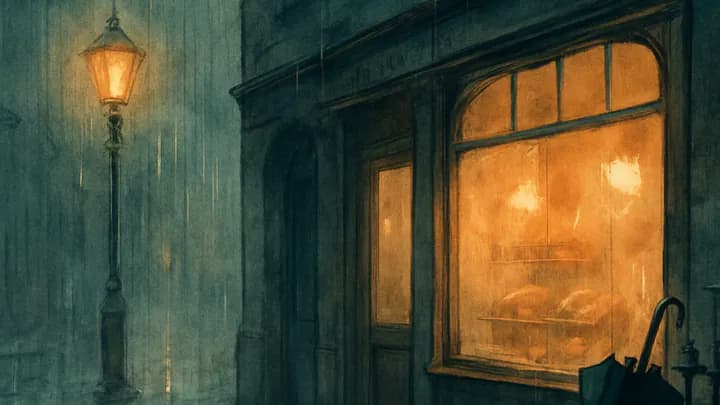
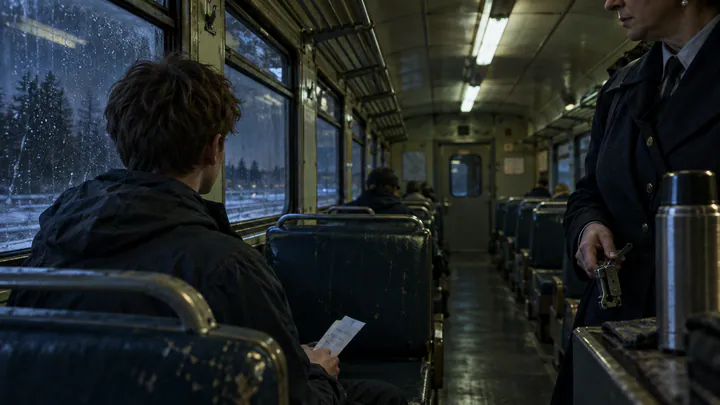
The rain started before Inspector Auden reached the bus stop, and by the time she remembered she had left her umbrella on the seat, the bus was already two streets away, sighing through puddles like a tired animal.
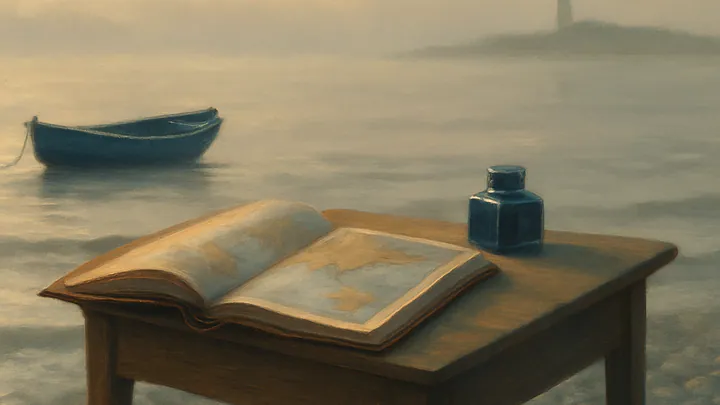
She stood under the awning of a closed florist and considered her options. She was sixty-three, retired eleven months, and had come into the city for a single, simple errand: to return a library book she had borrowed in 1994. The book — a slim volume on Dutch cartography — had surfaced last week behind a radiator she was finally throwing out. The fine, she suspected, would be more than the book was worth. She had come anyway.
Now she was umbrella-less, three blocks from the library, and the sky had the particular grey of a kettle just before it whistles.
"Excuse me." A boy of about ten stood at her elbow, holding a folded newspaper over his head like a tent. "Are you the lady who lost the black umbrella with the wooden handle?"
Auden looked down at him. Years of interviewing witnesses had taught her not to answer the first question a stranger asked, only the second.
"Why do you ask?"
"Because a man on the bus said someone left one, and he gave it to my mum, and my mum sent me to find you because she said you looked sensible and sensible people come back for their things."
"Where is your mother?"
The boy pointed across the street to a bakery with steamed windows. Through the glass, Auden could see the soft yellow shape of a woman wiping a counter.
"All right," Auden said. "Lead on."
The bakery smelled of cardamom and burned sugar. The woman behind the counter was perhaps forty, with flour on one forearm and a pencil tucked behind her ear. She handed Auden the umbrella without ceremony.
"He described you," she said. "Grey coat. Library book. Slightly cross expression."
"I was not cross."
"He said slightly."
Auden accepted this. "Thank you. Truly. People don't usually bother."
"People bother more than you'd think," the woman said. "They just don't always find who they're looking for."
It was the sort of sentence Auden would have ignored a year ago. Retirement had given her the strange gift of having time to hear things. She set the umbrella on the counter and looked at the woman properly.
"What's your name?"
"Marta."
"Marta, may I buy something? I'd like to sit a moment."
"The cardamom buns are good. Everything else is honest."
Auden took a cardamom bun and a cup of black tea to a small table by the window. The boy had vanished into a back room. The rain on the glass made the streetlamps look like they were melting.
She had not, in fact, come into the city only for the library book.
She had come because, three weeks ago, a letter had arrived at her cottage with no return address. Inside was a photograph — slightly water-damaged, the colors gone soft — of a young woman holding a baby on the steps of a building Auden didn't recognize. On the back, in handwriting she did not know, someone had written: She found him. She wanted you to know.
That was all.
For thirty years, Auden had carried one unsolved case the way other people carry a stone in a shoe. A woman named Iris had walked into her station in 1991 looking for a brother who had vanished from a children's home as a teenager. Auden had been twenty-eight and certain, and she had failed. She had tracked the brother to three cities and lost him in the fourth. Iris had moved away. The file had closed itself, the way files do.
The photograph could have been anyone. Auden had told herself this on the train.
Now, in a bakery she had never seen before, watching a stranger arrange pastries with the unhurried care of someone who had decided long ago that small things were worth doing well, she felt the stone shift.
"Marta," she said, when the woman came past to wipe a nearby table. "This may be an odd question. Have you lived in the city long?"
"All my life. My mother opened this place in 1980. I took it over when she got tired."
"Your mother. Is she —"
"Still around. Upstairs. She doesn't bake anymore. She reads." Marta smiled. "Mostly the same three books, over and over."
"What is her name?"
Marta paused, the cloth in her hand. Something in Auden's voice had reached her.
"Iris," she said. "Why?"
Auden set down her tea very carefully, as if it were full of something more fragile than tea.
"I think," she said, "I once tried to help your mother find her brother."
Marta looked at her for a long moment. Then she set the cloth down and sat in the chair opposite.
"You're the inspector," she said. "The young one. She talks about you."
"She does?"
"She says you were the only person who believed her. The only one who didn't say he was a runaway and good riddance."
"I didn't find him."
"No," Marta said gently. "But she did. Eight years ago. He was in a town up the coast, working at a marina. He'd been there the whole time, under a different name. He didn't remember the home. He didn't remember much. But he remembered her, once she sat across from him long enough."
Auden discovered she was holding the edge of the table.
"The photograph," she said. "On the steps."
"That's his daughter," Marta said. "My cousin. Mum sent the photo to your old station last month. She didn't know if you were still there. She said she'd been meaning to for years and then she got sick and then she got better and she thought, well, while I'm here."
"It found me."
"Things do. Eventually."
They sat for a while without speaking. The rain kept on. Somewhere upstairs, faintly, a kettle began to whistle, and a woman's voice called something fond and indistinct down a stairwell.
"Would you like to come up?" Marta asked. "She'd be glad. She'd be more than glad."
Auden picked up her umbrella. It was heavier than she remembered, the wood worn smooth by a hand that had carried it through thirty-five years of weather.
"In a moment," she said. "Let me finish my tea first. I'd like to arrive properly."
Marta nodded and went to put the kettle on again.
Outside, the rain eased, the way rain eventually does when it has said what it came to say. Auden looked at the library book on the table beside her tea. She would return it tomorrow. Today, it turned out, she had come into the city for something else entirely, and she had nearly missed it for the want of an umbrella she had been lucky enough to lose.