The Elevator Operator on the 47th Floor
In a tower where nobody remembers pressing the button for forty-seven, an old operator waits with a thermos of tea and a story only the tired will hear.
Drafted with AI and published automatically. Our editors set the standards and fix reported errors — how we work.
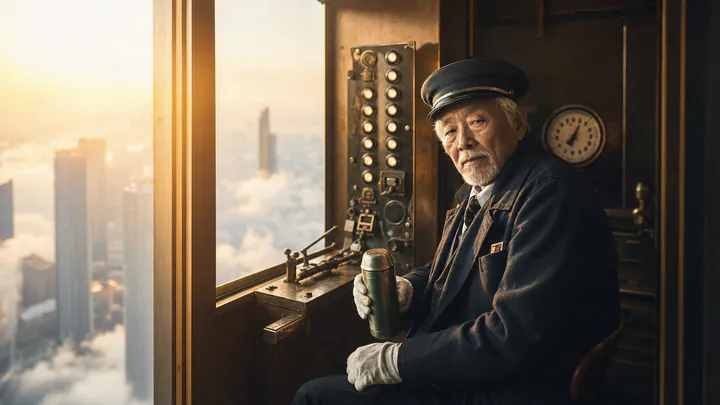
The elevator smelled of cedar shavings and old rain, which was the first sign Priya had stepped into the wrong one. The second was the man on the stool inside it, wearing a navy uniform with brass buttons, holding a thermos in both hands like a small dog he was afraid to drop.
"Floor?" he asked, without looking up.
Priya's mouth was already forming the number twenty-two, the floor where her firm kept its beige carpet and its beige coffee and its beige quarterly reports. But what came out was, "I don't know."
The man nodded as if this were the correct answer. He set the thermos beside him on a narrow wooden shelf that shouldn't have fit in any elevator she knew, reached up, and pulled a brass lever. The doors slid closed with a soft, considered sound, like a book being shut on a finger to keep the place.
"Forty-seven, then," he said.
"There's no forty-seven," said Priya. "The building has forty-six. I checked once, during a fire drill. I count things when I'm anxious."
"That's a useful habit." He finally looked at her. He had the kind of face that had been handsome so long ago that only the kindness remained, worn smooth by use. "Forty-seven is where people go when they don't know what floor they want. Not many press it. Most people are certain."
The elevator began to rise. There was no lurch, no ding, no digital number counting up. Only a low hum, like a cello being tuned in a distant room.
Priya had come to work that morning after three hours of sleep and a fight with her sister over the phone about their mother, who was neither ill nor well but somewhere in a country of her own choosing. On the train, she had read the same email eight times without absorbing a word. At the lobby coffee stand, the barista had asked, "The usual?" and Priya had almost cried, because she couldn't remember what her usual was.
She had stepped into the first open elevator without looking.
"How long have you worked here?" she asked the man, mostly to keep her mind from folding in on itself.
"Since before the building decided what it wanted to be," he said. "They were going to make it a hotel. Then offices. Then apartments. Then offices again. In between each idea, there was a pause. I was hired for the pauses."
"That's not a real job."
"No," he agreed pleasantly. "It isn't."
The hum shifted. Priya realized she couldn't feel the elevator moving anymore, though the small dial above the doors — brass, with a needle like a compass — was sweeping slowly past numbers she didn't recognize. Twenty-nine and a half. Thirty-one and three-quarters. A number that looked like the Greek letter she'd never learned.
"What happens on forty-seven?" she asked.
"Nothing much. There's a window. A chair. A pot of tea that stays warm because it was made by someone who cared. You sit for a while. When you're ready, you press the button to come back down, and the elevator remembers which floor you actually needed."
"That's it?"
"That's it."
Priya laughed, and it came out sharper than she meant. "I don't have time for a window and a chair. I have a deadline at four. I have — " She stopped, because she couldn't remember what came after the deadline. There was supposed to be a life on the other side of four o'clock, and she couldn't picture it. Just more four o'clocks, lined up like identical doors down a hallway.
The man unscrewed the top of his thermos and poured tea into the cap. He offered it to her. Steam rose in a slow curl, smelling of cardamom and something older, something like the porch of a house she had never lived in but somehow missed.
She took it. Her hands were shaking a little. She hadn't noticed until the cup steadied them.
"You're not the first tired person to step into my elevator," he said. "You won't be the last. I don't do anything, understand. I don't fix anything. I just take you somewhere quiet for the length of a cup of tea. That's the whole of it."
"Why?"
He considered. The needle above the door was hovering now, between two numbers she couldn't read.
"When I was young," he said, "I worked in a building that fell down. Not dramatically. Slowly. Bit by bit, over years. And what I remember, more than anything, is that no one ever stopped. Everyone kept walking past the cracks. Including me. I promised myself, if I ever got another building, I would give people a place to stop. That's all this is. A place to stop."
Priya sipped the tea. It tasted like her grandmother's kitchen in Pune, which she had visited exactly twice as a child and had never told anyone she thought about, ever.
The doors opened onto a small room. There was, as promised, a window — round, like a porthole — looking out at a sky the color of a wet stone. A single armchair, upholstered in green velvet worn bald at the arms. A low table with a teapot on it, and steam rising from the spout as if someone had just set it down and stepped into another room.
She sat. She didn't cry, though she'd expected to. She just watched the sky through the porthole and drank her tea, and after a while she noticed that the tightness in her chest — the one she'd carried so long she'd stopped calling it anything — had loosened by a quarter turn. Not gone. Just loosened.
She thought about her mother, and about her sister, and about the deadline. She thought about the barista and the usual she couldn't remember. She thought that maybe her usual was allowed to change.
When she was ready, she stood. There was a brass button by the door with no number on it, only a small engraved word: down. She pressed it.
The doors opened onto the elevator, and the man was still on his stool, thermos in hand.
"Twenty-two?" he asked.
"Twenty-two," she said.
He nodded and pulled the lever. As the doors closed, she said, "Thank you."
"Come back," he said. "When you don't know what floor you want. I'll be here."
She stepped out on twenty-two into the beige hallway, the beige coffee, the beige carpet. Her deadline was still at four. Her sister still hadn't texted back. Her mother was still in her chosen country.
But on her desk, when she sat down, she found she could read the email on the first try. And at the end of the day, she took the stairs — all twenty-two flights — just to feel her own legs carrying her home.