The Girl Who Carried the Murga's Bass Drum
A short story about Belén, a loud fifteen-year-old who hauls the bass drum for an all-male murga in 1986 Montevideo, and the closing verse she tells her niece about decades later.
Drafted with AI. This version has not been reviewed by an editor, so it carries no ads — how we work.
Story Time is original short fiction. The characters, places and events in this story are invented.
Agustina stabbed her thumb on the third sequin and put it in her mouth, so I took the jacket off her knees and told her the story she has been asking for since she was nine. The kitchen table was buried in satin, gold for the chorus, plain black for the stagehands, and the radio was low enough that we could hear the drums already practising two streets over on Isla de Flores.
"Pull the thread through slow," I said. "Like you're not in a hurry to be finished. Now listen."
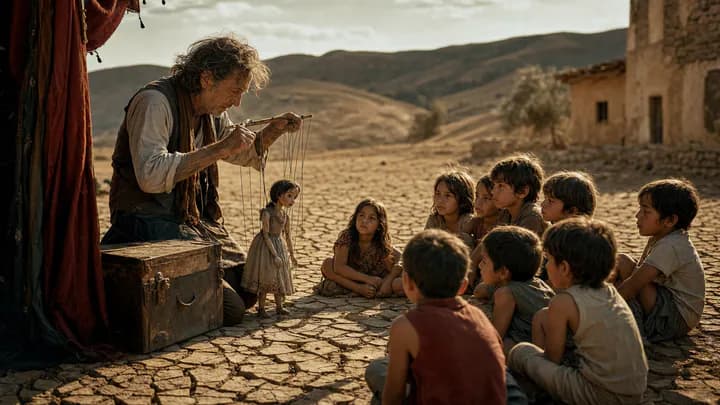
In February of eighty-six I was fifteen, taller than my father and louder than the bus. The murga was Los Desvelados del Sur, eighteen men and a battery of three, and my job was the bombo. Not playing it. Carrying it. Pocho Silveira played it, and Pocho had a bad back and a worse temper, so I hauled that drum up onto the back of the truck every night, wedged it between the cymbal stand and the cooler of tortas fritas, and hauled it off again at whatever tablado we were singing at, Palermo, the Cordón, a stage built out of pallets behind a butcher's in La Teja.
That was the first carnival after the generals. You have to understand that. The year before, people had still been looking over their shoulders. In eighty-six everybody sang like they'd been saving it up. The cuplés were full of things nobody would have dared to say two years earlier, and the crowds at the tablados knew every word by the second week.
So did I. I knew them by the first week. I knew the saludo and all four cuplés and the retirada, and I knew which of the men went flat on the long notes, which was your grandfather on the bad nights, though I never told him. I sang them in the truck with the wind off the rambla tearing the words out of my mouth. I sang them at the back of the club on Calle Durazno while I tightened the skin on the bombo, and that's how Washington Píriz heard me.
Washington was the director. He had a moustache like a broom and hands that could stop eighteen men on a single breath. He came to the back of the hall after rehearsal, wiping the white paint off his neck with a rag, and he stood there until I stopped.
"You've got a voice," he said.
"I've got all the words, too."
"I noticed." He folded the rag. "Nena, this murga has never had a girl's voice. Not in thirty-one years. And it isn't going to start in a contest year, with the jury counting every hair."
"So next year."
He looked at me like I was a bill he hadn't decided whether to pay. "Carry the drum, Belén."
Your grandfather was standing by the door with his levita over his arm. He'd heard every word. He sang second voice, Nelson Ferreira, twenty years in the chorus. I waited for him. He put on his cap and said we'd miss the last bus.
Agustina had stopped sewing. "He didn't say anything?"
"He said plenty. On the walk home."
What he said, between the bus stop and our door on Ciudadela, was that Washington wasn't wrong. That the jury would take points off for anything that looked like a gimmick. That the men had paid for their own costumes and their own paint and some of them had borrowed to do it.
"They'll mark us down," he said.
"You mean they'll mark you down."
He stopped under the streetlight and I thought he'd shout. He just took a cigarette out, didn't light it, and put it back. "Every year I think this is the year they'll put me in the front row," he said. "Every year Washington puts me behind the Gómez brothers. I'm forty-four, Belén."
I didn't understand then what he was telling me. I thought he was saying no. He was saying he was scared, which is a different thing, but at fifteen they sound the same.
So I carried the drum. Thirty-one nights of tablados. I ate choripán off the grill at the Parque Rodó stage standing up, with grease running to my elbow. I painted Pocho's face for him when his hands shook. I watched the men's voices wear down night after night, the way they do by the end of February, until the high parts sounded like a door that needed oil.
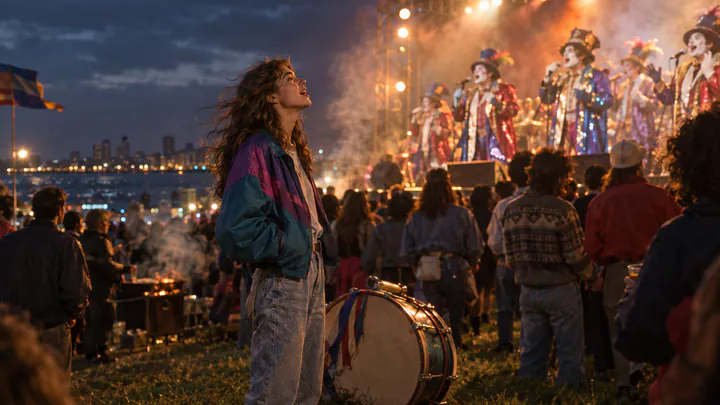
The final night of the contest was at the Teatro de Verano, out by the water. Everyone came. Half of Barrio Sur came in somebody's truck. The wind was blowing hard off the river that night, a south wind, cold for February, and it took the sound off the stage and pushed it back at the singers so they couldn't hear themselves properly. You could see them pressing their hands to their ears between numbers.
We were last on. By the time the retirada came round it was past one in the morning. I was down on the grass below the stage, where the battery's helpers stand, with the spare bombo between my feet, the one we kept in case Pocho split a skin.
The retirada is the goodbye song. You know that. Ours that year went: I'm leaving, barrio, I'm leaving, / but leave the window open, / leave a chair out on the pavement, / I'll be back before you've spoken. The last verse climbs. It goes up and up and the sobreagudos carry it over the top, and that's where the crowd starts crying, if it's going to.
Washington had taken it down a whole tone. I heard it on the first note. He'd done it to save the men's voices, and it was the right decision for the voices, but it was the wrong decision for the song. In that wind, a tone lower, it sounded like they were apologising. It sounded like a funeral that didn't want to bother anybody.
I knew where it was supposed to be. I'd sung it in the truck sixty times in the right key.
So I set down the drum. I remember that, the strap coming off my shoulder, the drum settling on the grass. And when they came to the last verse, I sang it from where I stood, in the key it was written in, as loud as I have ever done anything.
Agustina's needle was halfway through the satin. "In front of everyone?"
"Behind everyone. They were all facing the stage." I took the needle from her and finished the stitch. "The people around me turned. Somebody's grandmother grabbed my arm, I thought to stop me. She was holding on."
On the stage, they faltered. You could hear it, eighteen men suddenly singing against a voice coming from below them, half a line of mess, the Gómez brothers looking at each other. Washington's hands stopped in the air. I thought, that's it, I've broken it, they'll be disqualified and the whole barrio will know whose fault it is.
Then my father turned his head. He was in the second row, behind the Gómez brothers like always. He found me in the crowd, which can't have been hard, I was a head taller than everybody. And he went up. He took the line in my key, a whole tone above the men on either side of him, and his voice cracked on it and he kept going.
Washington looked at him. Then down at me. Then he lifted both hands and turned his palms up, the way he did when he wanted the chorus to rise, and they rose. All of them. They followed the key a fifteen-year-old with grease on her shirt had put on them from the grass, and the last verse went over the top of that wind the way it was always supposed to.
"Did you win?"
"Sixth." I bit the thread off. "Nobody remembers sixth."
"But what did he say? Washington?"
"He said I'd left the spare drum on the grass and somebody had nearly sat on it." I smoothed the jacket flat. "And in October, when they started rehearsals, there was a levita on the chair next to your grandfather's. It was too long in the arms. I had to take it up myself."
Agustina sat there a while. On the back of the chair hung the two jackets I'd cut for her, because she still hadn't told the director which list to put her name on: the black one with the deep pockets for the stagehands, the ones who carry the cymbal stands and the cooler and the drums, and the gold satin with the half-finished rows of sequins down the front.
She stood up and took the gold one off the chair and held it against her shoulders. The sleeves came down past her fingertips.
"It's too long," she said.
I reached for the pins.