The Glassblower Who Caught Lightning
In a coastal town where storms arrive like opinions, an aging glassblower attempts the impossible commission: a paperweight that holds a single bolt of lightning.

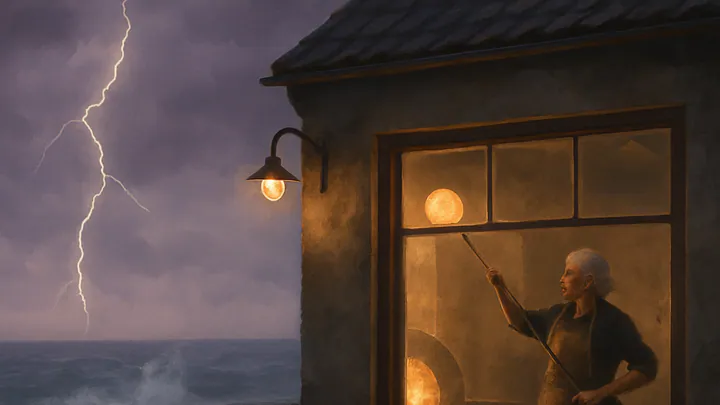
The first time Odile Marek caught lightning, it was an accident, and it cost her an eyebrow. The second time, she charged for it.
Her workshop crouched at the end of the pier road in Stellebrun, a town built so close to the sea that the windows tasted of salt even in August. She had inherited the building from her uncle, along with his furnace, his bad back, and his theory that storms were simply the sky clearing its throat to say something it would later regret. Odile had improved upon the furnace. The back she lived with. The theory she kept.
She was sixty-one the autumn the stranger came. The sky that morning was the color of an oyster shell, scraped clean, and the bell above her door rang in two short complaints, as if reluctant to be involved.
The man who entered was tall and apologetic in his shoulders. He wore a coat too thin for the weather and carried a wooden box the size of a loaf of bread. He stood on the mat for a long time, dripping politely.
"Are you the one who makes the weather glass?" he asked.
"I make a number of things," Odile said. She was trimming a length of pontil rod and did not look up. "Weather glass. Bottle stoppers. Eyes for the toymaker on Quill Street. What did you have in mind?"
"I was told," he said carefully, "that you once put a storm into a paperweight."
Odile set down the rod.
"That was a long time ago," she said. "And it was a very small storm."
"I can pay."
"That isn't the difficulty."
He opened the wooden box on her counter. Inside, nested in a folded scarf, was a pocket watch with its glass face cracked in a precise, branching line. The crack looked, Odile thought, exactly like a lightning strike seen from very far away.
"My wife," the man said, and then stopped, because the sentence had nowhere good to go. He tried again. "She loved storms. She used to stand at the kitchen window and count between the flash and the thunder. She said it was the only honest math." He touched the watch with one finger. "It stopped during the August gale. I would like — " He looked up at Odile, and his eyes were very tired. "I would like a paperweight with a bolt of lightning inside it. Just one. To set on her side of the desk."
Odile considered the watch. She considered the man. She considered the way the wind outside was beginning to lean on the windows like a relative with news.
"Come back in three weeks," she said.
The Catching
The trick, her uncle had told her once, was not to chase the storm. The storm would not be chased. The trick was to be ready in the small, breathing pause before it arrived, when the air went tin-flavored and the gulls fell quiet, and to ask it, very politely, for a single thread of itself.
Glass, he said, was nothing but sand that had been persuaded. Lightning was nothing but the sky losing its temper. The two had more in common than people thought.
For nineteen nights, Odile slept in the workshop with the shutters open and a crucible warm on the hearth. She drank tea so strong it tasted of iron. She prepared a batch of clear cristallo with a pinch of something her uncle had only ever called the listening salt, which she kept in a tin marked, dishonestly, BUTTONS.
On the twentieth night, the storm came.
It came the way real storms come — not announced but suddenly, as if it had been in the next room all along and had simply opened the door. The sea went white. The pier ropes screamed. Odile pulled on her leather apron and her grandfather's tinted goggles and carried the gather of molten glass out to the small iron platform her uncle had bolted to the seaward wall for exactly this purpose, and which the town council had repeatedly asked her to remove.
She held the glass up on the end of the rod.
"All right," she said to the sky, conversationally. "One. Just one. The smallest you've got."
The sky did not answer in words. It rarely did. But there was a moment — there is always a moment — when the air drew in its breath, and Odile felt the hairs on her arms lift like an audience standing for an anthem, and she knew to close her eyes.
The flash came down the rod like a guest who had been waiting in the rain. It went into the glass. The glass said yes, in the small ringing way glass has, and Odile felt the rod buck once in her hands and then go still.
When she opened her eyes, the storm was already going, embarrassed, the way storms do once they have given something away. She carried the gather back inside and worked it into a sphere, slowly, slowly, the bolt suspended in the heart of it like a white root.
She annealed it for two days. She polished its base flat. She wrapped it in the same folded scarf the man had brought the watch in.
The Delivery
He came on a Tuesday. The sky was mild and uninvolved.
Odile set the paperweight on the counter between them. The lightning inside was the size of a small, frozen river, branching once, twice, a third time into nothing. In certain lights it looked white. In others it looked the pale violet of the inside of a shell.
The man did not pick it up at first. He looked at it for a long time, with his hands flat on the counter on either side, as if he were steadying himself against a tide.
"Does it — " he began.
"No," Odile said gently. "It doesn't do anything. It sits. It catches the lamp. Sometimes, in very dry weather, it hums a little. That is all."
He nodded. He picked it up. He turned it in his hands, and the bolt inside turned with him, lazy as a fish.
"How much?" he said, and his voice had gone hoarse.
Odile named a price that was less than the work and more than he had expected, which is the correct price for that kind of object. He paid it in old notes from a leather wallet that smelled faintly of pipe smoke.
At the door, he stopped.
"Will it last?" he asked, without turning around.
Odile thought about this honestly. She thought about her uncle, and the listening salt, and the tin marked BUTTONS, and the small breathing pause before the storm.
"It will last," she said, "as long as someone is willing to count between the flash and the thunder."
He stood in the doorway a moment longer. Then he nodded once, the way a man nods when he has been given a fair answer, and stepped out into the bright, unremarkable afternoon. The bell above the door rang twice, less reluctantly this time.
Odile went back to her bench. Outside, somewhere far out over the water, the sky was beginning, very quietly, to clear its throat.
Frequently asked questions
What role does craft play in the story's treatment of grief?
The act of making — slow, attentive, requiring the right pause — mirrors the slow work of mourning. Odile's craft doesn't erase loss; it gives it a shape that can sit on a desk and be lived alongside.
How does the setting of Stellebrun shape the story's emotional weather?
The coastal town, with its salt-tasting windows and confiding sea, makes the supernatural feel domestic. Storms are treated as neighbors with opinions, which lets the magic register as ordinary craft rather than spectacle.
Why does the author leave the wife unnamed and largely undescribed?
Her absence is the story's true shape. Naming her or rendering her fully would risk turning her into a character to be solved; leaving her as a counted silence between flash and thunder keeps her present in the way grief actually keeps people present.
What do you make of Odile's closing line about counting between the flash and the thunder?
It reframes durability as relational rather than material. The paperweight lasts not because glass is permanent, but because remembrance is an active practice — someone has to keep doing the honest math.