The Greenhouse at the End of the Bus Line
When Marisol rides the 47 to its final stop on her grandmother's birthday, she finds a greenhouse that grows the one thing the city refuses to keep.
Drafted with AI. This version has not been reviewed by an editor, so it carries no ads — how we work.
The bus driver said the route ended at Halverson Loop, which was a lie, but the kind people tell when they don't want to explain. Marisol stayed in her seat anyway, because the timetable in her pocket said the 47 ran to a place called Endwell Field, and because today was her grandmother's birthday, and because she had nowhere else to be at four in the afternoon.
The driver glanced at her in the long mirror. He was older than the bus itself, with a beard like steel wool and a name tag that read, simply, ROY. "You sure, miss?"
"I'm sure."
"Endwell's not on the city map anymore."
"It's on mine."
He shrugged the soft shrug of a man who had stopped arguing with strangers around 1994 and folded the door shut. The bus shuddered, sighed, and pulled away from Halverson Loop's empty benches. Marisol watched the city thin into low warehouses, then into fields gone the color of weak tea, then into a road she was almost sure hadn't been there a moment before.
She held the paper bag on her lap a little tighter. Inside was a slice of orange almond cake, the kind her grandmother used to make on Sundays, wrapped in waxed paper and tied with kitchen twine. Marisol had baked it at six that morning, badly, weeping into the zest. It was the first cake she had ever attempted alone, and it had come out lopsided and slightly burned at one edge, which felt right. Her grandmother had been lopsided and slightly burned at one edge too.
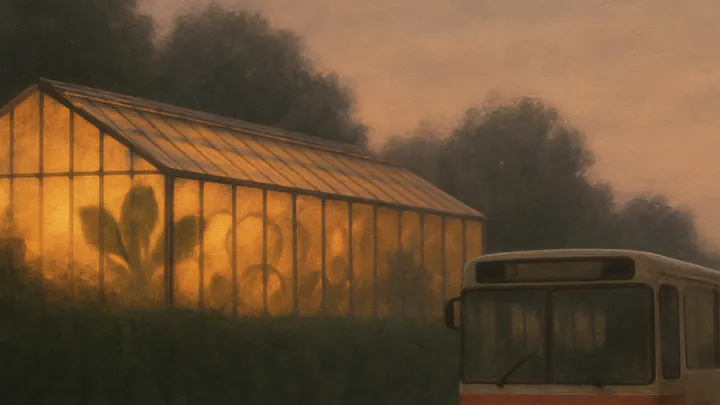
The bus rolled to a stop beside a hedge so tall it made its own weather.
"Endwell Field," Roy announced, to no one but her.
Marisol stepped down. The hedge had a gap in it shaped like a doorway, and through the gap she could see glass — a long, low greenhouse, its panes fogged and gleaming in the late sun. A hand-painted sign by the gap read: OPEN, IF YOU NEED IT.
She needed it. She walked through.
What Grew Inside
The greenhouse smelled the way her grandmother's kitchen had smelled at Christmas — citrus peel, cardamom, and something underneath that Marisol could only call warm paper, the smell of letters kept too long in a drawer. The aisles were narrow. Plants leaned in from both sides, curious, the way cats lean when a stranger sits on the couch.
A woman in a green canvas apron was misting a row of seedlings with a brass sprayer. She had silver braids and the unhurried hands of someone who had been doing exactly this for a very long time.
"You found us," the woman said, without turning. "Roy's getting better at letting people off."
"What is this place?"
"A greenhouse."
"I can see that."
The woman smiled at a fern. "Then you've answered your own question."
Marisol moved deeper in. The plants were unfamiliar. One had leaves that curled into the shape of small, listening ears. Another bore fruit like glass beads, each one holding a flicker of something — a wedding dance, a kitchen at dawn, a child running through a sprinkler. Marisol bent toward a bead and saw, for just a moment, her grandmother's hands kneading dough.
She straightened so fast her vision sparked.
"They're memories," the woman said gently, coming up beside her. "The city loses a great deal, you know. People drop things on buses, in elevators, in the half-second between one thought and the next. Most of it blows away. Some of it lands here. We tend what lands."
"That's not possible."
"No," the woman agreed. "And yet."
Marisol's throat tightened. "My grandmother died in March. I can't remember her voice anymore. I try, and I get the shape of it, but not the sound. Like a song you can hum but not sing."
The woman nodded as though she'd heard this exact sentence a thousand times, which perhaps she had. She led Marisol down a side aisle, past a trellis of pale blue blossoms, to a small clay pot on a wooden bench. Inside the pot was a single sprout, no taller than a thumb, with one folded leaf.
"This one came in last week," she said. "From the Number 12, near the river. A woman's laugh. Tea-colored. A little crooked at the end, like she was about to say something else but stopped herself."
Marisol's knees went liquid.
"That's her," she whispered. "That's exactly her."
"It might be. It might not. We don't label them. People come in, and they know, or they don't."
"Can I — can I take it?"
The woman considered her for a long, even moment. "You can. But things grown here don't travel well to apartments. They need a window with morning light and someone who'll talk to them at least three times a week. And they don't last forever. Maybe a year. Maybe two."
"And then?"
"Then you've had a year. Maybe two."
Marisol thought about this. She thought about her tiny kitchen on Bellweather Street, and the east-facing window above the sink that she'd been meaning to clean since February. She thought about how she sometimes spoke aloud to the kettle, just to hear a voice in the room.
"I brought cake," she said suddenly, lifting the paper bag like an offering. "It's her recipe. I burned the edge."
The woman's face did something complicated and kind. "Then sit," she said. "We'll have a slice. The plants love crumbs. It's terrible for them, and they love it anyway."
They sat on two upturned crates between the listening-ear leaves and the glass-bead vine. The cake was, objectively, not very good. The almonds had gone slightly bitter and the orange had bullied everything else off the plate. But the woman ate her piece slowly, with the attention of someone tasting a country they had not visited in years, and Marisol found herself laughing once — a short, surprised sound — when a tendril of the listening plant leaned toward her chewing.
"She would have liked you," Marisol said.
"She would have argued with me," the woman said. "About the cardamom. There's never enough cardamom."
"How did you —"
"Lucky guess."
It was not a lucky guess, and they both knew it, and neither of them said anything more about it.
When the sun began to lower itself behind the hedge, the woman wrapped the clay pot in damp newspaper and placed it carefully in Marisol's hands. The sprout trembled, then steadied.
"Three times a week," the woman reminded her. "Out loud. Tell it about your day. Tell it the boring parts especially. Memories are vain creatures; they like to feel needed."
"What if I forget?"
"Then you forget, and you come back, and we begin again. Roy runs the 47 every Thursday. He pretends he doesn't know the route. He knows the route."
Marisol walked back through the gap in the hedge. The bus was waiting, engine ticking softly, and Roy did not ask how it had gone. He only nodded at the pot in her lap and pulled the door shut with what might have been tenderness.
The city reassembled itself around them — warehouses, then traffic, then the bright, indifferent windows of home. On her kitchen sill that night, Marisol set the pot in the cleanest patch of glass she could manage, which wasn't very clean. She leaned close to the folded leaf.
"Hi, Abuela," she said. "I burned the cake. I think you would have laughed."
The leaf, very slightly, unfurled.