Bedroom Organization: A Practical Plan for a Restful Room
Bedroom organization works best as a sequence, not a shopping trip: clear the floor, edit your clothes, then buy storage sized to what is left. Here is the 90-minute reset, the storage that suits each room type, and the mistakes that cost the most money.
Rewritten with AI and republished automatically. Our editors set the standards and fix reported errors — how we work.
TL;DR: Organize a bedroom in order — clear the floor, edit clothes, then buy storage sized to what remains. Most people reverse that and end up with expensive bins full of things they do not want. Ninety focused minutes plus a five-minute nightly reset holds a room together better than any weekend overhaul.
What does bedroom organization actually mean?
Bedroom organization is a system of storage and habits that gives every item in the room a fixed home so surfaces stay clear with minimal daily effort. It is not the same as cleaning, and it is not the same as decorating. Cleaning removes dirt; decorating changes how a room looks; organization changes how the room behaves when you are tired.
The distinction matters because most people who say their bedroom is "a mess" do not have a cleanliness problem. They have a homelessness problem — twelve objects with no assigned place, migrating between the chair, the dresser, and the floor. Solve the assignment problem and the room mostly holds itself.
Where should I start if my bedroom is a total mess?
Start with a 90-minute reset that clears horizontal surfaces before you touch a single closet. Set a timer, put on music, and move through four passes. This sequence works because it delivers a visible result inside the first ten minutes, which is what keeps people going.
- Pass one — trash and dishes (10 minutes). Empty water glasses, receipts, packaging, dead pens, expired skincare. Nothing sentimental gets decided in this pass.
- Pass two — relocation (15 minutes). One laundry basket collects everything that belongs in another room. Carry it out once, at the end. Do not leave the bedroom mid-pass or you will not come back.
- Pass three — laundry triage (20 minutes). Every garment goes into exactly one of three piles: wash, hang, or donate. The "worn once, might wear again" pile is the reason your chair is buried. Give it a real home — a single wall hook or a slim valet stand — or delete the category.
- Pass four — surfaces (45 minutes). Nightstands, dresser top, windowsill. Empty each one completely, wipe it, and return only what earns the space.
At the end you have a functional room and a clear picture of your real storage shortfall. That picture is what you shop from, not a wishlist.
How do I edit my clothes without losing a whole weekend?
Work by category, not by location, and use a hard decision rule so you are not relitigating every T-shirt. The most reliable rule: if you have not worn it in twelve months and it is not formalwear or genuinely seasonal, it goes. A second useful test is the hanger flip — turn every hanger backward today, and anything still backward in a year is dead weight.
Sort what remains into four buckets: daily wear, occasional wear, seasonal, and sentimental. Daily wear gets the most accessible drawer and the eye-level rail. Seasonal goes high or under the bed. Sentimental items get one box — one, with a lid — and that box is the limit.
If you want the edit to hold, pair it with a defined wardrobe strategy rather than a one-time purge. Our guide to building a capsule wardrobe of around 30 pieces explains how to keep a closet from refilling itself, which is the part most decluttering advice skips.
Small closet upgrades that pay for themselves
- Slim velvet hangers typically recover four to six inches of rail per ten garments compared to bulky plastic.
- Shelf dividers stop sweater stacks from collapsing sideways, which is what makes a tidy shelf messy again by Wednesday.
- A second hanging rail under the first doubles capacity for shirts and folded trousers in any closet where the top rail sits above chest height.
- Over-door hooks give bags, robes, and tomorrow's outfit a legitimate home without a single drill hole — important in rentals.
Which storage solution is right for my bedroom?
Match the storage to the constraint you actually have: floor space, wall height, or budget. Buying the wrong category is the most common way people spend money and end up no tidier. Use the table below to narrow the field before you shop.
| Option | Typical cost | Effort to set up | Best for | Watch out for |
|---|---|---|---|---|
| Under-bed bins on wheels | Low | Minutes | Seasonal clothes, spare linens | Needs 6+ inches of clearance; open baskets collect dust |
| Storage bed or divan with drawers | High | Half a day | Small rooms with no closet | Drawers need side clearance to open; heavy to move |
| Ottoman or bench at foot of bed | Medium | Minutes | Bedding, the "worn once" pile | Becomes a dumping ground without a rule |
| Vertical closet organizers | Low to medium | 1–2 hours | Deep or tall closets with wasted air | Hanging shelf units sag under heavy knits |
| Wall shelves and rails | Low | 1–2 hours | Books, plants, reading nooks | Drilling restrictions in rentals; visual clutter above the bed |
| Freestanding wardrobe or clothing rack | Medium | 1–3 hours | Bedrooms with no built-in closet | Open racks look messy unless the wardrobe is edited |
Does under-bed storage work in every bedroom?
No — and this is the edge case that catches people out. Measure clearance from floor to frame before buying anything. Many contemporary platform beds sit four inches or less off the floor, which rules out almost every standard bin, and bed risers are not always safe with heavy or slatted frames.
There is a second exclusion worth naming honestly. If anyone in the room is sensitive to dust, open under-bed baskets are a poor choice because they trap dust close to where you breathe for eight hours a night. Sealed, lidded containers or a divan drawer are the better call. Vacuum-compression bags save enormous space but permanently flatten the loft of down duvets and wool knits — use them for cotton bedding and synthetics, not for the things you paid the most for.
What are the most common bedroom organization mistakes?
The costliest mistake is buying containers before decluttering. Bins bought in advance get filled with items you would otherwise have released, and they almost never match the dimensions of the space once it is empty. Measure first, shop second — in that order, every time.
Three more that show up constantly:
- Treating the chair as furniture. The bedroom chair becomes a laundry pile because the "worn but not dirty" category has no home. Give that category a hook or a valet stand and the chair becomes a chair again.
- Over-decorating an organized room. Eleven throw pillows and a dozen frames read as clutter no matter how tidy the drawers are. Limit yourself to three to five decorative pieces per surface area, and make them count.
- Organizing by container instead of by behavior. If you get dressed by the window, your daily-wear drawer should be near the window. Systems fail when they fight where you actually stand.
One decision rule prevents most rebound: the twenty-minute reset test. If putting the room back in order takes longer than twenty minutes, you own more than your storage can hold. Fix that with a second edit, not a third bin.
How do I organize a small bedroom with no closet?
Build a single wardrobe zone on one wall rather than scattering clothes across the room. A freestanding rack or wardrobe, a narrow dresser, a shelf above for boxes, and a curtain or folding screen to visually close it off. Concentrating clothing in one place is what makes a small room read as calm; the specific furniture matters far less.
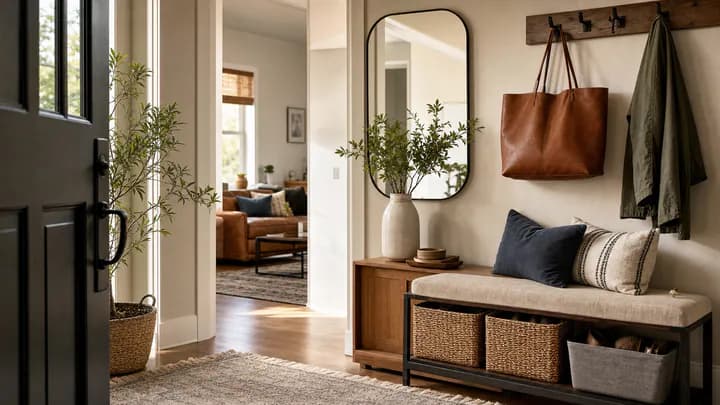
Then go vertical everywhere else. Wall-mounted nightstands free the floor and make the room look larger. A picture ledge holds books without a bookcase footprint. Hooks on the back of the door handle robes and bags. Consolidating the pieces you use every day into one small footprint is the same logic we applied to small entryways that work hard, and it transfers cleanly to bedrooms.
Cable management deserves a mention here because small rooms show it. Route charging cables behind the nightstand with adhesive clips, put the power strip inside a cable box, and keep one charging point rather than three. A visible tangle of white cords undoes a lot of organizing work.
How should I set up my nightstand for better sleep?
Keep the surface to a lamp, a water glass, and one or two personal items; put everything else in a drawer. The nightstand is the last thing you look at and the first thing you see, so it carries disproportionate weight in how restful the room feels.
A drawer or small basket for chargers, lip balm, hair ties, and medication does most of the work. If you read at night, a wall-mounted holder or a slim ledge keeps books off the surface entirely. Lower, warmer light on the bedside lamp supports a wind-down routine better than an overhead fixture.
Organization supports sleep, but it does not replace sleep habits — and it certainly does not treat a sleep disorder. Persistent insomnia is worth discussing with a qualified healthcare professional.
How do I keep the room organized after the first week?
Two habits carry almost all of the maintenance load: make the bed every morning, and run a five-minute reset before you get into it at night. The bed occupies the largest visual share of the room, so making it converts a messy room into a passable one in ninety seconds. The nightly reset — clothes away, surfaces clear, glass to the kitchen — stops any single day from compounding into a weekend project.
Add one weekly pass of ten to fifteen minutes: change linens, empty the relocation basket, return anything that drifted. And adopt the one-in, one-out rule at the point of purchase. Capping a category when you buy is far less painful than purging it six months later.
Once the system holds, that is the moment to think about how the room looks rather than how it functions. Our calm, cozy bedroom refresh guide covers texture, layered lighting, and color, and the companion piece on small upgrades that create big calm is a good place to spend a modest budget after the clutter is gone.
One honest caveat: none of this applies cleanly to a shared bedroom where only one person is invested. In that case, negotiate zones rather than standards — your surfaces, their surfaces, shared floor stays clear. A system that requires another adult to change their personality is not a system.
Key takeaways
- Declutter first, measure second, buy storage third — reversing that order is the most expensive mistake in bedroom organization.
- A 90-minute four-pass reset beats waiting for a free weekend, and it shows you exactly what storage you actually need.
- Under-bed storage requires at least six inches of clearance and lidded containers if dust is a concern; compression bags ruin down and wool loft.
- Give the "worn once" clothing pile a real home — a hook, a valet, or an ottoman — or the bedroom chair will keep collecting laundry.
- If restoring order takes more than twenty minutes, you own more than the room can hold; edit again rather than buying another bin.
- Daily bed-making plus a five-minute nightly reset maintains the system with almost no effort.
Frequently asked questions
How long does it take to organize a bedroom?
A focused first pass takes about 90 minutes for an average bedroom, with clothing edits and closet work spread over one or two additional sessions. Rooms that have been accumulating for years may need three to four sessions, but working in timed blocks beats waiting for a free weekend that never arrives.
Should I buy storage bins before or after decluttering?
After, always. Bins bought before an edit get filled with things you would have discarded, and they rarely match the dimensions of what actually remains. Measure the space and the pile, then buy.
What should I keep on my nightstand?
A lamp, a water glass, and one or two personal items — a book, a journal, glasses, or a small tray for jewelry. Everything else belongs in a drawer. A visually quiet nightstand is the easiest surface in the house to keep clear because it has a natural limit.
How do I organize a bedroom with no closet?
Build a wardrobe zone against one wall using a clothing rack or freestanding wardrobe, a three-drawer dresser beneath or beside it, and a fabric curtain or screen to visually close the zone. Keeping all clothing in one place matters more than the furniture you choose.
Does under-bed storage work with every bed?
No. Platform beds and low frames often leave under four inches of clearance, which rules out most bins, and floor-vent heating or a dust-sensitive sleeper makes sealed containers a better choice than open baskets. Measure clearance before buying anything.
Can a tidy bedroom actually improve sleep?
A calm, low-stimulation bedroom supports the wind-down routine that sleep specialists generally recommend, though organization is a supporting factor rather than a treatment. If poor sleep persists despite good habits, consult a qualified healthcare professional.
What is the one-in, one-out rule?
For every new item that enters a category — sweaters, candles, throw pillows — one item in that category leaves. It caps growth at the point of purchase, which is far easier than running a full declutter every six months.